Employer willingness to sponsor international grads dropped from 55% in 2022 to just 29% in 2026. That's not a small dip. That's less than a third of companies still open to hiring the international students your office spends four years supporting.
If your career services team cares about inclusive outcomes, that number is your problem to solve too, alongside the employers'. Here's what's actually driving the drop, and what your office can do about it.
The Talent Gap Employers Are Ignoring
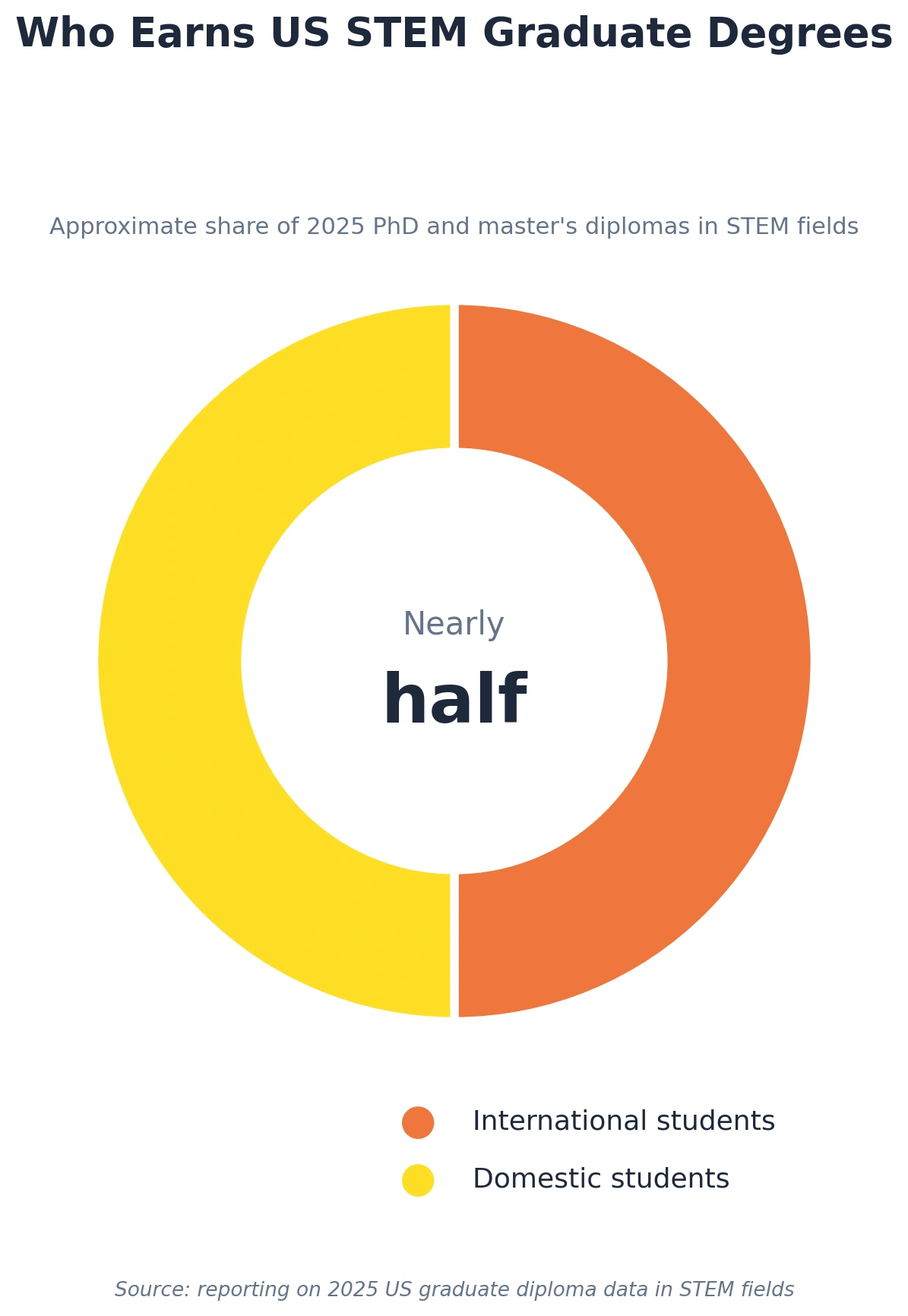
Start with the number that should matter most to any employer: nearly half of all PhD and master's diplomas in science, tech, and engineering fields in 2025 went to international students. That's not a niche talent pool. That's close to half the pipeline for the exact skills employers say they can't find enough of.
When a company rules out international candidates by default, it isn't avoiding paperwork. It's cutting its own candidate pool in half before the search even starts. That's the pitch your office should be making to every employer partner, before you ever get into visa logistics.
The Filter Nobody's Watching
Here's a problem worth flagging to your employer partners directly. Many applicant tracking systems use a yes-or-no eligibility question, often something like "will you require sponsorship now or in the future," and answering it the wrong way triggers an automatic rejection before a human ever opens the resume. The system isn't making a judgment call. It's just doing exactly what the employer configured it to do, and most hiring managers don't realize their own setup is doing it.
Consider a student, for example, who tailors a resume for weeks, applies to a role they're genuinely qualified for, and gets an automatic rejection within minutes. Not because of skill. Because of a checkbox their ATS was never configured to think twice about.
This is a fixable, technical problem, not a legal one. It's also a much easier conversation to have with an employer than a debate about visa rules. You're not asking them to change policy. You're asking them to check a setting.
Skip the Regulatory Weeds
Employers hear about H-1B fee changes, court rulings, and OPT policy reviews and often panic before checking if any of it applies to the candidate in front of them. Most of the time, it doesn't. Policy shifts create a lot of noise well before they create real new requirements, and that gap between headline and impact is exactly where good candidates get passed over for no real reason.
Your office doesn't need to become a legal help desk to fix this. You just need to be the calm, credible voice that tells employer partners which changes actually affect their hiring and which ones don't.
Why International Hires Stick Around
Employers who hesitate often assume international hires are a flight risk. Flip that assumption around when you're pitching employer partners. A candidate who spent years navigating a genuinely complicated system to build a career in a specific country has already put more into staying than most job-hoppers ever do, and that's an argument worth making even without a hard number behind it.
That's a retention argument, not a compliance one. Lead with it. It also ties into a broader point worth raising with employer partners: international hires often bring workplace skills domestic hires haven't had to build. Our piece on cross-cultural management strengths is a useful one to share when you're making the case for why a diverse team outperforms a homogenous one.
Four Moves Your Office Can Make Now
If you run career services or admissions, here's where to put your energy this semester.
Ask employer partners directly if their ATS auto-rejects sponsorship-need candidates. Most hiring managers don't know their own system is doing it.
Lead employer conversations with the talent gap stat, not visa mechanics. ROI opens doors that compliance talk closes.
Build a running list of employers who've sponsored before. A company that's done it once rarely needs convincing twice.
Move visa and credential planning earlier in a student's timeline, so it's never the reason an offer stalls.
It's also worth raising remote hiring as an option some employer partners haven't considered. A company that isn't ready to sponsor a visa yet may still be able to hire a graduate working remotely from abroad, though that comes with its own compliance questions. Our breakdown of remote hiring for grads covers what employers need to know before going that route.
On that last point, credential evaluation is often the quiet reason offers stall. An employer who can't read a foreign transcript will delay a decision rather than risk one. Getting that evaluation done early removes the excuse before it comes up. Our piece on how employers verify degrees is worth sharing with employer partners directly.
If a student needs the full mechanics of CPT, OPT, and STEM OPT to plan their own timeline, our CPT and OPT explainer covers that separately, so you don't have to walk them through it from scratch every time.
The employer hesitation is real. But most of it is built on myths your office is better positioned to correct than anyone else.
 The Real Economics Behind Entry-Level Gigs
 Can 3-Year Degrees Solve the Teacher Shortage?
 Does College Public Speaking Really Matter in Today’s Job Market?
 Strategies for Communicating Tuition and Outcomes to Prospective Students
 How Politics Is Shaping College Enrollment