

Your institution likely invests significant resources in cross-cultural management training for staff and students. Meanwhile, thousands of international students on your campus possess something your programs cannot easily replicate: years of lived experience adapting across cultural boundaries.
This does not mean international students arrive as polished cross-cultural consultants. Lived experience and teachable expertise are different things. But it does mean your institution has an underleveraged resource that, with the right structure, could strengthen how you prepare all students for global careers.
Cross-cultural leadership has become the defining challenge of modern organizations. The Economist Intelligence Unit surveyed leading executives from 68 countries and found that 90% ranked cross-cultural leadership as the top management challenge for the coming decades. Your international students practice these skills daily, even if they cannot always articulate what they know.
The Business Case for Cross-Cultural Literacy
International business managers need cross-cultural literacy because misunderstanding cultural norms leads to failed negotiations, broken partnerships, and lost revenue. Research shows that 20% to 40% of expatriate managers end their foreign assignments early, with cultural issues — not job skills — driving nearly all of those early terminations. Each failed assignment costs between $250,000 and $1.25 million when factoring in relocation, downtime, and indirect expenses.
The demand from emerging markets makes this more pressing. Companies like Coca-Cola now sell more product in Japan than in the United States. Managers who understand cultural differences can adapt their leadership style, communication approach, and decision-making to match local expectations.
Culture shapes how people view hierarchy, time, authority, and teamwork. The GLOBE study, spanning 62 countries, found that leadership preferences vary significantly across national cultures. A participative leadership style works well in Germany but signals weakness in Saudi Arabia, where authoritative leadership is expected. Managers who lack this knowledge make costly mistakes.
What International Students Bring to the Table
International students practice cross-cultural adaptation every single day. They adjust their communication style between professors, classmates, and staff. They interpret unfamiliar social cues. They manage relationships across cultural boundaries while maintaining their own identity.
There is a meaningful distinction, however, between unconscious adaptation and conscious competence. Many international students develop effective strategies for navigating their new environment without being able to explain why those strategies work. They have the skills but may lack the vocabulary or frameworks to teach others.
This is where universities can add value. International students possess raw experiential knowledge. Institutions can help them reflect on that experience, connect it to established frameworks, and develop the ability to transfer their insights to others.
Consider what an international student does in a typical week. They switch between direct and indirect communication depending on context. They read nonverbal cues from people raised in different cultural traditions. They adapt to classroom norms that differ from their home country. They build trust with people who hold different expectations about relationships.
This is the same skill set that corporations pay consultants thousands of dollars to teach executives. The difference is that international students developed these capabilities through necessity rather than formal instruction — which means their competence may be deep but not always transferable without additional development.
NAFSA reports that international students contributed more than $40 billion to the U.S. economy in the 2022–2023 academic year. Their value extends beyond tuition revenue. Research in the ETS Research Report Series found that 78% of surveyed employers rated the ability to work across cultures as more important than undergraduate major.
The Four Components of Cultural Competence
Cultural competence has four major components, often called the 4 C's: Awareness, Attitude, Knowledge, and Skills.
Awareness involves recognizing your own cultural worldview — how your background shapes your assumptions, biases, and behaviors. International students often develop heightened cultural self-awareness, though this varies by individual.
Attitude refers to your openness toward cultural differences. Most international students learn quickly that their home country's methods represent one option among many. However, some respond to cultural difference with defensiveness rather than curiosity. Lived experience does not guarantee a growth mindset.
Knowledge means understanding how culture impacts communication, management style, problem-solving, and relationship-building. International students acquire practical knowledge through daily experience, but they may lack the theoretical frameworks to generalize insights across contexts.
Skills represent the ability to put awareness, attitude, and knowledge into action. International students practice these skills constantly, which builds competence that holds up under pressure. This is their strongest asset.
Most corporate training programs focus heavily on knowledge while neglecting attitude and skills. International students often have the reverse profile: strong practical skills, limited formal knowledge. The combination of experiential learning and structured education produces the best outcomes.
The Four Types of Organizational Culture
Business professors Robert Quinn and Kim Cameron at the University of Michigan developed the Competing Values Framework, which identifies four types of organizational culture: Clan, Adhocracy, Market, and Hierarchy. Their research found that nearly 90% of organizations worldwide fall primarily into one of these categories.
Clan Culture operates like an extended family. Teamwork and collaboration matter most. Leaders serve as mentors who prioritize employee development. Decision-making is decentralized. Startups often adopt this culture to build loyalty.
Adhocracy Culture prioritizes innovation and risk-taking. These organizations move fast, challenge the status quo, and embrace change. Companies like Apple, Google, and Tesla exemplify this approach.
Market Culture focuses on results and competition. Organizations measure success by market share, revenue, and performance. Customer service and external positioning drive decisions.
Hierarchy Culture emphasizes process, procedure, and stability. Clear rules reduce mistakes and control costs. This culture suits organizations where consistency matters most, such as government agencies or large manufacturing operations.
International students encounter multiple culture types during their education. They adapt to hierarchy culture in formal academic settings, clan culture in student organizations, and adhocracy culture in innovation labs. This can prepare them to recognize different organizational environments, though academic culture differs meaningfully from corporate culture. Students still need guidance to translate campus experience into workplace readiness.
Why Culture Outweighs Salary
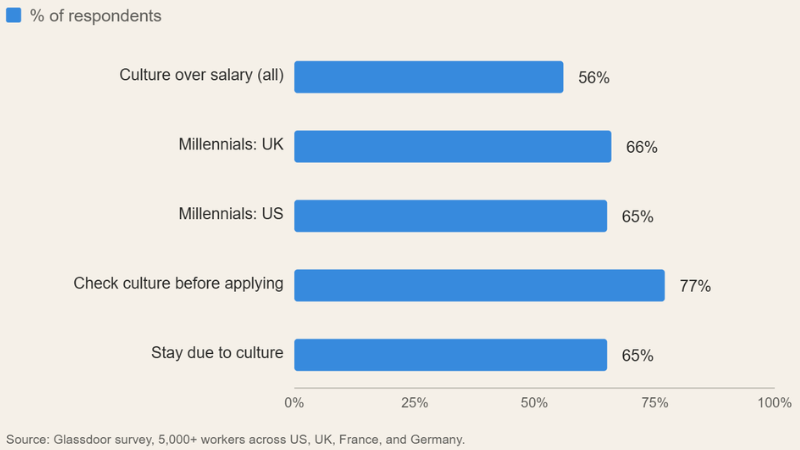
Glassdoor surveyed more than 5,000 workers across the United States, United Kingdom, France, and Germany. The results showed that 56% ranked workplace culture as more important than salary for job satisfaction. Among millennials, this rose to 65% in the U.S. and 66% in the U.K.
The same survey found that 77% of adults consider a company's culture before applying for a job. Nearly three-quarters would not apply unless its values aligned with their own. And 65% of employees say culture is a main reason for staying.
MIT Sloan research found that toxic workplace culture predicts turnover at 10 times the rate of compensation. Salary did not even make the top five predictors of employee departure.
Your graduates will enter workplaces where cultural fit determines retention more than pay. International students often understand this intuitively. But understanding that culture matters is different from knowing how to assess or shape organizational culture. That gap is an opportunity for targeted education.
What International Students Can and Cannot Offer
To leverage international student expertise, be precise about what these students bring and where they need support.
What international students can offer:
Firsthand accounts of cultural adjustment that illustrate concepts better than case studies
Pattern recognition for cultural differences that domestic students and faculty may miss
Credibility when discussing the emotional and practical challenges of cross-cultural work
Diverse perspectives that challenge assumptions and expand classroom discussion
Language skills and cultural knowledge specific to their home regions
What international students typically cannot offer without additional development:
Structured frameworks for analyzing culture that transfer across contexts
Facilitation skills to lead workshops or training sessions
Knowledge of business-specific cultural norms beyond academic settings
The ability to articulate implicit knowledge in ways others can learn from
Understanding of cultures beyond their own and their host country
This distinction matters. Positioning international students as instant experts sets them up to fail and undermines the credibility of cross-cultural programming. Positioning them as experienced practitioners who can contribute meaningfully within a structured program respects both their knowledge and its limits.
Designing Effective Programs
Your institution can tap into international student expertise in several ways, provided programs include appropriate structure and support.
Peer mentorship programs pair international students with domestic students or staff who want to develop cross-cultural skills. These work best when mentors receive training on how to share their experience effectively and when the program includes reflection prompts that help both parties extract transferable insights.
Classroom integration goes beyond simply having international students present. Faculty can design assignments that require cross-cultural collaboration and value diverse perspectives. Faculty should frame these contributions carefully to avoid tokenizing students or treating them as representatives of entire nations.
Advisory roles give international students a voice in institutional decisions about global programs, international recruitment, and cultural inclusion initiatives. They can identify problems that administrators miss. Advisory input works best when combined with data and professional expertise.
Research partnerships connect faculty studying cross-cultural management with international students who can provide insider perspectives and access to populations in their home countries. This improves research quality while giving students experience articulating their cultural knowledge.
Co-facilitation models pair international students with trained facilitators for workshops and training sessions. The student provides authentic experience and credibility. The facilitator provides structure, pacing, and the ability to connect stories to broader frameworks.
Building Institutional Capacity
Cross-cultural competence cannot be developed through occasional workshops. It requires sustained exposure, practice, and reflection. International students demonstrate this through their multi-year adaptation process.
Universities serious about cross-cultural management should invest in faculty development beyond awareness training. Professors need skills to facilitate cross-cultural learning in their classrooms and to draw out international student contributions without putting unfair burden on those students.
Curriculum integration embeds cross-cultural competence across disciplines rather than isolating it in specialized courses. Business students should encounter these concepts in finance, marketing, and operations courses — not just in a single international management elective.
Assessment methods should measure actual competence rather than exposure. Portfolio assessments, simulations, and behavioral interviews capture skills that multiple-choice tests miss. International students can help validate these assessments by reviewing whether they reflect real cross-cultural challenges.
Structural support for meaningful interaction between international and domestic students matters. Residential programs, team-based courses, and co-curricular activities should maximize cross-cultural engagement rather than allowing self-segregation. Proximity alone does not produce learning. Structured interaction does.
The Competitive Advantage
Universities that recognize international students as cross-cultural resources gain advantages in several areas.
Recruitment improves when prospective international students see that your institution values their cultural knowledge, not just their tuition dollars. Word travels fast in international student networks.
Outcomes strengthen when international students feel recognized and engaged. Students who feel valued have higher retention rates and better academic performance.
Reputation grows when your graduates demonstrate strong cross-cultural competence in the workplace. Employers notice which institutions prepare students for global careers.
Revenue benefits extend beyond international student tuition. Corporate training programs, executive education, and consulting services can incorporate international student perspectives as a differentiator.
Practical Next Steps
University leadership can act on this immediately.
This semester, invite a small group of international students to share their cross-cultural adjustment experiences with your executive team. Ask what they had to learn, what surprised them, and what they wish the institution had done differently. Listen for insights your formal programs may be missing.
This year, pilot one program that positions international students as contributors to cross-cultural education rather than only recipients. Options include a peer mentorship initiative with proper training, a co-facilitation model for orientation sessions, or an advisory committee for global programs. Build in reflection and feedback mechanisms from the start.
Within two years, evaluate what works and integrate successful elements into your formal cross-cultural competence programming. Create pathways for recognition, compensation, or academic credit. Build sustainable structures rather than one-off events.
The executives who rank cross-cultural leadership as their top challenge need graduates who can perform in global environments. Your international students have experience that can help. The question is whether your institution will create the structures that turn that experience into transferable expertise.
Treat international students as practitioners with valuable knowledge that requires development — not as finished experts, and not as customers who only need services. That distinction will shape whether your programs succeed.
 The Real Economics Behind Entry-Level Gigs
 Can 3-Year Degrees Solve the Teacher Shortage?
 Does College Public Speaking Really Matter in Today’s Job Market?
 Strategies for Communicating Tuition and Outcomes to Prospective Students
 How Politics Is Shaping College Enrollment