The U.S. Department of Education published its accreditation final rule on October 30, 2026, and accreditors now have until July 1, 2027, to rebuild their standards around it. Officially titled Accreditation, Innovation, and Modernization, or AIM, the final rule rewrites transfer credit requirements, ties program review to graduate earnings, and adds contested checks on campus academic freedom.

Most of the first deadlines fall on accreditors, but nearly every provision eventually lands on your registrar, your budget office, or your faculty handbook.
Accreditors Have Until July 1, 2027, to Comply
Accreditors can start applying the rule's provisions on January 1, 2027, as long as they don't place new requirements on institutions before July 1. ED rejected phase-in requests from commenters, arguing that the eight months before July is plenty of time for agencies to revise their rules.
Two carve-outs stretch that calendar. Renewal applications that accreditors filed before July 1, 2026, will still go through review under the old regulations. Agencies applying during the transition get until July 1, 2028, to finish separating from trade associations.
The rule doesn't trigger an immediate re-review. Expect the new requirements at your next scheduled accreditation cycle.
Why ED Rewrote the Rules and Who Objected
The rule carries out Executive Order 14279, which President Trump signed in April 2025 to push ED toward overhauling accreditor oversight. ED received more than 7,000 comments on the August proposal and finalized it with no substantive changes.
In announcing the rule, ED called it the most significant overhaul of accreditor recognition in decades, built around student outcomes, lower burden, intellectual diversity, and competition. Critics point to the Higher Education Act, which bars the Secretary from issuing regulations on accreditors' standards, and argue the rule oversteps that limit. ED's position is that the rule doesn't force any specific standard on accreditors.
The American Association of Community Colleges pressed ED to pull back its oversight of First Amendment compliance, intellectual diversity, and academic freedom, and ED declined all three. ED's own impact analysis lacks data on competition showing more accreditors will raise quality.
New Accreditors Can Enter the Market Faster
A new agency used to need two years of operating history before it could seek ED recognition. Now it can apply once it has standards and procedures in place and at least one college or program has applied to it, although ED won't grant recognition until the agency has actually accredited someone. The rule also wipes out geographic-scope distinctions among institutional accreditors, and ED will count anticompetitive behavior against any agency seeking recognition.
Colleges can also switch accreditors or hold more than one, and accreditors must build common forms for institutions making a change.
On the federal side, ED will shift to a risk-based recognition review. Lower-risk agencies file streamlined applications, while accreditors with the most federal aid exposure get closer scrutiny.
For a college stuck with a slow or expensive accreditor, that's real leverage. New America, a think tank, has cautioned that freer switching also hands struggling colleges a way to sidestep accountability.
Who Has to Act, and When
Accreditors carry the earliest deadlines, but most of their new standards point straight back at campus offices.
Requirement | Who Acts | Deadline |
|---|---|---|
Early use of any provision | Accreditors, optional | From January 1, 2027, with no new institutional requirements before July 1, 2027 |
Updated standards, policies, and reviewer training | Accreditors | July 1, 2027 |
Transfer credit policies, disclosures, and appeals | Institutions, confirmed by accreditors | July 1, 2027 |
Program-level outcomes review | Accreditors | July 1, 2027 |
Review of institutional cost/benefit analysis | Accreditors | July 1, 2027 |
Direct feedback channel for students, faculty, and staff | Accreditors | July 1, 2027 |
Separation from trade associations | Accreditors applying during the transition | July 1, 2028 |
Renewals filed before July 1, 2026 | ED, under the old rules | Advisory committee meetings in 2027 and early 2028 |
Accreditors Will Grade Each Program on Its Own Results
Accreditors must now judge programs on completion rates, licensure exam results, post-graduation employment, and earnings relative to the cost of attendance. Because the review happens program by program, a strong flagship program can no longer mask a certificate with weak licensure pass rates sitting a few buildings away.
ED set no national cutoffs. Each accreditor picks its own thresholds and can scale the review to institution size, so a six-program college won't carry the documentation load of a campus running 120-plus programs. ED also refused sector exemptions for religious, minority-serving, tribal, small, or liberal arts institutions.
Transfer Denials Now Need a Written Reason and an Appeal Path
Accreditors must confirm that your policies follow this sequence for undergraduate coursework from schools accredited by a Department-recognized agency:
You review the transcript, and you can't deny credit just because of where the student studied or which recognized agency accredited that school.
You award credit for completed coursework that matches your own courses in content and learning outcomes.
If you deny a course, you give the student a written reason specific to that course.
You deliver the results before the student signs an enrollment agreement, registers, or makes a nonrefundable payment.
The student gets 15 calendar days from your written notice to appeal.
In practice, this ends blanket rejections. Turning down an incoming student's community college statistics course now requires a course-level written justification, and that justification has to reach the student before any deposit changes hands. You also have to publish your transcript deadline, transfer criteria, articulation agreements, and prior learning criteria.
The registrar's office absorbs most of this. Offices that now reject credit with a quick exception code will have to write out the reasoning behind every denial, run an appeal process, and notify students directly in writing, all by July 1, 2027.
Academic judgment still sits with you. You can judge equivalency mainly on learning outcomes, and you never have to accept coursework that fails your academic standards. Coursework from outside the Department-recognized system, including credit on foreign academic transcripts, falls outside the comparable-credit provision.
If colleges stopped rejecting the credits students lose today, ED's illustrative math puts the drop in federal aid spending at nearly $4 billion a year. ED also concedes the change could cost colleges tuition dollars.
Academic Freedom Reviews Put Public Institutions in a Bind
The most contested provision requires accreditors to check that academic freedom protections apply consistently to faculty regardless of viewpoint or ideology. Accreditors will also review intellectual diversity and research misconduct policies. Religious-mission institutions are exempt, and accreditor decisions must also stay viewpoint-neutral.
Critics in the comment record called the provision unconstitutional and warned it would chill faculty speech. ED brushed off some objections as hyperbole, and it said an institution without a formal academic freedom policy isn't automatically out of compliance.
Public institutions face the sharpest tension. Several states already regulate DEI in accreditation, and PEN America counts at least nine such bills across six states, including an Arkansas law that bars public colleges from complying with DEI-related accreditation standards. The federal rule also limits accreditor review of public governance set by state law, such as state-appointed board members, according to the Association of Governing Boards.
That leaves a public campus answering to a state legislature on curriculum and DEI while a federally recognized accreditor audits its record on viewpoint neutrality. The rule doesn't settle how either side defines those terms.
Programmatic Accreditors Must Split From Their Trade Associations
Many programmatic accreditors have long-standing ties to the professional associations in their fields. The rule severs those ties. Accreditors can't share staff, services, equipment, technology, or office space with a related trade group, and budgets and dues must stay separate.
AGB flagged higher costs for programmatic accreditors as a risk when it reviewed the proposal. The accreditor for audiology and speech-language programs says leaning on its parent association's staff and systems has kept program fees down, and that the required split could raise costs for the programs it reviews. If your nursing, allied health, or business programs carry specialized accreditation, budget for the possibility of higher fees after the 2028 split.
Big Spending Decisions Now Need a Paper Trail
When accreditors apply their standards on facilities, equipment, and supplies, or on fiscal and administrative capacity, they must review any cost/benefit analysis your institution has performed. That includes your budget, resource allocation, strategic plans, and how capital spending affects future operating costs.
ED says you don't have to run a formal analysis, which leaves a gap between what's required and what reviewers will ask. A board vote on a new residence hall, for instance, will be easier to defend if the minutes show how trustees weighed the building's long-term operating costs.
Accreditors Take On New Student Protection Duties
Every accreditor must run at least one structured channel for current students, faculty, and staff to contact it directly about its standards or your compliance.
Closures bring added duties. When an institution shuts down without a teach-out plan, its accreditor must work with ED and the state to help students finish their education at no extra charge, and it must line up transfer options if no teach-out comes together. Colleges in good standing may get more requests to serve as teach-out partners.
What to Do Before July 2027
The accreditation final rule staggers its deadlines: accreditors move first, institutions face new requirements on July 1, 2027, and the trade association split runs to July 1, 2028.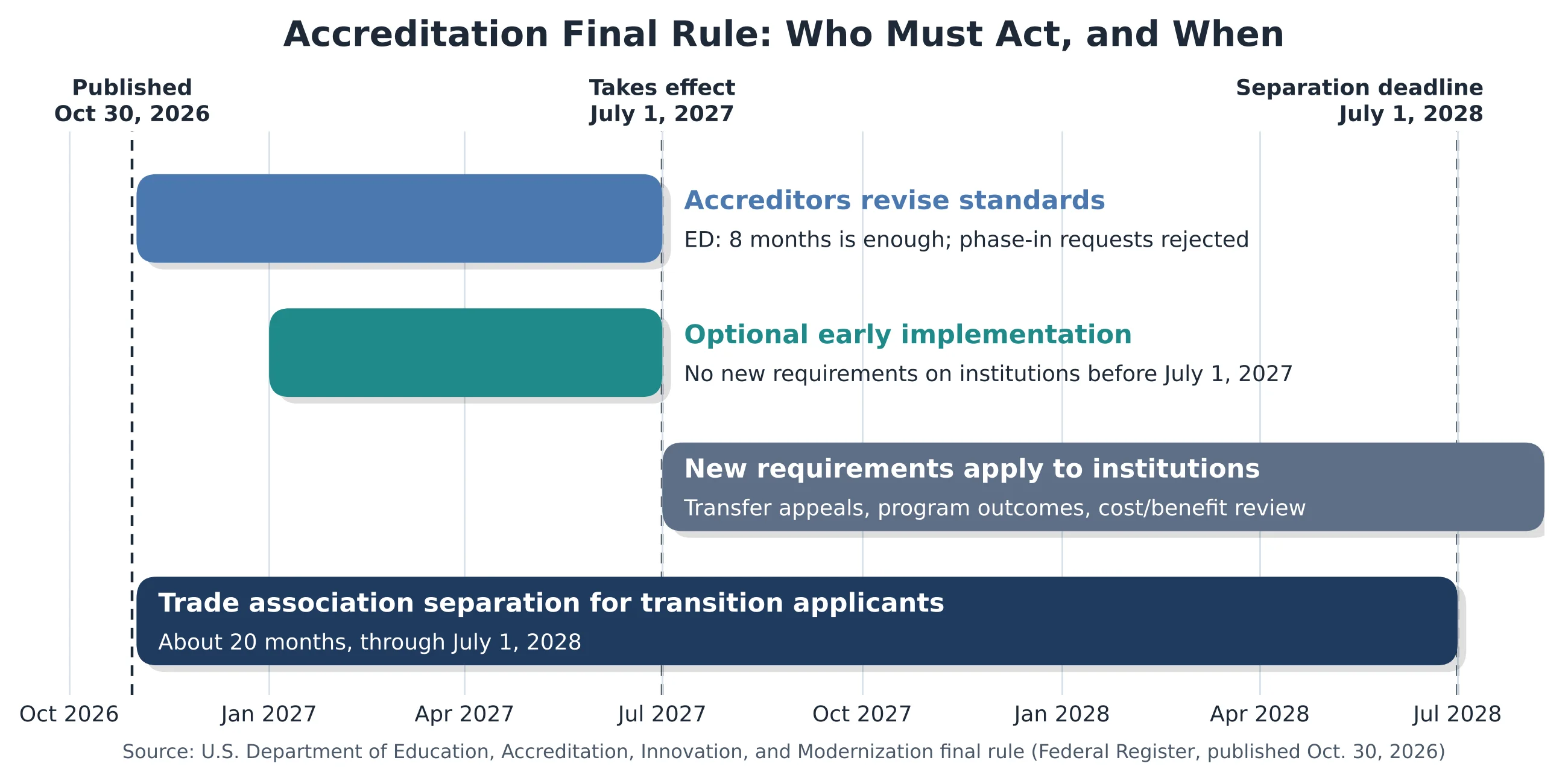
Start with transfer credit and program outcomes, since both carry hard requirements on that first date. That means rebuilding your transfer workflow around course-level denials and 15-day appeals, and pulling program-level completion, licensure, employment, and earnings data before your accreditor asks for it. Through 2027, track your accreditor's proposed standard changes and comment when it opens a review period. Document the reasoning behind major capital and budget decisions, and ask each programmatic accreditor how it plans to separate from its trade association and what that means for your fees.
 How Campus Surveillance Affects Students
 4 Strategies Universities Can Use to Elevate International Placement Rates
 How Skills-Based Hiring is Changing International Student Resumes
 How Coding Stopped Being a Job and Became a Basic Skill
 How State Lawsuits by the DOJ Mean Higher Tuition for Undocumented Students