

Remote work has become a fixture in the American workforce. Over 32 million people now work remotely, representing about 22% of the U.S. workforce according to Neat and Yomly. For higher education institutions, this shift creates both opportunities and complications when hiring international graduates and faculty.
What started as a pandemic emergency has become a permanent strategy. International remote hiring offers access to global academic talent that might otherwise be unavailable. But compliance complexity and legal barriers remain real obstacles. This article provides a practical framework for admissions officers and employers evaluating whether to hire international graduates for fully remote positions.
The Current State of Remote Work in the U.S.
Is Remote Work Declining?
No. It's evolving.
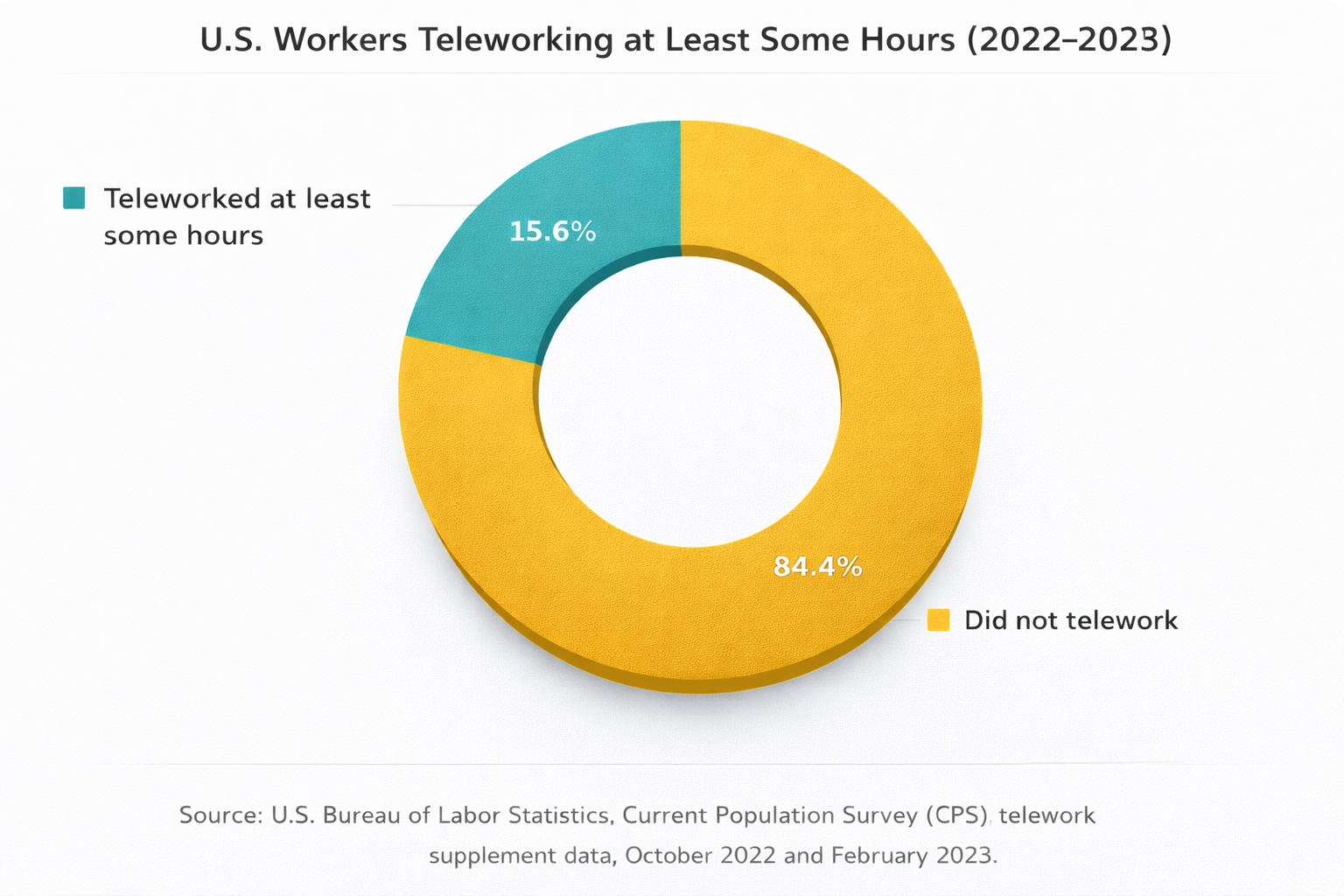
Despite return-to-office mandates from Amazon, JPMorgan, and AT&T, remote work continues to grow. Bureau of Labor Statistics data shows remote workers increased from 17.9% in late 2022 to 23.7% by early 2025 according to CoAdvantage. The narrative that remote work is dying doesn't match reality.
Hybrid work has become the dominant model. About 24% of job postings in late 2025 were hybrid, up from 21% two years earlier according to Robert Half. Fully remote positions have stabilized at around 12% of postings. Technology, marketing, and finance lead in remote and hybrid adoption.
The demand side tells a clear story. Remote and hybrid jobs make up just 20% of LinkedIn listings, but they generate 60% of all applications as noted by JobsPikr. Candidates want flexibility. Employers who offer it have a recruiting advantage.
What Percentage of U.S. Jobs Are Fully Remote?
About 12% of job postings are fully remote based on late 2025 data from Robert Half. Another 24% offer hybrid arrangements. The remaining 64% require full-time office presence.
These numbers vary by industry. In technology, 15% of roles are fully remote and 29% are hybrid. In marketing and creative fields, 15% are fully remote and 30% hybrid. Healthcare and administrative roles remain heavily on-site.
In higher education, remote options vary by role. Administrative positions, research roles, and adjunct teaching increasingly offer remote flexibility. Tenure-track faculty positions typically still require physical presence, though this is changing.
The Return-to-Office Reality
Major corporations have issued RTO mandates, but enforcement remains inconsistent. Amazon said it wanted its 350,000-person workforce in the office by early January. As of February, many of their offices didn't have enough desks to accommodate the return according to Fortune. AT&T faced similar problems.
Workers resist through creative workarounds. Some 43% of hybrid workers partake in "coffee badging," going to the office for a few hours just to show their faces, according to CNBC. Others practice "micro-shifting," which means working in non-linear blocks based on personal energy rather than fixed hours.
The CEO of Randstad, the world's largest talent company, summarizes the current state: the equilibrium seems to have been found, and it's generally a hybrid model around three to four days plus some work from home.
Higher education faces unique pressures. Faculty, researchers, and staff each have different remote work needs. A one-size-fits-all policy rarely works.
Can International Students Work Remotely in the U.S.?

F-1 Visa Restrictions on Remote Work
The rules are strict. According to USCIS, F-1 students may not work off-campus during the first academic year, but may accept on-campus employment subject to certain conditions and restrictions.
Here's the critical point many students miss: any work done on U.S. soil requires U.S. work authorization, even if it is remote work for a company in another country. A student working remotely for a Canadian company from their apartment in Boston still needs authorization according to Interstride.
Harvard's International Office states that while you are located in the U.S., any paid work that you do, including remote work for a U.S. or non-U.S. employer, freelancing, side hustles, and any other paid opportunities require you to obtain employment authorization before the work begins.
CPT and OPT for Remote Positions
After the first year, students have options.
Curricular Practical Training (CPT) allows authorized remote internships during study if tied to academic credit. To qualify, the internship must be relevant to your field of study. You should be able to accept a remote work opportunity utilizing CPT as long as all other CPT requirements are fulfilled according to Duke Career Hub.
Optional Practical Training (OPT) permits post-graduation remote work. Freelancing is allowed with pre-graduation and post-graduation OPT, and you can freelance for companies outside the U.S. Students cannot work more than 20 hours per week while classes are in session, and all work must relate to their field of study.
STEM OPT extensions have additional requirements, including physical U.S. presence. Generally, remote work performed abroad while on post-completion OPT is not allowed because OPT requires that you are physically present in the U.S. while working according to Avvo.
Penalties for Unauthorized Work
For international students, the penalty for working illegally in the U.S. is severe. You may lose your student visa, not be able to get another visa in the future, and be banned from re-entry to the U.S. for three or ten years according to Interstride.
Admissions officers should counsel students clearly on visa-compliant remote work options. Misunderstanding these rules puts students at serious risk.
Can U.S. Employers Hire Foreign Remote Workers?
Yes, But Structure Matters
U.S. institutions can legally hire international workers who remain in their home countries. Unlike hiring someone to work in the U.S. (which requires visa sponsorship), hiring remote workers who stay in their home countries doesn't trigger immigration requirements according to HireWithNear. They're working from abroad, so you're not bringing them into the U.S. labor market.
The challenge isn't immigration. It's employment structure. You need a compliant way to pay workers, handle taxes in their country, and manage benefits.
Three Main Hiring Structures
Option 1: Establish a local entity. This means setting up a legal branch of your institution in the worker's country. It's time-consuming and expensive. According to RemoFirst, it's a time-consuming process, sometimes taking up to six months or more, and typically costs between $20,000 and $150,000+, depending on the country. This approach makes sense only for large-scale, long-term presence in a specific country.
Option 2: Use an Employer of Record (EOR). Deel explains that an Employer of Record is an organization that employs and pays your workers compliantly on your behalf. With an EOR, your organization can hire employees domestically or internationally without establishing a legal presence or registering for a business tax ID.
The EOR becomes the legal employer in the worker's country. They handle payroll, taxes, benefits, and compliance. You pay the EOR, which employs the worker. This is the fastest option for onboarding international hires.
Option 3: Hire as independent contractors. This is simpler but carries misclassification risk. According to Playroll, several countries have special definitions and tests to determine when a worker should be classified as an independent contractor rather than an employee. Misclassification can lead to fines, back-pay liabilities, and legal scrutiny.
Why EORs Work Well for Higher Ed
EORs address higher education's unique needs. Innovative Employee Solutions notes this includes creating a compliant payment structure to ensure the worker is receiving the total compensation earned per course throughout the semester. This meets the compliance requirements set forth by state and federal governments while also meeting the budgeting and compensation needs of clients.
One EOR helped a private communications and arts institution expand its master's program by hiring more than 30 remote employees across 17 states. The same model works for international hiring.
The Challenges of International Remote Hiring in Higher Ed
Compliance Complexity
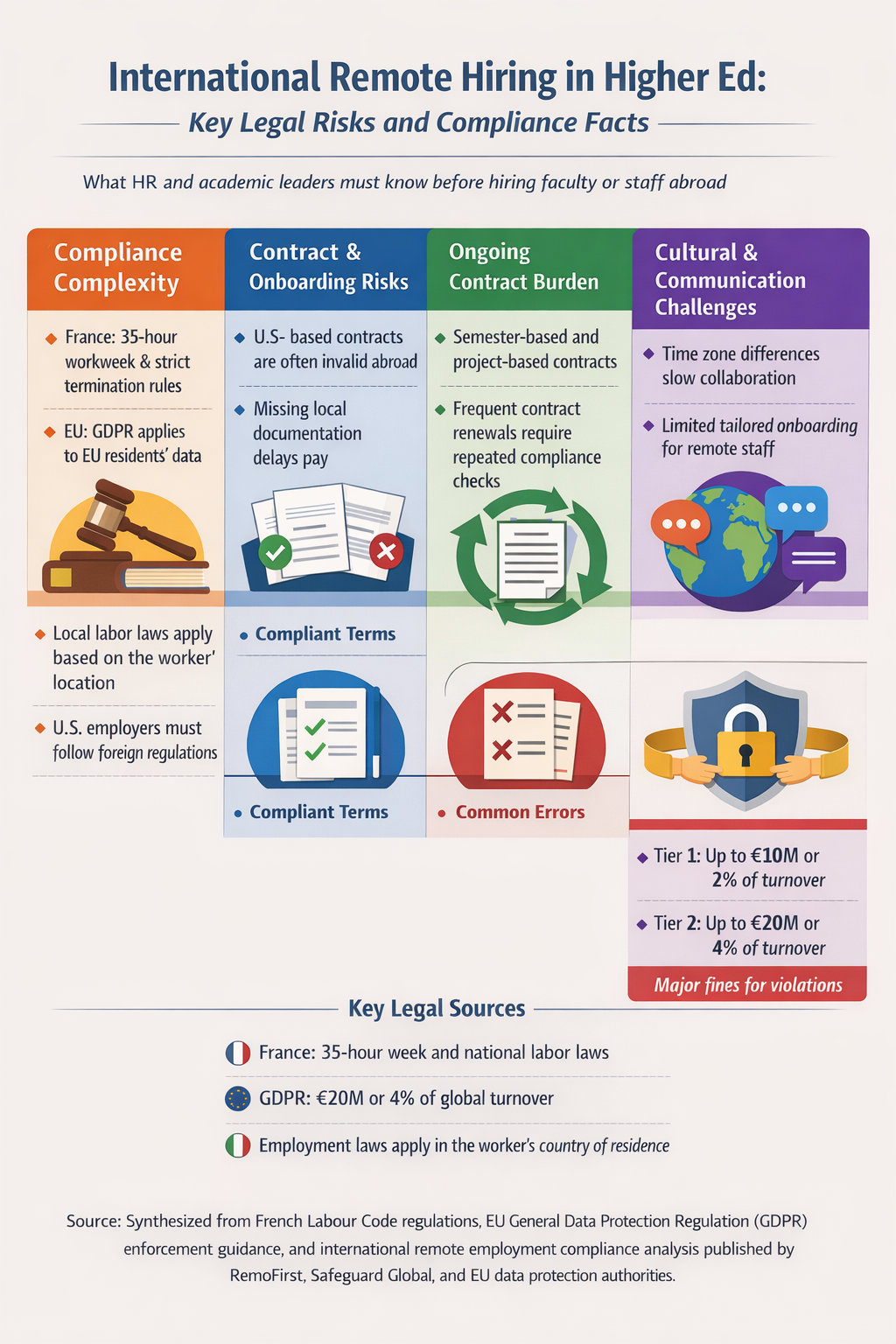
Each country has its own labor laws, tax regulations, and benefits requirements. In France, the standard workweek is 35 hours, with strict rules on overtime compensation. Japan has a concept of lifetime employment that makes termination difficult. Germany requires specific health insurance coverage.
RemoFirst warns that failing to adhere to local employment laws can lead to costly consequences: lawsuits, lost talent, damage to your business reputation, and even jail time.
For higher education specifically, Safeguard Global notes that institutions seeking to hire renowned faculty members in the United States and abroad must comply with the specific and varied employment laws of their home countries regarding remote work. Noncompliance can carry heavy penalties for the university.
Contract Conversion Issues
Faculty who previously worked on U.S. campuses but now teach remotely from abroad present a specific problem. Safeguard Global explains that if your international faculty have previously taught in the U.S. but now are remote, existing contracts will need to be converted to new contracts that adhere to local labor laws.
HR departments often discover that workers they've employed stateside lack the necessary documents to work overseas, such as the health insurance required in Germany. This can delay onboarding and payroll for weeks.
When employees start working without a valid contract (which is illegal in many countries), institutions face compliance risk. They may need to classify unpaid wages as signing bonuses once contracts are finalized.
Fixed-Term Contract Complications
Unlike other industries that hire once, higher education typically requires semester-length contracts and research project-based agreements. Safeguard Global notes that unlike other white-collar industries, which commonly hire once, higher ed typically requires contracts for the length of a semester or research project, and that means re-upping contracts throughout the year for everyone you employ.
Each renewal must meet local compliance requirements. This creates ongoing administrative burden.
Cultural and Communication Challenges
FlexJobs notes that even with great digital tools, communicating asynchronously and across time zones can create lags in collaboration or decision-making, resulting in communication breakdowns or bottlenecks.
International remote workers may receive less personalized onboarding or training, especially if HR and management are focused on domestic teams. Remote workers can feel isolated without intentional culture-building efforts.
Data Privacy and Security
RemoFirst explains that the European Union's General Data Protection Regulation (GDPR) is one of the most comprehensive data protection laws. It applies to any company processing the personal data of EU residents, regardless of its location. Violations can result in fines of up to EUR 20 million or 4% of global annual turnover, whichever is higher.
Germany adds further requirements through the Federal Data Protection Act. Institutions must invest in secure systems for global HR operations.
How International Remote Hiring Gives Higher Ed an Edge
Access to Global Academic Talent
Top faculty, researchers, and graduate students may be unwilling or unable to relocate to the U.S. Safeguard Global notes that top foreign faculty may be unable or unwilling to move to the United States. Remote hiring removes this barrier.
Benefits include access to specialized expertise unavailable locally, greater diversity in faculty perspectives, and the ability to staff research projects with international collaborators.
Innovative Employee Solutions states that by embracing a nationwide and global talent pool, institutions can ensure they recruit the best talent for their students, irrespective of geographic boundaries. This pivotal shift enables schools to transcend traditional location constraints, enriching their educational offerings and broadening student perspectives.
Cost Efficiency
HireWithNear notes that hiring international remote workers expands your talent pool dramatically and reduces overhead costs by $35,000 to $55,000 annually per hire compared to U.S.-based employees.
However, cost should not be the primary driver. The real value lies in talent access. Chasing cost savings alone can lead to poor hiring decisions.
Competitive Advantage in Recruitment
FlexJobs reports that in the fourth quarter of 2025, remote job postings increased by 3%, marking a shift away from the cooling remote job market earlier in the year. Institutions offering remote options attract candidates who prioritize flexibility.
Yomly notes that around 98% of professionals want to work remotely at least part-time for the rest of their careers. Institutions that refuse to offer flexibility will lose candidates to those that do.
Expanded Research Partnerships
Safeguard Global explains that the shift to "work from anywhere" employment, combined with international hiring, means increased opportunities to participate in research projects and partnerships that may have been considered unrealistic or undesirable before.
Fixed-period projects can now draw talent from anywhere. A university in Ohio can collaborate with a researcher in Singapore without requiring relocation.
Practical Solutions for Higher Ed
Step 1: Audit Your Current Workforce
Start by identifying existing staff working remotely from abroad. Review contract compliance for each location. Flag any fixed-term arrangements needing renewal. Many institutions discover they already have remote international workers operating in compliance gray areas.
Step 2: Partner with an Employer of Record
EOR providers handle local compliance, payroll, and benefits. Horizons notes that instead of months to set up an entity, you can onboard employees in 24 hours.
Major EOR providers include Deel, Oyster, Remote.com, and Papaya Global. For higher education specifically, People Managing People notes that Foxhire has specialized its EOR services to support organizations hiring for technical, healthcare, or higher education roles. They handle educational credential verification for college and university hires.
Innovative Employee Solutions explains that an Employer of Record can mitigate these risks by managing all aspects of compliance, from worker status to compensation, according to the varied laws of each locale.
Step 3: Develop Clear Remote Work Policies
Define eligibility criteria for remote international positions. Establish expectations around availability, time zones, and communication. Create onboarding protocols for distributed teams.
Safeguard Global notes that a cumbersome hiring process full of delays frustrates faculty. As top talent in their fields, they expect smooth onboarding and timely, accurate, and compliant payroll. Shielding remote faculty from administrative complexity helps with retention.
Step 4: Invest in Technology Infrastructure
Remote teams need video conferencing, asynchronous communication tools, secure file sharing, and collaboration platforms. HR systems must handle global payroll across multiple currencies and tax jurisdictions.
University of Washington notes that employees are fully responsible and liable for addressing and resolving any compliance obligations that may be associated with their international work location, including, but not limited to, income and social taxes, health and other types of insurance, foreign bank account reporting, and immigration/visa requirements. Clear documentation of these responsibilities protects both the institution and the employee.
Step 5: Address Culture and Connection
Schedule regular check-ins with international remote staff. Hold virtual orientation sessions. Budget for periodic in-person gatherings when feasible.
ResearchGate notes that flexible work arrangements in higher education bring many rewards and benefits, including improved talent acquisition, productivity, and retention. These arrangements also enhance the quality of life for workers through greater satisfaction, engagement, and a better overall experience.
Companies Successfully Hiring Fully Remote International Workers

Higher education can learn from companies that have built successful fully remote, globally distributed teams.
GitLab
Hire Overseas notes that GitLab is one of the largest fully remote companies in the world, with employees spread across 60+ countries. Known for its "handbook-first" approach, GitLab documents everything, ensuring alignment across time zones.
GitLab has no physical headquarters. Their comprehensive public handbook details every aspect of how they operate, from onboarding to performance reviews. This level of documentation is essential for distributed teams.
Automattic
The company behind WordPress.com, WooCommerce, and Tumblr operates with over 2,000 employees in 90+ countries. InclusivelyRemote notes that Automattic offers flexible hours, paid sabbaticals, open vacation policies, and a strong writing-first culture. Its transparency and documentation practices are a gold standard in remote work.
Arc.dev notes that Automattic pays location-agnostic salaries. A developer in Lagos earns the same as one in San Francisco for the same role.
Zapier
Arc.dev explains that Zapier is an automation platform that connects apps and services, supported by a remote team in over 40 countries. The company has been remote since its founding.
InclusivelyRemote notes that Zapier enables asynchronous work and values results over hours. Perks include profit sharing, annual retreats, home office budgets, and generous paid leave. The company promotes deep work and avoids the burnout associated with synchronous-heavy cultures.
Buffer
Mural notes that with employees spread across 15 countries, Buffer offers benefits such as family support funds, home office reimbursement, and fully paid sabbaticals. The company publishes transparent salary formulas so employees understand exactly how compensation is calculated.
Wikimedia Foundation
This nonprofit demonstrates that remote work viability extends beyond tech companies. EarnBeyondBorders notes that the Wikimedia Foundation is a non-profit organization dedicated to encouraging the growth, development, and distribution of free multi-lingual content. They operate with a distributed global team, proving mission-driven organizations can succeed with remote models.
Higher ed takeaway: These companies prove distributed teams can operate effectively at scale. The key is intentional culture-building, clear documentation, and investment in the right tools.
Conclusion
International remote hiring is no longer experimental. The infrastructure exists. The workforce expects flexibility. The tools have matured. For higher education institutions willing to manage compliance complexity, remote international hiring offers a genuine competitive advantage.
ResearchGate notes that institutions of higher education will need to adapt to new hiring processes and procedures to eliminate compliance risks for remote work. Those that refuse to adapt will struggle to attract top talent.
The questions admissions officers and employers should ask:
Do we have the legal infrastructure to hire compliantly abroad?
Have we partnered with an EOR or built internal expertise?
Are our policies clear enough to support distributed teams?
Can we offer international graduates legitimate remote pathways?
Institutions that answer yes will attract stronger talent, build more diverse faculties, and compete effectively in a global academic market. The question is no longer whether remote international hiring is viable. It's whether your institution is ready to do it right.
 Strategies for Communicating Tuition and Outcomes to Prospective Students
 How Politics Is Shaping College Enrollment
 How Top Performers Land US Job Offers
 The College Majors Foreign Students Regret Choosing
 The Tightest Job Market in Years for College Grads