How tech is reshaping degrees worldwide isn't some abstract idea for the future. It's happening in your classes right now, in the way you get graded, and in how your school talks to you.
If you're studying abroad or applying to a foreign university, this affects you directly. The tools your school picks shape your workload, your support system, and even what counts as a real credential.
Redefining What a Degree Looks Like
Small credentials are having a big moment
Micro-credentials are short, focused courses that prove you can do one specific thing. Think a data analysis certificate or a project management course you finish in a few weekends.
According to Frontiers in Computer Science, adoption of these short credentials keeps climbing, especially where schools team up with employers to build them.
A business student chasing a data skill employers keep asking for doesn't need a whole extra year to get it. She can stack a short credential on top of her degree and list it right on her resume.
What you get | Traditional degree | Stackable credentials |
|---|---|---|
Time | 2 to 4 years | Weeks to months per piece |
Cost | Full tuition upfront | Pay as you go |
Recognition | Well established everywhere | Growing, but uneven by country |
Flexibility | Fixed curriculum | Pick what you need |
You never really stop learning now
School used to work like a straight line. You start, you finish, you're done. That's changing. More programs let you keep learning in short bursts long after graduation, especially online.
This matters if you're an international student. You don't have to fly back home for a certificate update. You can add skills from wherever you're working.
Mixing subjects is normal now
Degrees used to sit in their own box. Business here, engineering there. Now schools combine subjects on purpose because real jobs don't stay in one lane either.
A computer science student might take a policy class. A nursing student might take a data course. The goal is graduates who can solve problems, not just recite one subject back on a test.
Tech Inside the Classroom
AI is grading your work and building your study plan
Your professor probably uses an AI tool now, for feedback on essays, for catching copied text, or both. Cengage Group's most recent GenAI report, cited in our AI in education report, found that faculty use of AI tools nearly doubled in a year.
Some platforms adjust the material based on how you're doing. Get a concept wrong three times and the system slows down and gives you extra practice instead of moving on to the next chapter.
Say a student is struggling with statistics. An adaptive platform flags it early, and instead of failing the midterm cold, she gets extra practice problems two weeks before the exam, not after.
Class isn't just a screen anymore
Virtual reality and simulation tools are showing up in labs, nursing programs, and engineering courses. You can practice a surgical step or a lab experiment before you touch the real thing.
For instance, a nursing student can now practice inserting an IV in a high fidelity virtual simulation, getting real time feedback on technique long before she ever works with an actual patient.
Behind the Scenes: Universities as Tech Companies
Behind the scenes, schools are moving records, admissions, and financial aid to the cloud. That's good for you because it usually means faster processing and fewer lost documents.
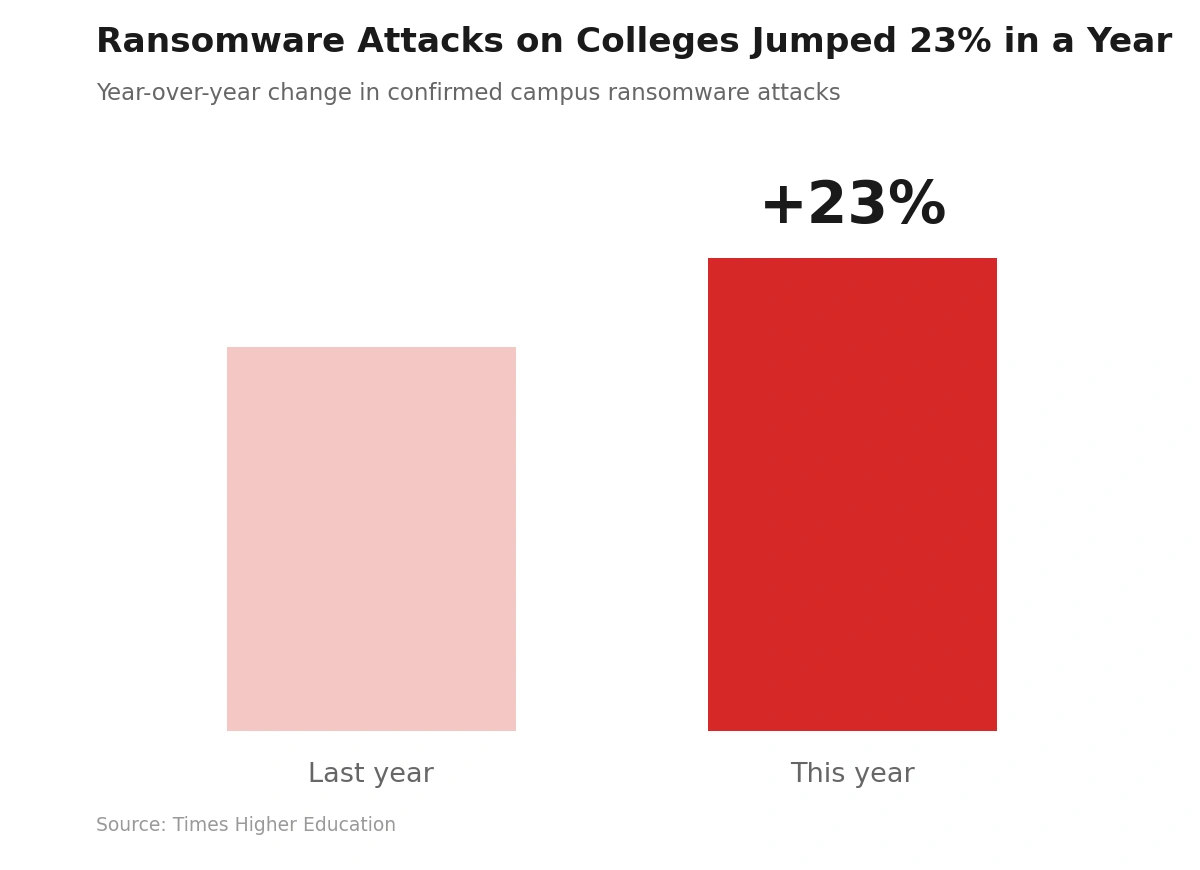
It also means schools are bigger targets for cybercriminals. According to Times Higher Education, ransomware attacks against colleges jumped about 23 percent in a single year.
If your school gets hit, it can freeze your admissions file or transcript for months. That's why cybersecurity spending keeps climbing right alongside the tech upgrades you actually notice.
The Human Element
Some things AI still can't do
Critical thinking, empathy, and reading a room are becoming more valuable, not less. AI can write you a paragraph. It can't run a group negotiation or calm down a tense meeting.
Employers are placing more value on things AI can't easily replicate, like critical thinking and empathy. That's part of why some schools are pushing more in-person debate back into their programs, even the online-heavy ones.
Your advisor might have an AI assistant now
Some schools use AI tools that flag students who are falling behind before grades even slip, based on things like attendance and login activity. Data from Inside Higher Ed, cited in a separate higher ed AI trends piece, shows a growing share of colleges use predictive analytics to catch students at risk early.
For international students specifically, this can catch you at a rough patch, like a heavy course load hitting right when a visa deadline is stressing you out, before it turns into academic probation.
Picture an international student juggling a part time job whose login activity suddenly drops. The system flags it, and an advisor reaches out before it turns into a bigger problem.
The degree isn't the finish line
Schools are shifting from just handing you a diploma and waving goodbye to offering ongoing support, like alumni credential updates, career check ins, and stackable options after graduation.
Think of your degree as a launchpad rather than a final destination. As higher education keeps changing, picking the right program matters more than ever.
Scholaro Premium can help you compare how international programs stack up before you commit, so your degree keeps paying off well after graduation.
Tech isn't replacing your education. It's reshaping how you get it, prove it, and use it after you walk across the stage. Keep an eye on the tools your school picks. They shape more of your experience than you might think.
 How Universities Use Zero-Waste Swap Programs to Cut Student Costs
 How Industry Partnerships Shape Modern Curricula
 How Post-COVID Aid Programs Help Universities Rebuild Admissions
 Beyond the Acceptance Rate and How Colleges Decide Who Gets In
 How Leveraging Job Placement Strategies Can Reenroll Returning Students