Most software work today starts with an AI draft. Developers spend less time typing code and more time checking what AI tools produce. That change sits behind two trends you might not connect at first: entry-level coding jobs are shrinking, and jobs built around design and review are growing. It also explains why coding as a basic skill now shows up in job postings well outside the IT department.

AI Handles Most of the Typing
Developers already work this way. Stack Overflow's 2026 Developer Survey, released in October 2026, collected more than 30,000 responses from 169 countries. According to the Stack Overflow survey results, about two-thirds of respondents use coding assistants or coding agents. Fewer than one in five use no AI tools.
The survey also shows where AI pulls its weight. About three in four respondents said it helps with implementation, meaning the actual code writing. A similar share said it helps with debugging and refactoring. Only about a third said it helps with team communication or design.
In other words, AI does best at hands-on coding. That's the same work that used to fill a junior developer's day.
Entry-Level Workers Feel It First
Payroll records back this up. The Stanford Digital Economy Lab tracks jobs by age and occupation using data from ADP, the largest U.S. payroll provider. Its August 2026 Stanford entry-level research uses data through June 2026. It found that employment for workers ages 22 to 25 in highly AI-exposed jobs sits about 19% below where it would be if it had kept up with same-age workers in less-exposed jobs.
The raw counts show the gap clearly. Between November 2022 and June 2026, employment for 22- to 25-year-olds in the most exposed jobs fell about 11%. In the least-exposed jobs, the same age group grew about 10%.
Older, experienced workers don't show this gap. The researchers also found no sign of widespread job loss across the economy. In jobs where AI mostly assists people instead of automating their tasks, employment is holding steady or rising.
Software development is one of the clearest examples. Stanford reported in October 2026 that employment for 22- to 25-year-olds in software development and customer service has fallen more than 3% a year since late 2022. Recently, that drop picked up to 4.4%.
Think about what that means for a new grad. A student, for example, who finishes a computer science degree this year and expects a first job writing basic features walks into a market where jobs for developers that age have shrunk every year since late 2022. And writing and debugging code are the exact tasks developers now say AI handles best.
Federal Projections Favor Designers Over Coders
The government numbers tell the same story. The U.S. Bureau of Labor Statistics counts computer programmers and software developers as separate jobs. Its 2025 to 2035 projections, released in August 2026, send them in opposite directions.
The programmer job outlook projects a decline. BLS says many companies will likely use technology, including AI, to automate repetitive programming tasks. It also expects some higher-skilled programming work to move to software developers.
Occupation | Projected employment change, 2025 to 2035 | Median annual pay, May 2025 |
|---|---|---|
Computer programmers | Decline of 7% | $100,390 |
Software developers | Growth of 10% | $135,980 |
Software QA analysts and testers | Growth of 6% | $104,300 |
All computer occupations | Growth of 6% | $109,470 |
All occupations | Growth of 3% | $50,980 |
The difference comes down to the work itself. Programmers write and test code based on someone else's design, and BLS expects fewer of them. Developers design applications and plan how systems fit together, and BLS expects their numbers to grow faster than average. The developer job outlook projects about 106,100 openings a year for developers, QA analysts, and testers over the decade. Programmers get about 4,400.
Read the Stanford and BLS data together and the pattern is easy to follow. The work AI drafts well sits mostly in entry-level and programmer roles. The work that still needs human judgment sits in design and oversight.
Review Takes Up More of the Job
You can see this in what developers do each day. In the survey's Stack Overflow work data, 67% of respondents review code, 63% make architecture decisions, 56% write documentation, and 52% deploy software. Writing code is only one part of the job.
Trust is the reason review matters so much. Nearly half of developers in the 2026 survey said they trust AI output when they can check it easily. Fewer than 7% would trust AI with important decisions. About 79% said source attribution matters when they judge AI-generated code or technical answers.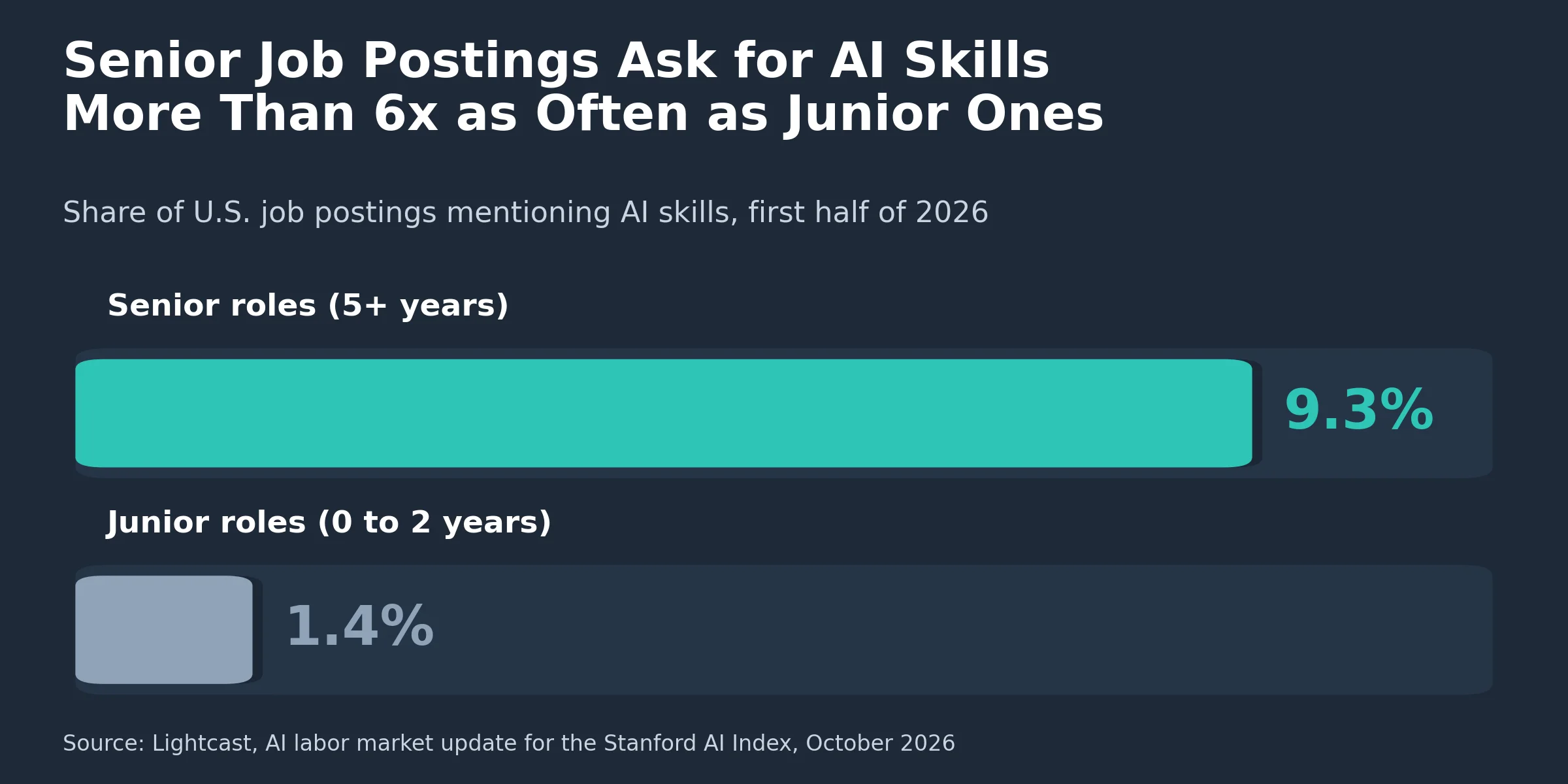
Most employers haven't set rules yet. Only about a quarter of respondents said their employer had published approved AI tools or formal guidance. About 30% said AI use at work was optional and left up to them.
Vibe Coding Opens Coding to Everyone Else
This shift reaches past engineering teams. Collins Dictionary named "vibe coding" its 2025 Word of the Year. Collins defines it as using AI, prompted in everyday language, to help write computer code. The dictionary noted a sharp rise in the term's use after it first appeared in February 2025 and said AI is making coding more accessible.
Say a public health student needs to clean up a messy survey dataset. A plain-English prompt could get that student working code without a programming class. The student still has to check that the code did what it was supposed to. That's the same review step professional developers rely on.
Job Postings Expect AI Skills
Employers outside tech are writing AI into their job ads. In a March 2026 Lightcast AI jobs analysis, the labor market data firm found that more than 56% of AI jobs are outside tech, and that share keeps rising. About 20% of IT job postings are AI jobs.
Lightcast data in the 2026 Stanford AI Index shows that 2.5% of all U.S. job postings in 2025 mentioned AI skills. Postings that asked for agentic AI skills, such as building and managing AI agents, rose from 0.06% of postings in 2024 to 0.23% in 2025. That works out to roughly 90,000 U.S. postings.
For staffing teams, this shows up right in the job description. An HR coordinator role, for example, may now ask for the ability to automate reports with AI tools.
Employers Still Value Judgment Most
When the job is checking AI's work, the skills you use to judge it matter most. The latest World Economic Forum Future of Jobs Report surveyed more than 1,000 employers representing over 14 million workers. It ranks AI and big data as the fastest-growing skills through 2030. Analytical thinking still holds the top spot as the core skill, with seven in 10 companies calling it essential. Creative thinking, resilience, and curiosity and lifelong learning are also expected to grow in importance.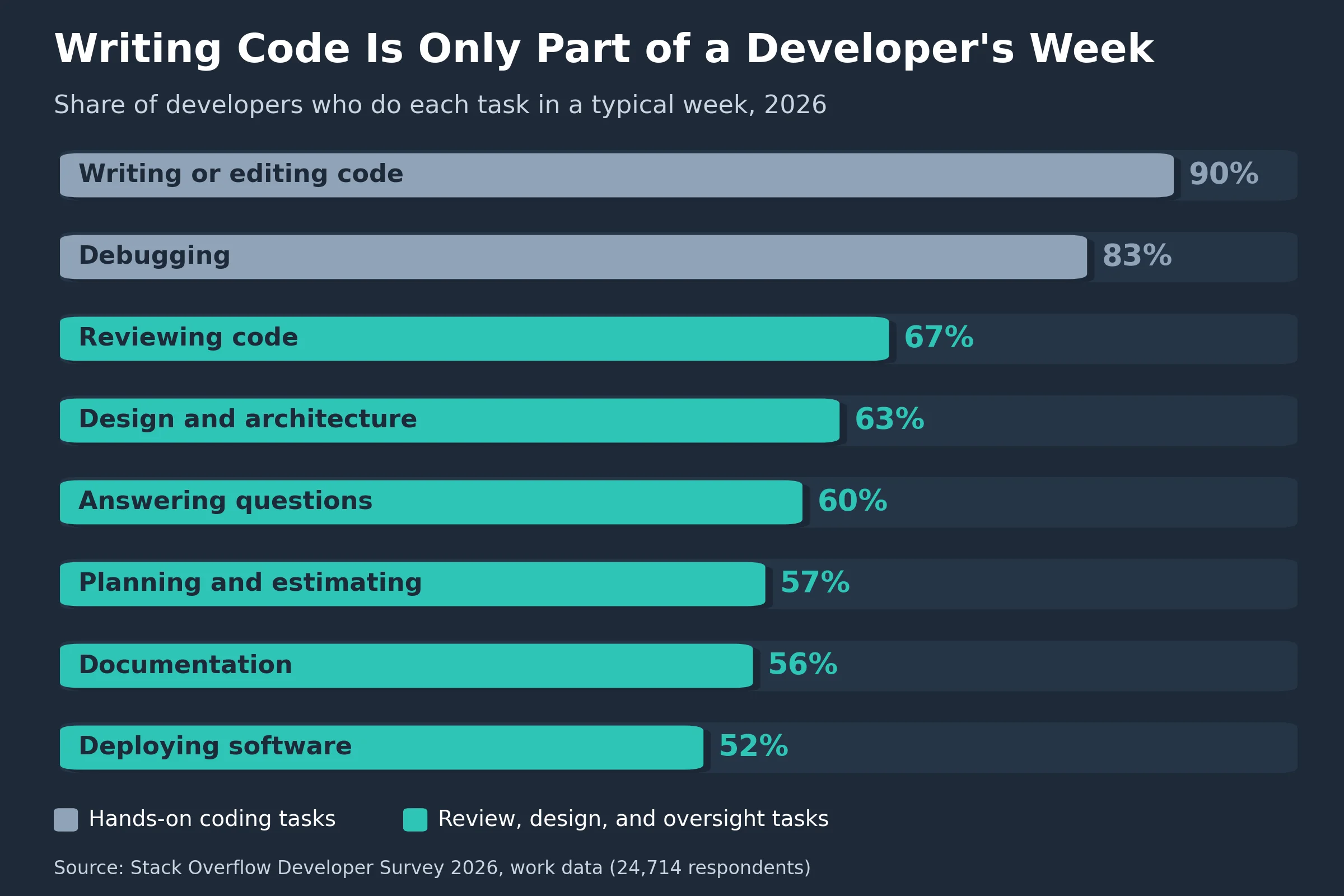
Lightcast's 2026 data lines up with that. Only two of the most common skills in AI job postings are AI-related. The rest include communication, management, operations, and problem-solving.
Workers Need More Training
Employers expect a big reskilling push. The same World Economic Forum report estimates that about 39% of workers' current skills will change or become outdated between 2025 and 2030. If the global workforce were 100 people, 59 would need training by 2030. And 85% of the employers surveyed plan to make upskilling a priority.
Developers are already on it. In the 2026 Stack Overflow survey, 52% said they learned a new coding skill or programming language in the past year.
Hiring Now Centers on Review Skills
Coding as a basic skill now means knowing how to direct AI and check its output. Federal projections, developer surveys, and job posting data all point to the same need: people who can review AI-generated code, in tech roles and beyond.
 How State Lawsuits by the DOJ Mean Higher Tuition for Undocumented Students
 5 ways colleges can make career prep 'unavoidable' for students
 The Real Economics Behind Entry-Level Gigs
 Can 3-Year Degrees Solve the Teacher Shortage?
 Does College Public Speaking Really Matter in Today’s Job Market?