
AI in higher education is no longer a future conversation. It's already happening on campuses everywhere, for better and worse. Universities are adopting AI tools faster than they're building the rules to govern them, and students are feeling the effects in real time.
Here's what leadership, faculty, and advisors need to understand before they get left behind.
What AI Actually Offers Universities
The upside is real. AI gives institutions tools they've never had at this scale:
Personalized learning: AI can adjust content based on how a student is performing in real time, not only at exam time.
Smarter admin: Enrollment management, scheduling, and advising get faster and more responsive.
Research support: Literature reviews that used to take weeks now take hours.
Early alert systems: AI flags struggling students before they drop out.
Over 90% of the world's top universities have already adopted AI-powered teaching tools, according to data presented at the 2025 Artificial Intelligence Action Summit. That's not a trend. That's a shift.
Scenario 1 A student is failing organic chemistry by midterm. Office hours are twice a week and always packed. They start using an AI tool at midnight to walk through problems when no one else is available. They pass the course. They probably wouldn't have without it.
The Risks Universities Can't Afford to Ignore
The risks here are not hypothetical. They're showing up on campuses right now.
Academic integrity is getting messy
AI-generated writing is hard to detect. Tools built to catch it are imperfect and inconsistent. One in four institutions surveyed by UNESCO in 2025 had already encountered ethical issues linked to AI use, including authorship disputes and outright plagiarism.
Scenario 2 Another student uses an AI tool to restructure their argument in an essay. They don't think it counts as cheating. Their professor flags the paper with a detection tool and they end up in a meeting with the dean. The course policy said nothing specific about AI. Nobody can clearly explain what rule was broken.
Overreliance is already a documented problem
Students who lean too heavily on AI without guidance develop weaker writing skills, produce less original work, and sometimes show signs of anxiety when the tool isn't available. AI helps learning when students engage with it critically. It undermines learning when students use it as a shortcut.
Equity gaps are getting wider, not smaller
Not every student has equal access to AI tools, fast internet, or devices that run them well. Institutions that roll out AI without addressing this risk leaving their most vulnerable students further behind. The research is clear: uneven implementation widens the digital divide rather than closing it.
Privacy and data risks
Student data that feeds AI systems raises real compliance questions under FERPA, GDPR, and other frameworks. Most institutions don't yet have a clear answer for where that data goes or who controls it.
Misinformation embedded in AI outputs
AI tools hallucinate. They invent citations, misquote sources, and present false information confidently. In academic settings, that's not a minor inconvenience. It's a credibility problem for the whole institution.
Area | Opportunities | Risks | Adoption | Student Impact |
|---|---|---|---|---|
Teaching & Learning | Personalized feedback, adaptive content | Overreliance, weaker writing skills | High | Mixed; depends on guided use |
Academic Integrity | Faster plagiarism detection tools | AI-generated work hard to detect | Growing | High risk of misconduct cases |
Admin & Advising | Chatbot advising, early-alert systems | Reduced human interaction | High | Faster support, less personal |
Research Support | Literature reviews, data analysis | Hallucinations, false citations | High | Risk of misinformation in papers |
Equity & Access | Broader access to learning tools | Widens digital divide | Uneven | Disadvantages under-resourced students |
Career Readiness | AI fluency as a job market skill | Graduates unprepared without it | Low | Only 51% feel ready (Cengage 2025) |
Institutional Policy | Framework for ethical AI use | Inconsistent rules, governance gaps | Developing | Unclear expectations for students |
What the 10-20-70 Rule Means Here
Boston Consulting Group studied AI adoption across many organizations and found a pattern they call the 10-20-70 rule.
10% of your success comes from the algorithms and tools you choose
20% comes from your technology infrastructure and data
70% comes from your people and your processes
Think about that. Seventy percent. Most institutions are spending the bulk of their AI budget on software. That's backwards.
Example: Imagine a university spends $500K on an AI-powered advising platform. If they don't train advisors to use it, explain it to students, or update workflows around it, the platform collects dust. The BCG data says this is exactly what happens in most organizations. The tool isn't the problem. The people-first investment is missing.
BCG research also shows that 69% of employees name colleagues as their main source of AI learning, not formal training programs. That means the fastest way to build AI fluency at your institution is to identify staff who are already using it well and let them teach others.
The Challenges Specific to Higher Ed
General AI risks apply everywhere. But higher education has its own set of problems on top of them.
Policy is inconsistent and slow
There's no federal standard for how universities should govern AI use. Some institutions are permissive, some restrictive, most are somewhere in between without a clear rationale. Nearly half of higher ed professionals in a 2025 EDUCAUSE survey said their institution's AI policies are somewhat or extremely permissive. That's not a strategy. It's an absence of one.
Faculty aren't getting enough support
Nearly half of universities are experimenting with AI in teaching, including lesson planning, grading, and plagiarism detection. But faculty are largely doing this without clear institutional guidance or proper training. That creates inconsistency across courses and departments that confuses students.
Environmental costs are rarely part of the conversation
Running AI systems at scale is energy and water intensive. Universities with sustainability commitments need to factor this into any AI infrastructure decision. It's not a dealbreaker, but it should be part of the conversation.
Scenario 3 One student in an environmental policy program spends a whole semester studying the carbon footprint of digital infrastructure. Then their department rolls out a new AI grading tool and nobody mentions the energy cost once. The student brings it up in class. The professor says it's a good question. Then the class moves on.
The Global Student Impact
International students are dealing with all of this at a harder difficulty level.
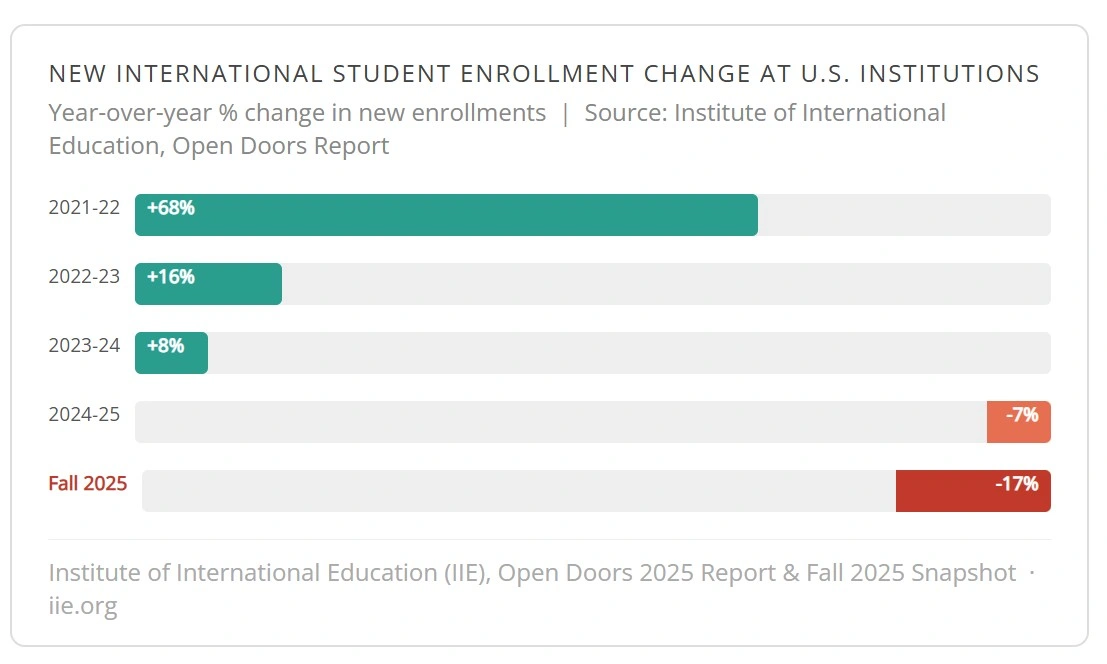
According to the Institute of International Education, new international student enrollment at U.S. institutions dropped 17% in fall 2025, the largest non-pandemic decline in 11 years. That's a structural pressure on tuition-dependent institutions, not a short-term dip. At the same time, AI tools designed primarily for English-language, Western educational contexts often don't serve international students as well. Language bias is real. Cultural bias in AI assessments is documented.
For these students, AI can be either a genuine support tool or another barrier. The outcome depends on how early institutions build equity into their implementation, not as an afterthought.
Data privacy is another layer. Students from countries with different data sovereignty laws are interacting with AI systems governed by U.S. or EU rules they may not fully understand. Institutions need to be upfront about what data is collected and how it's used.
The career readiness gap
The Cengage 2025 Graduate Employability Report found that only 51% of graduates felt they had enough AI skills for the jobs they were applying to. Employers are already treating AI fluency as a baseline. Universities that teach AI as a standalone elective rather than embedding it across programs are graduating students who arrive behind on day one.
Scenario 4 A recent graduate goes through multiple job interviews and gets asked about their AI workflow in every single one. Their degree program never touched it. Their classmates who figured it out on their own get the offers. They spend the first three months on the job catching up on tools they should have learned in school.
What Institutions Should Actually Do
Here's where the 10-20-70 rule gets practical. Invest in people first.
Build AI literacy across the curriculum, not just in tech or business programs. Every graduate needs a working understanding of how to use and evaluate AI tools.
Create governance frameworks with equity at the center. If your AI policy doesn't address access for students with disabilities, international students, and under-resourced learners, it's not finished.
Train and support faculty instead of expecting them to figure it out on their own. Peer learning works. Use it.
Be transparent with students about what AI tools you're using, how their data is handled, and what the rules are in each course.
Align AI investment with accreditation requirements and emerging regulation. The EU AI Act is already in force. U.S. guidance will follow.
AI in higher education is a real opportunity and a real risk at the same time. The tools are available. The gap is in how institutions are using them, who they're leaving out, and whether leadership is treating this as a technology purchase or a people-first transformation. Most institutions are getting that order wrong. The ones that fix it will be in a better position. The ones that don't will keep wondering why their AI investments aren't delivering.
 5 ways colleges can make career prep 'unavoidable' for students
 The Real Economics Behind Entry-Level Gigs
 Can 3-Year Degrees Solve the Teacher Shortage?
 Does College Public Speaking Really Matter in Today’s Job Market?
 Strategies for Communicating Tuition and Outcomes to Prospective Students