
About one in three college-bound students now drop a school from their list based only on the politics of the state it's in. That figure comes from national studentPOLL data released by the Art & Science Group in October 2026, and it shows politics shaping college enrollment long before acceptance letters arrive.
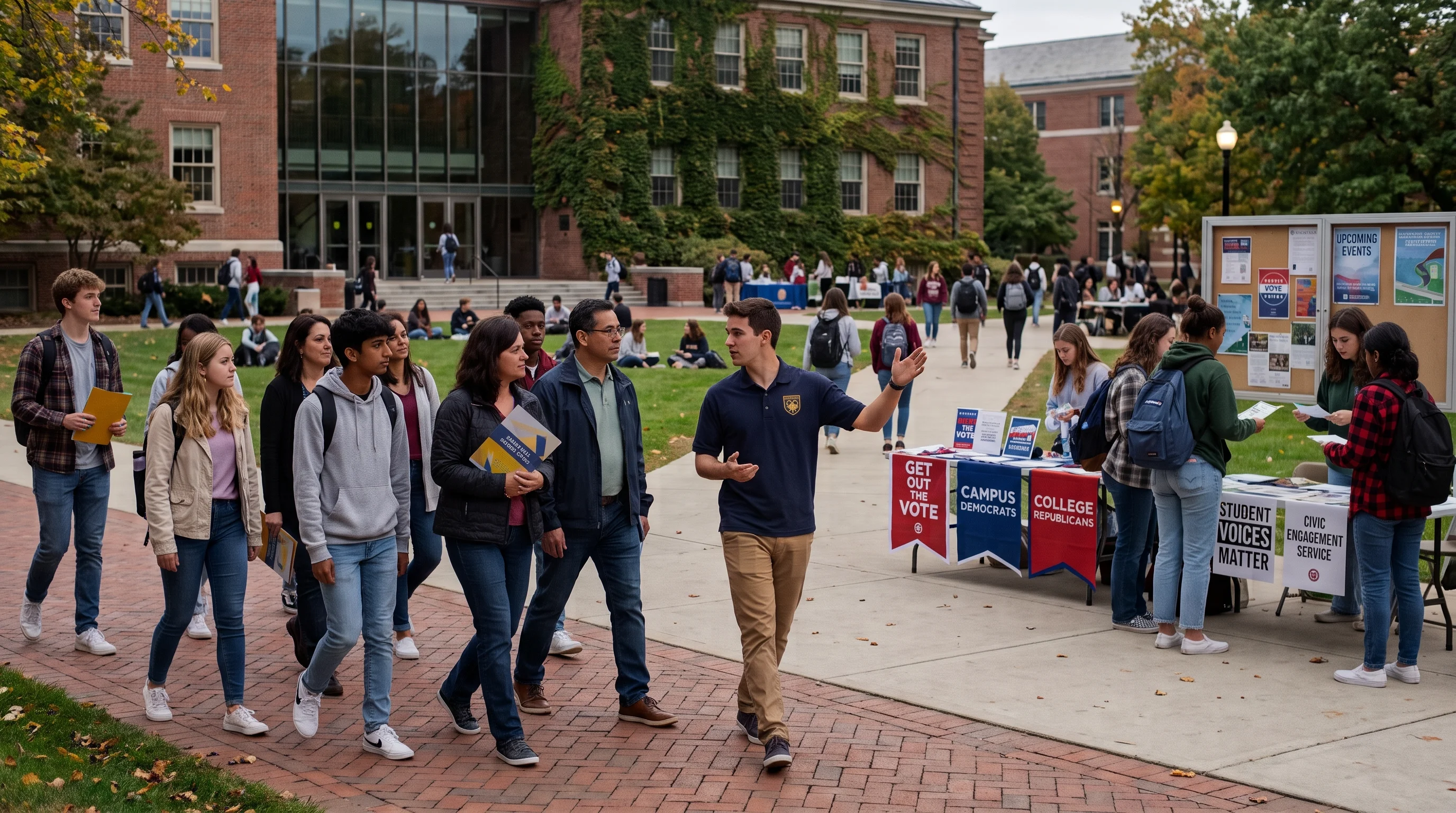
A September 2025 working paper adds the longer view. It tracks four decades of growing political divides between campuses and measures how much students would pay to attend a college that matches their views.
A Third of Students Now Cut Schools Over State Politics
The Art & Science Group found that 24% of students ruled out a college purely because of state politics in 2023. That rose to 28% in 2024 and 34% in 2026. The firm's latest studentPOLL findings describe this as a "consistent and legitimate upward trend," and the 2026 results confirm that the 2024 increase was not a one-off.
The 2026 poll surveyed 1,347 high school seniors in the spring and 1,547 recent graduates over the summer. The 34% comes from the summer group and only counts students who dropped a school purely over politics. Including students who said politics had some influence on their choices brings the share close to half.
Campuses Have Been Drifting Apart for Decades
The working paper, published in the EdWorkingPapers series at the Annenberg Institute at Brown University, examined the politics of more than 7 million college freshmen at 1,022 colleges between 1982 and 2019.
In 1982, 21.9% of freshmen called themselves liberal or far left, 21.1% conservative or far right, and 56.9% middle of the road. By 2019, those figures were 37.6%, 19.5%, and 42.9%. The middle shrank, and campuses moved further apart.
The shift was sharpest at the most selective colleges, where the share of liberal freshmen climbed from 25% to 52.3%. Colleges that already leaned liberal in the 1980s became more liberal, while religious colleges outside the Catholic tradition became more conservative.
Race, gender, religion, grades, and home region don't fully explain the split. The researchers say this suggests political views themselves play a direct role in where students enroll.
Students Will Pay Real Money to Avoid the Other Side
The researchers then surveyed 1,028 current undergraduates in June 2025. Each student compared pairs of made-up colleges that differed on cost, distance, size, quality, and politics. The methods and results are in the full working paper.
Students said they would pay the following per year for a 10-point shift:
Liberal students: $2,617 for fewer conservative classmates, $1,162 for more liberal classmates, and $3,064 for a state with more Democratic voters
Conservative students: $2,201 for fewer liberal classmates and $2,720 for a state with fewer Democratic voters, with no clear preference for more conservative classmates
Moderate students: no clear preference about classmates, but $956 for a state with more Democratic voters
Students put more value on avoiding the other side than on finding people who share their views. The paper calls this affective polarization.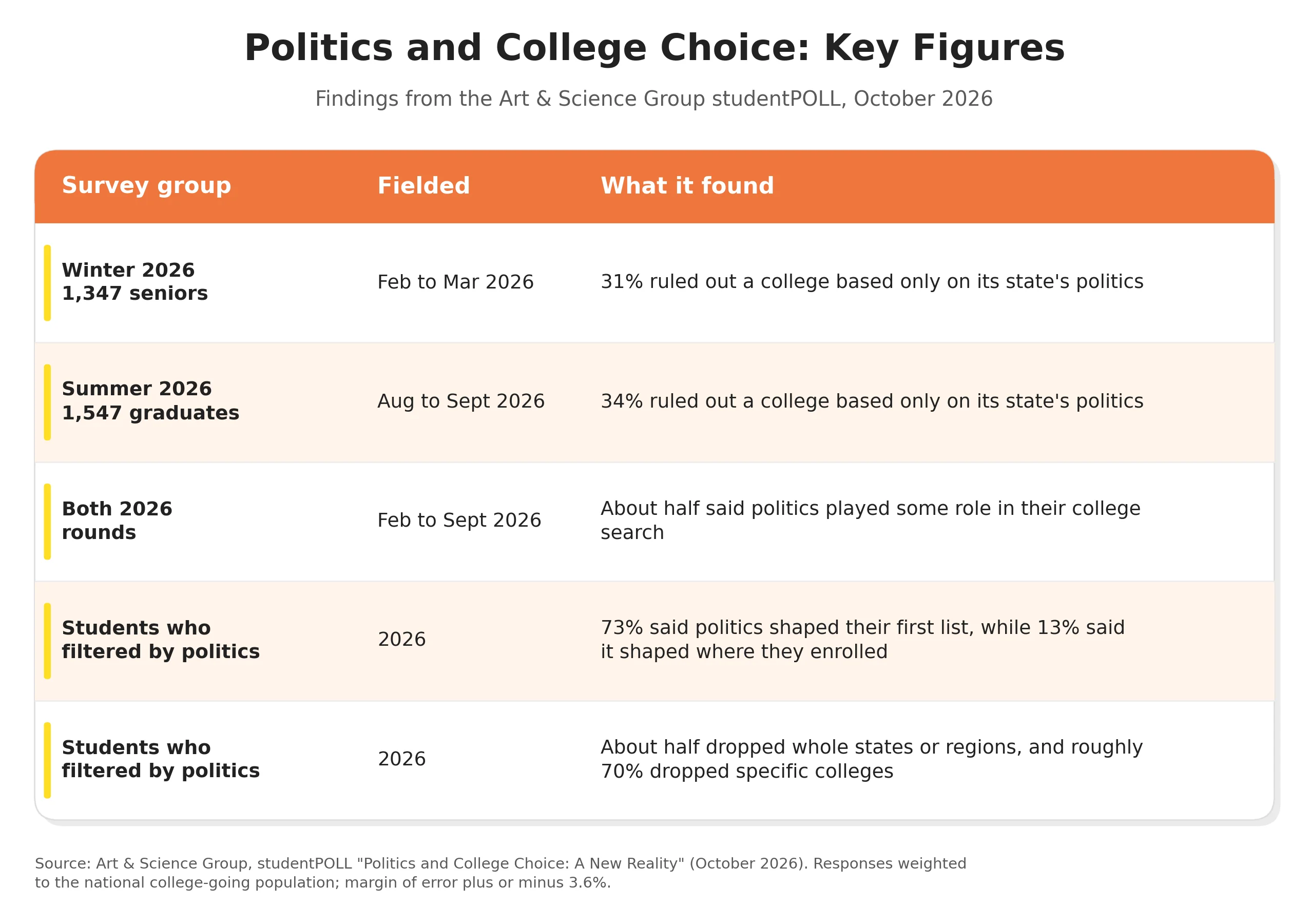
The researchers also translated these amounts into other trade-offs. Cutting opposing classmates by 10 points was worth as much to students as a college 155 miles (conservative students) or 340 miles (liberal students) farther from home. It was also worth as much as a college with average SAT scores 73 points (conservative) or 106 points (liberal) higher. The researchers say that rivals what students would pay for academic quality or a shorter distance from home.
Which States Get Crossed Off
In the 2026 studentPOLL, more than 15% of each group ruled out these states:
Conservative-leaning students: California, Colorado, and New York
Liberal-leaning students: Alabama, Florida, Georgia, Louisiana, Mississippi, South Carolina, and Texas
The working paper also found that state politics matters on its own. Liberal students put a bigger price on a state's voting pattern ($3,064) than on the mix of classmates ($2,617).
Inside Higher Ed's coverage of the poll reports that nearly half of students who filtered by politics cited whole states or regions, while over 70% judged specific colleges.
Most of the Cutting Happens Early
Among students who ruled out schools over politics, 73% said it shaped which schools they looked at, and 59% said it affected where they applied, according to Inside Higher Ed's coverage. Only 25% said it came up when comparing offers, and 13% said it played a part in where they enrolled.
The working paper looked at students already in college and listed what happens before students apply as one area for future research. The studentPOLL covers that stage.
The experiment has a limit. Students got exact political breakdowns for every college. The researchers point out that real decisions run on what students believe about a campus, and those beliefs can be off or incomplete.
Who Sorts Most, and Why It Matters
The working paper found these preferences across most student groups. Women and students whose parents have a bachelor's degree were willing to pay a bit more, but the differences between groups generally weren't statistically significant.
The researchers also note that political views are linked to race, socioeconomic status, and rural or urban roots. They warn that continued sorting could widen gaps in who attends which colleges, give students fewer chances to hear opposing views, and push polarization deeper into society.
What This Means for Your College List
Neither study was designed to tell you how to build a college list, but the timing data is relevant to anyone building one. Most political filtering happens before students apply, while far fewer say politics shaped their final choice. Cutting a school that early means deciding before you've seen its aid offer or spent time on its campus.
The working paper also measured state and campus politics as separate factors. A state's voting record won't tell you what daily life is like at a specific college, so its policies, student groups, and the people who study there are worth checking directly. Current students can speak to campus climate and campus belonging in ways a state's reputation can't.
Students in the experiment placed political fit at roughly $2,200 to $3,100 a year for a 10-point shift. Politics can be a fair part of your decision. Comparing it against real costs and offers keeps it in proportion with the other factors that shape your next four years.
 How Top Performers Land US Job Offers
 The College Majors Foreign Students Regret Choosing
 The Tightest Job Market in Years for College Grads
 How Universities Are Adapting Health Programs to a Moderating Job Market
 How Flexible Are PhDs in a Changing Job Market