
Human connection is losing ground on campus. Students are more digitally plugged in than ever, yet Trellis Strategies research drawing on nearly 44,000 college students found that 57% say they feel lonely. Only 15% report never feeling lonely. The U.S. Surgeon General declared loneliness a public health epidemic in 2023, linking it to cardiovascular disease, dementia, and premature death. Student leaders, though, are paying attention. Across the country, they are pushing back on a campus culture built around screens in practical, visible ways that university leadership would do well to support.
The Connection Crisis on Campus
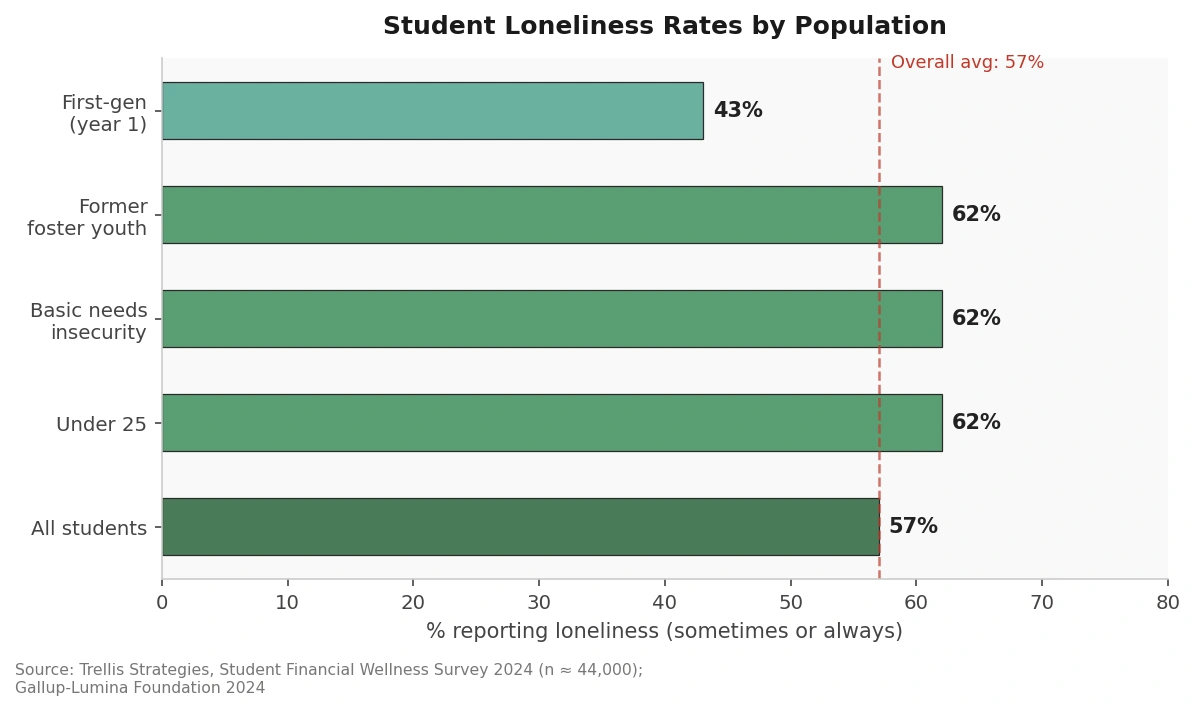
The data is hard to dismiss. Among students under 25, former foster youth, and those facing basic needs insecurity, more than 60% report feeling lonely sometimes or always, according to Inside Higher Ed's analysis of Trellis Strategies data. A 2024 Gallup-Lumina Foundation report found that first-generation college students are 30% more likely to feel isolated during their first year than continuing-generation peers.
A spring 2024 Student Voice survey found that 35% of students had never participated in any campus activities. College administrators report that students are less likely to join organizations or social opportunities than before the pandemic. The post-COVID disruption to social development has proven more durable than most institutions anticipated.
A 2024 study in Learning, Media and Technology examined social connection in hybrid university settings. It found that passive digital access does not substitute for active, physical placemaking. A 2025 meta-analysis in Frontiers in Psychology covering 56 studies and more than 30,000 participants confirmed a moderate-to-strong negative relationship between loneliness and belonging. First-year students and international students showed the most pronounced effects. You cannot engineer belonging through a portal.
Consider a first-year student who attends every class, submits every assignment on time, and never misses a deadline. By any institutional metric, things look fine. But she eats alone most days, hasn't joined a single club, and has no meaningful relationship with a faculty member or peer. She is enrolled, but she does not feel she belongs. Without intervention, she is statistically more likely to quietly disengage and stop out before her second year than a student who feels even a loose sense of connection to campus life.
The chart below shows loneliness rates across student populations, based on Trellis Strategies' 2024 Student Financial Wellness Survey and Gallup-Lumina Foundation 2024.
Why Reclaiming Connection Matters
The Retention Link: Resilience and Belonging
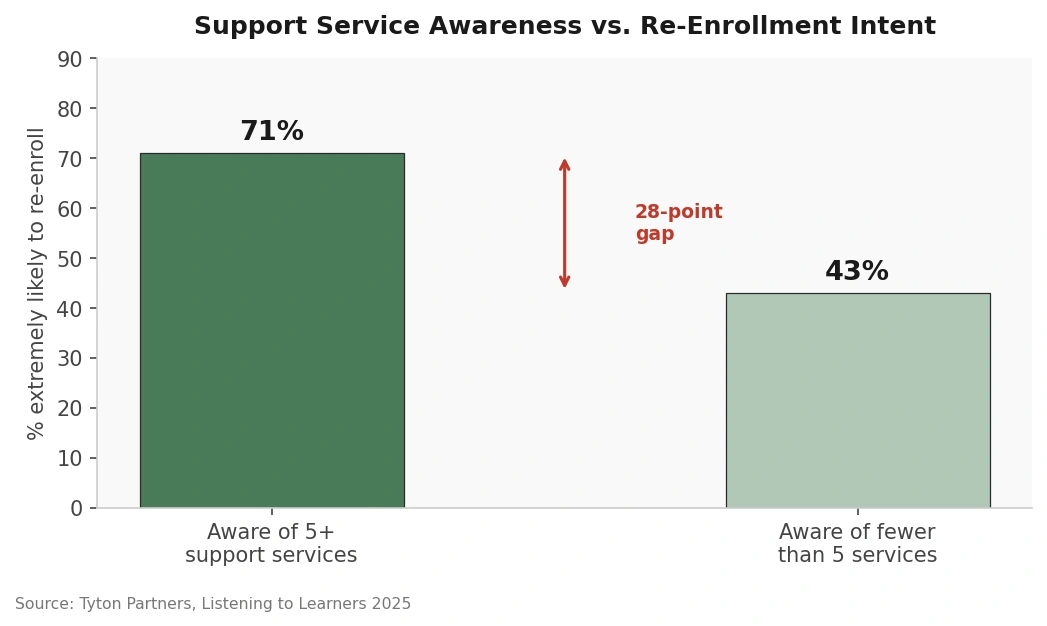
Students who feel connected to their institution are more likely to stay enrolled, seek support, and finish their degrees. Tyton Partners' Listening to Learners 2025 report makes the stakes concrete: students aware of five or more campus support services are 28 percentage points more likely to say they will re-enroll than those aware of fewer, 71% versus 43%. Awareness alone, before a student has even used a service, drives persistence. The design of your support ecosystem is a belonging decision, not just an operational one.
The chart below shows how support service awareness drives re-enrollment intent, based on Tyton Partners' Listening to Learners 2025.
Why Students Are Skeptical of Automated Classrooms
Students know what makes them feel they belong. Research on hybrid programs shows they identify faculty and peer respect, a welcoming culture, and in-person experiences as the strongest contributors. Most identify the hybrid format itself as a barrier. Remote access gives students flexibility; it does not give them community.
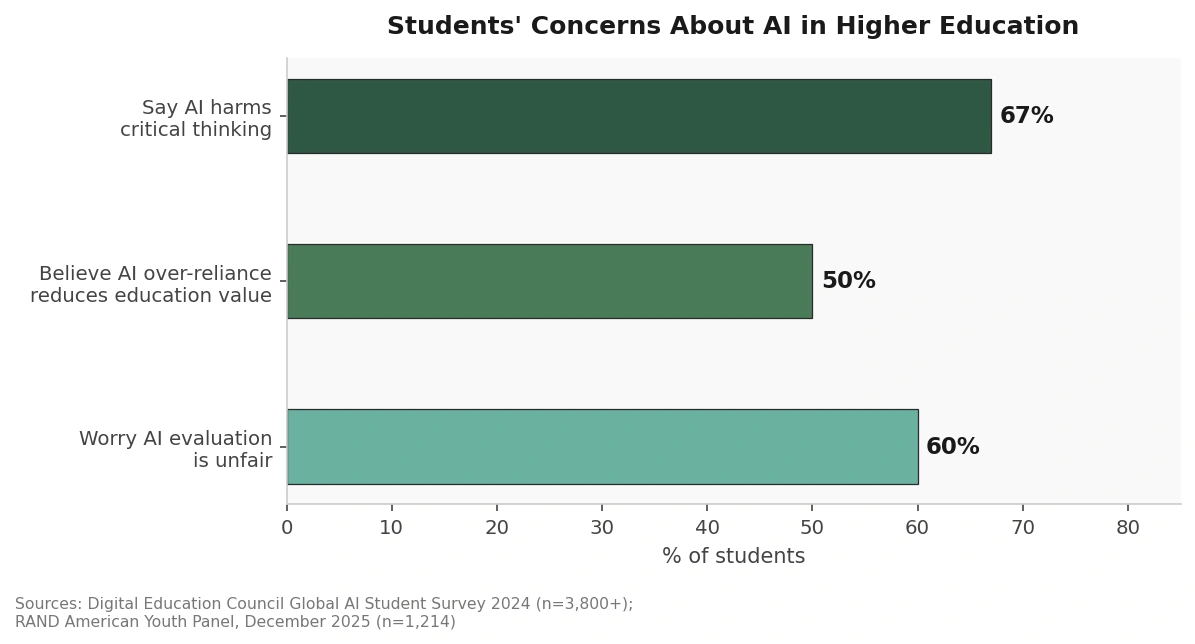
The pushback on AI reinforces this. A Digital Education Council survey of more than 3,800 students across 16 countries found that 60% worry about the fairness of AI evaluation, and over 50% believe over-reliance on AI reduces the value they get from their education. RAND's American Youth Panel survey from December 2025 found that 67% of students agreed AI over-reliance will harm their critical thinking, up more than 10 points in ten months. Students are not anti-technology. They are skeptical about AI replacing the human judgment they depend on to feel seen.
The chart below shows how students feel about AI in higher education, drawing on the Digital Education Council 2024 and RAND 2025 surveys.
The Human Toll of Institutional Blindspots
International students navigating complex academic transitions face compounded social risk. When students encounter early administrative friction, such as struggling with credential evaluations or paperwork before stepping into a classroom, it creates an immediate sense of alienation. That institutional barrier feeds directly into loneliness, acting as a significant mediating factor in international students' sense of both collegiate and departmental belonging, according to this Frontiers study. A graduate student who arrives from abroad, spends his first two months resolving credential and enrollment paperwork, and misses orientation, early social events, and the informal peer bonding that happens in week one, can find himself months behind socially with no obvious way to catch up. By the time the administrative friction clears, the belonging window has often already closed. The Hope Center's 2023-2024 survey found that 57% of students who had previously stopped out reported doing so because of mental health issues. Loneliness sits at the center of that figure.
How Student Leaders Are Reclaiming Human Connection
Dimension | Digital-First Model | Human-First Push |
|---|---|---|
Communication | Mass email, LMS portals | Peer mentoring, small-group dialogue |
Feedback and assessment | AI-assisted grading tools | Faculty and peer review |
Social support | Chatbots, apps, automated referrals | Co-designed physical and peer spaces |
Belonging | Engagement metrics, portal logins | Felt sense of inclusion and presence |
Designing "Tech-Free" Spaces
NYU IRL, or In Real Life, is the most visible example of student-led connection work right now. The Human Connection Club at NYU pushed the institution to open a screen-free lounge with board games and crafts. When it opened, co-founder Grant Callahan observed that the tables were always full and that strangers ended up in real conversations about lifestyle, creativity, and shared experience. The NYU IRL initiative now spans campuses in New York City, Abu Dhabi, and Shanghai, with faculty resources for device-free classrooms, supper clubs in dining halls, and phone-free zones with charging lockers at the door. Students shaped the program's final form. The institution's job was to resource what students had already started.
Leading with Vulnerability
Student leaders who talk openly about their own struggles, anxiety, academic pressure, or isolation reduce the stigma around help-seeking faster than any institutional campaign. Active Minds, the student-founded mental health advocacy organization, built its entire model on peer honesty. Its 2025 conference brought together nearly 400 student leaders and advocates, focusing on storytelling as a tool for campus-level change. A fall 2025 survey found that 73% of students trust campus counseling services. The trust exists. The gap is between trust and use, and it closes fastest when peers model help-seeking first.
Co-Designing School Culture
Spaces and policies designed without student input tend to miss what actually builds connection. Campus Compact's 2025-2030 plan calls for institutions to amplify student voice and develop connection spaces and resource hubs alongside students, not for them. The University of Delaware's Campus Culture and Engagement Task Force, launched in fall 2025, is co-creating its new campus culture framework through direct community dialogue with students. An institution that tells students what belonging looks like will lose every time to one that asks.
What the Data Tells Us
Loneliness affects more than half of college students and is linked to lower retention, worse mental health, and reduced belonging across student populations.
Students aware of five or more campus support services are 28 percentage points more likely to say they will re-enroll, regardless of actual service use.
Student leaders are driving human connection through peer mental health advocacy, tech-free spaces, and intergenerational programs, often ahead of institutional policy.
Sixty percent of students worry about the fairness of AI evaluation, even as AI adoption across campuses rises.
Co-designing campus culture with students produces support environments with higher awareness, use, and belonging outcomes.
Three Priorities for University Presidents and Boards
Connection is a retention metric. Loneliness is not a personal problem students bring to campus. It is a structural outcome of how campuses are designed, how support is delivered, and how much student voice shapes the environment. Institutions that treat belonging as a student affairs concern rather than a leadership priority will keep seeing it surface as a retention crisis.
Student leaders are already doing the work. Across the country, student-founded clubs are opening screen-free lounges, peer advocates are building mental health campaigns, and student coalitions are pushing for co-designed spaces before any administrator puts them on an agenda. Active Minds did not wait for a mandate. The most valuable thing leadership can do is stop building parallel programs and start resourcing the ones students have already built. Fund the clubs. Give student-led advocates a seat at the policy table. Create the physical spaces students are already asking for.
AI will not close the belonging gap. Students have told you this clearly, repeatedly, and in peer-reviewed data. Most students are skeptical of AI in assessment, and nearly all still want a real person when something important is on the line. The institutions that invest in human-centered design, in spaces, peer programs, and integrated in-person support, will differentiate on belonging outcomes. The institutions that automate their way toward connection will not.
 How Politics Is Shaping College Enrollment
 How Top Performers Land US Job Offers
 The College Majors Foreign Students Regret Choosing
 The Tightest Job Market in Years for College Grads
 How Universities Are Adapting Health Programs to a Moderating Job Market