
Disclaimer: This article is for general informational purposes only and does not constitute legal, medical, or financial advice. Insurance requirements, costs, and coverage rules change regularly. Always verify current requirements with your university's international student office, your visa sponsor, and your insurance provider before making coverage decisions.

Health care in the U.S. works differently from most other countries. There is no universal or government-funded system. Every service has a cost, and without health insurance for international students, a single hospital visit can run into tens of thousands of dollars.
Understanding your options before you arrive — or before your current coverage lapses — is one of the most practical things you can do as an international student.
Medical Scenario | Estimated Cost (Uninsured) |
|---|---|
ER visit (minor) | $1,500–$3,000 |
Appendectomy | $7,000–$50,000+ |
Fractured arm (non-surgical) | up to $2,500+ |
Serious illness or car crash | $150,000+ |
Ambulance ride | $500–$3,000 |
X-ray | $190–$1,000+ |
Is Health Insurance Required?
Federal law does not require F-1 or M-visa holders to carry health insurance, but in practice, almost every U.S. university requires it before you can register for classes. If you don't meet your school's requirement, you may be blocked from enrolling.
J-1 visa holders face a stricter standard. The U.S. Department of State mandates that J-1 exchange visitors and their J-2 dependents maintain health insurance for the full duration of their program. According to federal regulations under 22 CFR 62.14, the minimum coverage must include at least $100,000 in medical benefits per accident or illness, $50,000 for emergency medical evacuation, $25,000 for repatriation of remains, and a deductible no higher than $500 per accident or illness. Willful failure to maintain this coverage is a visa status violation that can lead to program termination.
Before you buy any plan, check your school's specific requirements. Not every plan that meets federal minimums will satisfy your university's criteria.
Health Insurance Options
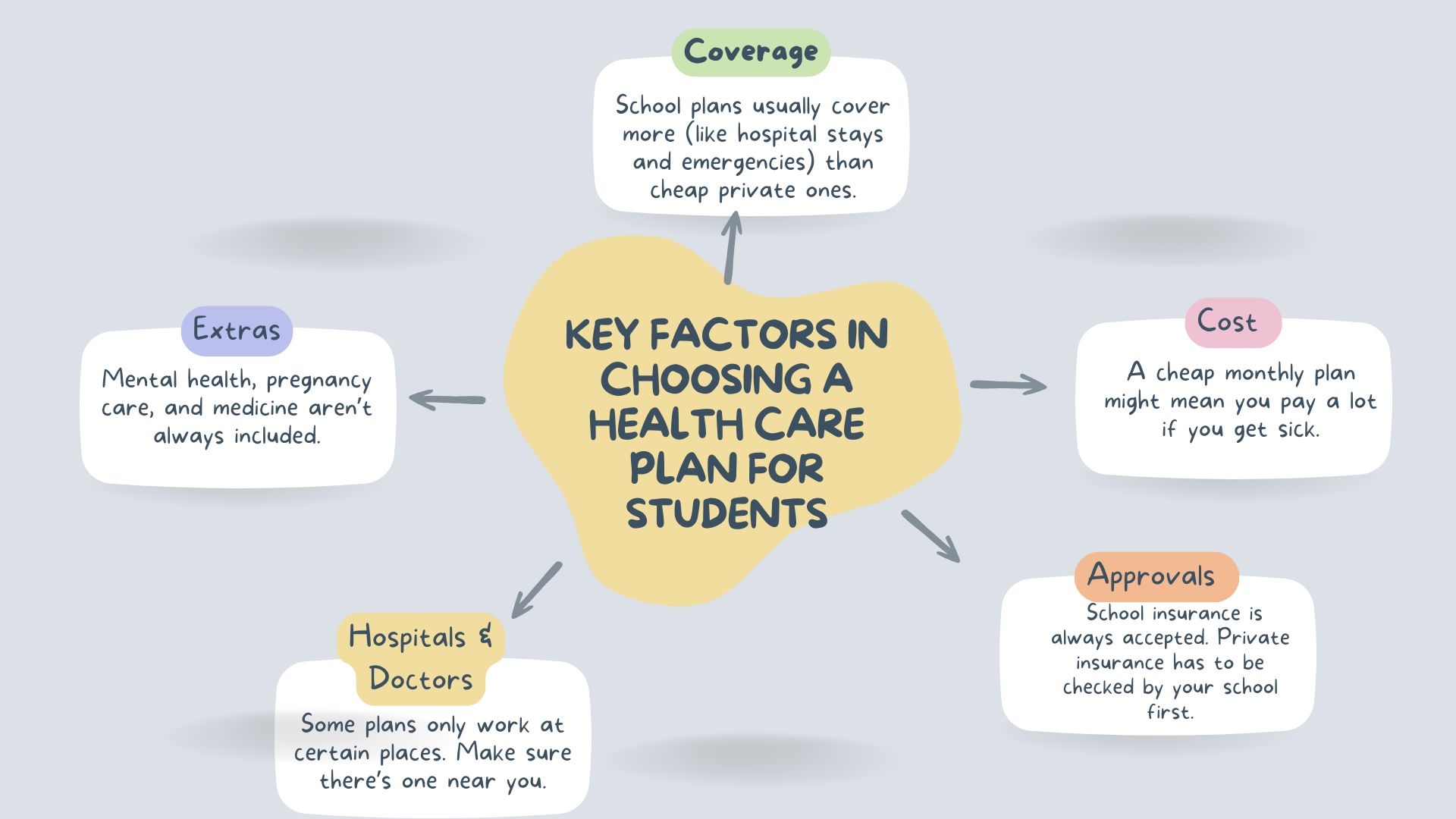
You have three main paths to coverage as an international student.
University-sponsored plans (SHIP/SHBP)
Most schools auto-enroll international students in a Student Health Insurance Plan (SHIP) or Student Health Benefits Plan (SHBP). These plans are designed to meet both visa requirements and school requirements, and they typically offer the lowest out-of-pocket cost when you use on-campus facilities. The trade-off is cost. University plans tend to be the most expensive option, and you often have less flexibility in choosing your provider network.
Some schools make these plans mandatory for F and J visa holders with no opt-out option. Others allow you to apply for a waiver if you can show a comparable private plan.
Private international student plans
Private plans from providers like ISO, ISI, IMG, Compass, and Aetna are often more affordable than university-sponsored plans while still meeting visa and school requirements. These plans are designed specifically for international students and typically cover doctor visits, hospitalization, emergency care, mental health, and sports injuries. Many also include medical evacuation and repatriation coverage — both required for J-1 holders.
To use a private plan instead of your school's plan, you generally need to apply for a waiver. The process and deadline vary by school, so check with your international student office early in the semester.
Medicaid and low-income state programs
Some international students qualify for Medicaid or other state-funded low-cost insurance programs, depending on visa type, income, and state of residence. Eligibility is not guaranteed and varies significantly by state. If you have limited income and cannot afford private coverage, ask your school's international student office whether you may qualify.
Cheapest Health Insurance for International Students
Cost is the first thing most students look at, and it varies based on your age, visa type, coverage level, and how long you need coverage.
Private plans are generally the most budget-friendly option. According to American Visitor Insurance, students under 20 typically pay between $30 and $124 per month for private coverage. Under 25, some plans start as low as $24 per month at the most basic tier. By age 40, costs can reach around $300 per month. Annual plans tend to run $1,500 to $2,500 depending on what's included.
A few strategies to keep costs down:
Compare private plans against your university plan before accepting auto-enrollment
Skip dental and vision add-ons if possible — get checkups before leaving your home country
Choose a higher deductible to reduce your monthly premium if you're generally healthy
Apply for a waiver early if a private plan meets your school's requirements and costs less
Avoid plans with sub-limits buried in the fine print — a plan might advertise $100,000 in coverage but cap hospital reimbursement at $500 per day
The cheapest plan is not always the best plan. A low monthly premium with inadequate coverage can cost far more if you actually need care.
Understanding Your Costs
Before you pick a plan, understand how cost-sharing works in the U.S. system. You will almost always pay something when you access care, even with insurance.
Cost Term | What It Means |
|---|---|
Premium | Monthly or semester payment to maintain coverage |
Deductible | Amount you pay out-of-pocket before insurance starts covering costs |
Co-pay | Fixed fee per visit (e.g., $30 at urgent care) |
Co-insurance | Your percentage share after the deductible (e.g., 20%) |
In-network | Providers contracted with your insurer — lower cost |
Out-of-network | Providers not contracted — you pay significantly more or all costs |
According to the University of Minnesota's International Student and Scholar Services, one hospital day can exceed $10,000 even for routine care. An ambulance ride can cost several hundred to several thousand dollars, and insurance only covers it if the situation is a genuine emergency. Always carry your insurance card and check whether a provider is in-network before your visit. Using an out-of-network provider by mistake is one of the most common and avoidable ways international students end up with unexpected bills.
Where to Get Care
Where you go for care directly affects what you pay. The U.S. system has several levels, and starting at the right one saves you time and money.
On-campus health center
This is your best first stop for most health issues. Campus clinics are typically the most affordable option — often free or low-cost — and are designed for student needs. Many cover primary care, mental health, immunizations, and pharmacy services. Hours can be limited, and you may need an appointment, but for non-urgent problems this is where you'll spend the least.
Telehealth
Many student insurance plans now include 24/7 telehealth access. It's a practical option for non-urgent issues, getting prescriptions, or mental health support without leaving your room. Some plans include unlimited virtual mental health care at no extra cost per session.
Urgent care / walk-in clinic
For problems that can't wait — minor injuries, infections, flu, sprains — but aren't emergencies, urgent care centers are a solid option. No appointment is needed, and they're typically open evenings and weekends. With insurance, a co-pay of $30–$50 is typical. Retail clinics inside pharmacies like CVS MinuteClinic are a cheaper alternative for minor issues.
Primary care doctor (GP)
A general practitioner or family doctor works well for ongoing or non-urgent health needs. You'll need an appointment, and some practices may not accept short-term or new patients. If your school's plan requires a referral before seeing a specialist, your campus clinic or GP is typically the starting point for that process.
Hospital emergency room (ER)
The ER is the most expensive place to receive care and is reserved for life-threatening emergencies: severe chest pain, difficulty breathing, serious injuries, signs of stroke, uncontrolled bleeding, or very high fever. Using the ER for non-emergencies is one of the most common and costly mistakes international students make. According to Michigan State University's Office for International Students and Scholars, wait times for non-emergencies can run several hours, and the costs will be far higher than urgent care. If you need emergency care, dial 911. Use an ambulance only if you need medical attention during transit to the hospital.
Important Tips
Always carry your insurance card — physical or as a screenshot on your phone
Check that your provider is in-network before every visit
Many plans require a referral from your campus clinic before you can see a specialist — skipping this step can mean the visit isn't covered
Get a dental and eye exam before you arrive in the U.S. Adding those to a student plan significantly raises your premium
Some private international student plans include home-country coverage for short trips — typically up to 15 days per 3-month period. Check your policy before traveling home
Keep receipts for all medical expenses and file claims promptly
Mental health care counts as health care. Many plans now include coverage, and campus counseling services are often free or low-cost
If your school's plan is mandatory, ask about the waiver process at the start of the semester. Missing the deadline locks you in for the full semester
Don't ignore billing errors. U.S. medical billing is complex and mistakes are common. Review every statement before paying
 How Universities Are Adapting Health Programs to a Moderating Job Market
 How Flexible Are PhDs in a Changing Job Market
 Understanding the Decline of International Enrollment in American Universities
 Why AI Writing Polish Can Flatten Student Expression
 Connecting International Talent to Inclusive Careers