
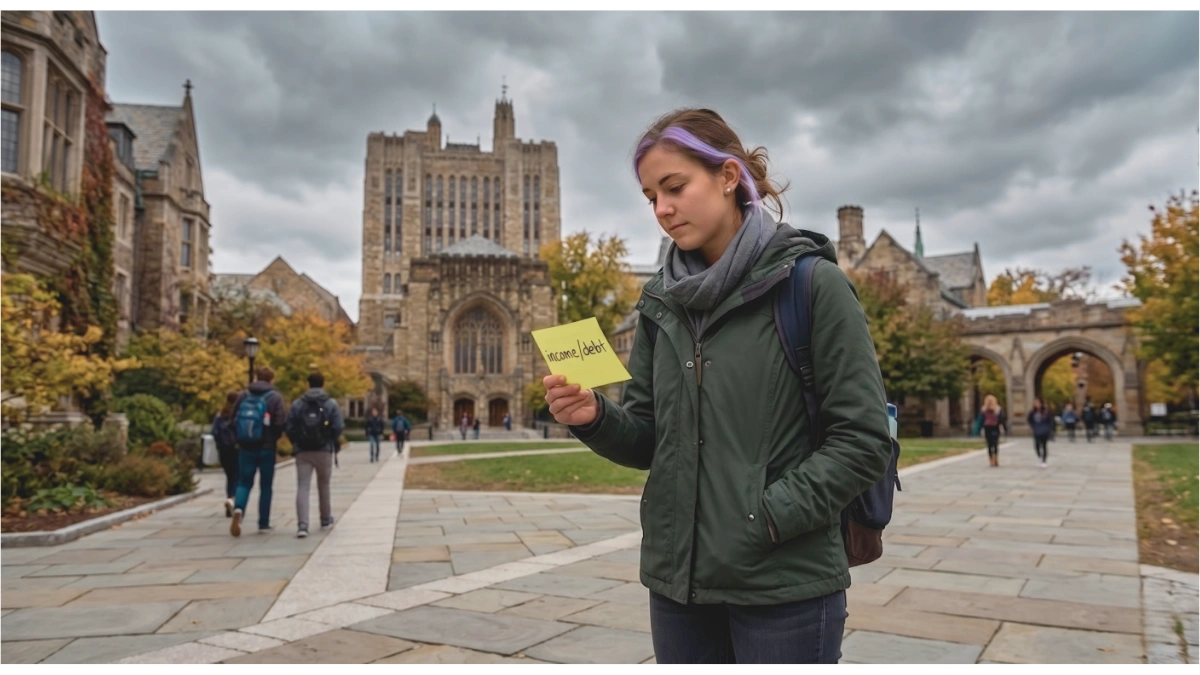
Student debt is one of the biggest financial decisions you'll ever make. And in 2026, with new federal loan rules kicking in and interest rates sitting at 6.39% for undergrads, the stakes are higher than ever.
So how do you know when you've crossed the line? Here's a clear breakdown.
Projected starting salary | Recommended max debt | Est. monthly payment (10-yr) |
|---|---|---|
$45,000 | $35,000 – $45,000 | ~$450 |
$60,000 | $50,000 – $60,000 | ~$600 |
$75,000 | $60,000 – $75,000 | ~$750 |
$110,000 | $90,000 – $110,000 | ~$1,100 |
The State of Student Debt Right Now
Before we get into the rules, here's where things stand. Total U.S. student loan debt sits at $1.84 trillion across 42.8 million federal borrowers. The average debt load (federal and private combined) is $43,570, but the median is just $24,109. The average public university student graduates with around $31,960 in debt. The average starting salary for the Class of 2024 was $65,677. And right now, 5.3 million borrowers are in default.
The gap between the average and the median matters. Graduate borrowers with massive balances pull the average up. Most undergrads are closer to that median figure.
What Changed on July 1, 2026
The One Big Beautiful Bill Act overhauled federal student lending. Here's what's new.
For borrowing limits, dependent undergrads can borrow $5,500--$7,500 per year up to a $31,000 lifetime cap. Independent undergrads get $9,500--$12,500 per year up to $57,500. Graduate students are capped at $20,500 annually with a $100,000 lifetime limit. Professional students (medicine, law, dental) get $50,000 per year up to $200,000. Parent PLUS loans are now capped at $20,000 per year per student, with a $65,000 lifetime limit.
Graduate PLUS loans are gone for new borrowers. Before, grad students could borrow up to the full cost of attendance. That option no longer exists, per the U.S. Dept. of Education.
For repayment, loans disbursed on or after July 1, 2026 have two options. The Tiered Standard Plan offers fixed payments over 10, 15, 20, or 25 years depending on your balance. The Repayment Assistance Plan (RAP) is income-driven and replaces SAVE, PAYE, and ICR. With RAP, you pay 1--10% of your adjusted gross income with a $10 minimum. Unpaid interest won't compound. But forgiveness comes after 30 years -- ten years longer than older plans.
If you're currently on SAVE, PAYE, or ICR, you have until July 1, 2028 to switch to IBR (which preserves a 25-year forgiveness timeline) or you'll be auto-enrolled in RAP.
How Much Is Too Much: The Core Rules
Rule 1: The Salary-to-Debt Rule
Don't borrow more than your expected first-year salary. If you're heading into a field that starts at $60,000 a year, your total debt should stay under $60,000.
It's not a perfect formula, but it's the most widely used benchmark in higher education finance. The average public university graduate borrows around $31,960 -- well inside that range for most majors.
Rule 2: The 10% Rule
Your monthly student loan payment shouldn't exceed 10% of your projected monthly gross income.
To put some numbers to it: if you expect to earn $45,000, keep total debt between $35,000 and $45,000 -- that puts your monthly payment around $450. At $60,000, aim for $50,000--$60,000 in debt with payments around $600. At $75,000, stay under $75,000 in debt with payments around $750. And at $110,000, a debt load of $90,000--$110,000 puts payments at roughly $1,100 per month. All estimates are based on a standard 10-year repayment plan.
Run your own numbers before you sign anything.
Real Talk: What Your Major Actually Changes
"Too much debt" isn't the same number for every student. It depends heavily on what you study.
Take two students borrowing $50,000. Nursing graduates start at around $72,334 a year, so Student A's debt-to-income ratio is comfortable from day one. Liberal arts graduates start at around $47,854, so Student B with the same $50,000 in debt is already over the salary-match threshold -- before rent, groceries, or a car payment.
The debt didn't change. The math did.
Engineering, computer science, nursing, and economics degrees have the highest ROI -- often $500,000 or more over a lifetime. Meanwhile, two-year degrees in liberal arts carry no ROI, and nearly half of master's degree programs leave students financially worse off. See the full breakdown from the Georgetown CEW.
That doesn't mean you should only study STEM. But you need to go in with eyes open about the numbers.
A Tale of Two Borrowers
Maya started nursing school at a state university in 2024. She borrowed $48,000 total, graduated in four years, and landed an RN position at $74,000. Her monthly loan payment is around $500 -- about 8% of her gross monthly income. She's on track to pay it off in under 10 years.
Jake went to a mid-tier private school for a communications degree. Four and a half years, a gap semester, and some lifestyle upgrades later, he graduated with $87,000 in debt and a starting salary of $41,000. His monthly payment is $890. That's over 26% of his gross monthly income -- before taxes.
Same generation. Very different financial realities. The difference wasn't intelligence or work ethic. It was the numbers going in.
What 2026 Interest Rates Actually Cost You
Federal student loan interest rates for undergrads currently sit at 6.39%, fixed for the life of the loan. Graduate rates are 7.94%, and PLUS loans run at 8.94%.
Here's why that matters: on a $35,000 loan at 6.39% over 10 years, you'll pay roughly $13,200 in interest alone. Stretch that to a $60,000 loan and you're looking at about $22,600 in interest over the same period.
Private loans are a different story. Rates range from around 3% to nearly 18% depending on your credit, and they come without income-driven repayment protections. If you can't make payments, your options shrink fast.
Every dollar you borrow costs you more than a dollar. Factor in the interest before you commit to a loan amount.
Income-Driven Repayment: Does It Save You?
The new RAP plan can make larger debt loads more "survivable" on paper. Payments scale to 1--10% of your income and unpaid interest won't grow your balance.
But survivable isn't the same as smart. You're repaying for 30 years under RAP before forgiveness kicks in. That's a third of your working life.
And starting in 2026, any forgiven balance is taxable income. If you reach forgiveness with $80,000 still owed, you'll owe income tax on that entire amount in the year it's forgiven. Plan for that bill well in advance.
IDR plans are a safety net, not a strategy.
The Rise of Trades and Certificates
Not every path to a good income runs through a four-year degree.
Undergraduate certificates in technical trades -- including vehicle maintenance, precision metalworking, HVAC, and electrical installation -- have a median ROI of $313,000, compared to just $160,000 for the median bachelor's degree. Full salary data by field is available through the BLS Outlook Handbook.
A two-year HVAC certificate might cost $8,000--$15,000. A plumbing apprenticeship costs almost nothing. These paths won't work for everyone, but if you're borrowing $60,000 for a four-year degree with uncertain job prospects, it's worth asking whether a different route makes more sense.
The Hidden Cost of Overborrowing
The monthly payment is the obvious problem. The less obvious one is everything you can't do while you're paying it.
Research shows that 32% of borrowers delayed buying a home because of student debt. More than half delayed retirement savings. And the math on delayed retirement savings is brutal -- money invested at 25 is worth far more at 65 than money invested at 35.
One study found that when student loan repayments kicked in, 25% of borrowers cut their 401(k) contributions by a median of 2.7 percentage points. That's compounding in reverse.
Reality Check: Ask Yourself These Questions

Before you sign anything, run through this list:
Have you exhausted free money first? Grants and scholarships don't need to be repaid. Apply everywhere before you borrow a dollar.
Does your monthly payment fit real life? Run the 10% rule against your expected first-year salary. Then subtract rent, groceries, and transportation from what's left.
Are you borrowing for the education or the experience? A nicer dorm, a meal plan upgrade, a more expensive campus -- these get baked into your loan. Ask yourself if they're worth it.
What does your field actually pay? Look up median starting salaries using the BLS Outlook Handbook before you borrow.
Have you modeled your full four-year debt? Multiply your first-year estimate by four. That's your real target.
Is College Still Worth It?
Yes -- but only if you treat it like an investment with real numbers attached.
The Georgetown Center on Education and the Workforce estimates bachelor's degree holders earn roughly $1 million more over a lifetime than workers with a high school diploma. The return is real. But it depends on what you study, where, and how much you borrow to do it.
College works as an investment. It doesn't work as a blank check.
Check your full loan balance at StudentAid.gov. Run your numbers. Then borrow accordingly.
 How Universities Are Adapting Health Programs to a Moderating Job Market
 How Flexible Are PhDs in a Changing Job Market
 Understanding the Decline of International Enrollment in American Universities
 Why AI Writing Polish Can Flatten Student Expression
 Connecting International Talent to Inclusive Careers