Social media for international student recruitment is no longer a supporting tactic. In 2026, it sits at the center of how universities attract, enroll, and support students from overseas, and that shift is happening under real pressure.
Recruitment does not stop at enrollment anymore either. Social media now works as a continuous bridge, carrying a person from prospective lead, to enrolled student, to active alumnus, often on the same handful of platforms. That is why this article covers more ground than recruitment alone. Skip a stage and you lose the thread that holds your pipeline together.
Visa backlogs, policy reversals, and a crowded field of destination countries have made this one of the hardest years on record to plan an international enrollment strategy.
Universities cannot treat their social media presence as an afterthought. The financial stakes are too high. International students contributed $42.9 billion to the U.S. economy and supported 355,736 jobs during the 2024-25 academic year, according to NAFSA. Early Fall 2025 numbers already show a drop of more than $1.1 billion and nearly 23,000 jobs, so the institutions that protect their international pipeline now will be the ones still standing in five years.
Enrollment Pressure Factor | Impact Level |
|---|---|
U.S. visa policy shifts | High |
Political rhetoric deterring applicants | High |
Over-reliance on one source market | High |
Rising competition from local universities abroad | Medium |
Safety and campus inclusion concerns | Medium |
Social Media as a Recruitment Tool
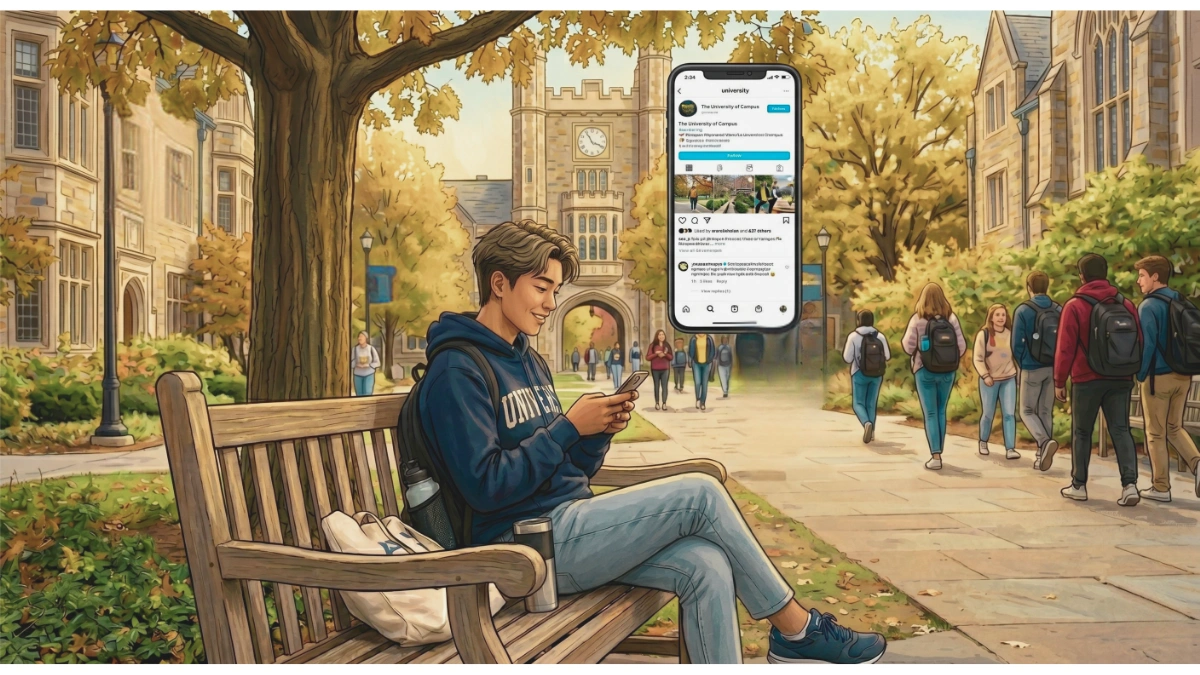
The question of whether to run social media campaigns for international recruitment has been settled. As one university recruitment director put it, social media is no longer a question institutions ask themselves. It is something they just do, because it works when done right.
What changed in 2026 is how universities measure that work. Vanity metrics, likes, impressions, follower counts, have given way to enrollment yield data. The most important number now is your Enquiry Conversion Rate, which tracks how many social interactions turn into high-intent actions like application starts or webinar signups.
Where students actually look depends on their stage and region. Here is the current map:
Quick-Reference: 2026 Platform Ecosystem
Undergraduate social search: Instagram, YouTube, TikTok (especially Southeast Asia)
Postgraduate and alumni validation: LinkedIn
Regional powerhouses: WeChat and Weibo in China, Facebook in Southeast Asia
Conversion and first inquiries: WhatsApp, Messenger, WeChat DM
Increase Enrollment Through Platform-Specific Strategy
A broad social media presence without a clear platform strategy wastes budget and effort. Algorithm changes at major platforms have cut organic reach hard, especially outside your home market. Paid amplification is not optional anymore.
Effective targeting works by region, academic interest, and behavior. Universities that segment by market, and adapt language and format to each one, consistently beat institutions running a single global feed.
A peer-reviewed study tracking 163 UK universities' use of Weibo and WeChat over several years found a clear pattern: consistent engagement on Chinese platforms tracked with real growth in Chinese student enrollment, even after accounting for university reputation. The strategy works because posting alone is not enough. It takes someone fluent in the platform and the language replying to followers in real time.
The bottleneck in 2026 is not whether regional platform strategy works. It is execution at scale. Institutions getting real traction run the same approach across three or four language tracks at once, using AI translation tools to keep posting cadence consistent in each market without hiring a full team for every one.
Posting cadence, time zone scheduling, and format selection, short-form video, polls, live Q&A, all affect how the algorithm distributes your content. Post consistently and use interactive formats, and you reach more prospects without raising ad spend.
User-Generated Content: The Trust Factor
Polished institutional content rarely converts at the same rate as content made by students. International students use social media for peer insight, and platforms now complement official sources of information rather than replace them. Student ambassadors, takeovers, and unscripted campus videos read as authentic in a way produced marketing cannot fake.
A 2025 RNL study found that 84% of students say social media helps them research colleges. What they are really looking for is peer validation: proof that real students chose this school, like being there, and are building careers out of it.
UGC does cultural work too. Student-led content showing campus diversity, religious life, and everyday social scenes answers questions prospective international students rarely ask out loud, about safety, inclusion, and belonging.
Showcase Your Values and Promote Achievements
Social media gives you a channel to show institutional character, not just program details. Research milestones, sustainability commitments, faculty recognition, and ranking wins all build credibility with overseas applicants who never get to visit your campus.
Inclusion messaging matters here too. Campaigns like #YouAreWelcomeHere and #WeAreInternational tell prospective students their culture and identity will be respected. With political uncertainty still running high in several major destination countries in 2026, that kind of positioning carries direct recruitment value.
Student achievement posts, prizes, publications, internships, graduate outcomes, do double duty. They reward your current students and give prospective applicants outcome evidence when they weigh return on investment.
Improving Learning and Support Through Social Media
Recruitment gets most of the attention, but social media also shapes what happens after a student enrolls, and that is where retention gets decided. For international students adjusting to a new academic system and culture, informal spaces like WhatsApp groups, Discord servers, and Instagram communities cover gaps that formal university structures miss.
Research backs integrating social media into the learning environment with real structure. A study published by the National Library of Medicine found that pairing constructivist learning with the right task-technology fit on social platforms improves the student learning experience and helps knowledge spread. When faculty use these platforms to share resources, start discussion, and acknowledge student work, outcomes go up.
Peer-to-peer learning moves faster through social channels too. Study groups, shared notes, and subject-specific content spread through the apps students already check daily. That builds digital literacy, a skill employers weight more heavily every year.
The risk is distraction. Institutions getting the best results treat social media as a structured tool with defined use cases, not a free-form extension of campus life.
Connect Alumni and Boost Fundraising
Alumni engagement stays underused at most schools, and it is the final stage of the same recruitment-to-retention bridge raised in the introduction. LinkedIn is the most direct channel here. It links current international students with graduates in their field, supports mentorship, and gives prospective students the career proof they look for before applying.
Alumni who feel connected give more, recruit within their networks, and show up for outreach events that support international admissions. Social media keeps that relationship cheap to maintain. A well-run alumni group on LinkedIn or a closed Facebook page pays back across fundraising, employer partnerships, and recruitment, all from the same effort.
Key Trends Reshaping 2026 Engagement
Short-form video dominance. Instagram Reels, YouTube Shorts, and TikTok keep outperforming static content for reach among 18 to 24 year olds globally.
AI-generated content pressure. As more institutions use AI to produce content at scale, authentic student-led posts carry more weight, not less.
Closed communities. WhatsApp groups, Discord servers, and niche Instagram communities build enrollment-stage trust that public feeds cannot replicate.
Metric maturity. Analytics tools now track social media's direct contribution to enrollment yield, which makes budget justification easier and strategy sharper.
The institutions that perform best in 2026 will not necessarily be the ones with the biggest budgets. They will be the ones matching the right content, in the right format, to the right platform, and measuring it against enrollment outcomes instead of engagement numbers.
Your Next Move: 2026 Checklist
Use this list to turn the trends above into action this term:
☐ Audit vanity metrics. Shift your KPIs from follower growth to application starts and webinar registrations tied to social UTM links.
☐ Launch a closed community pilot. Build a regional, opt-in WhatsApp or Discord channel where admitted international students can talk to peer ambassadors directly.
☐ Empower UGC creators. Move 30% of your production budget away from polished agency video and into the hands of international student creators making raw, unedited Reels and Shorts.
☐ Check DM response times. Staff your international admissions team for dedicated WhatsApp and WeChat coverage so you catch high-intent prospects in their own time zone.
 The Real Economics Behind Entry-Level Gigs
 Can 3-Year Degrees Solve the Teacher Shortage?
 Does College Public Speaking Really Matter in Today’s Job Market?
 Strategies for Communicating Tuition and Outcomes to Prospective Students
 How Politics Is Shaping College Enrollment