The job market for new college grads in 2026 is rough. If you're finishing your degree this spring, you're up against tighter conditions than students faced two or three years ago. That's not me being negative for the sake of it. That's just what the numbers say.
Here's what's causing it, who's got it worse than others, and what you can actually do about it.
Metric | Number | Source |
|---|---|---|
Hiring growth for the Class of 2026 | 5.6% | NACE |
Underemployment, grads age 22 to 27 | 42% | NY Fed |
Unemployment, recent grads | 5.6% | NY Fed |
Job openings nationwide | 6.5 million | BLS |
Employers using skills-based hiring | 70% | NACE |
Why Hiring Slowed Down
A few things are hitting the job market at once. That's what makes 2026 feel different from a normal slow year.
Companies are spooked. Tariffs, inflation, and federal budget cuts make it hard for businesses to plan six months out. When that happens, hiring freezes come first.
People aren't quitting. Workers are staying put in their jobs. Fewer people leaving means fewer spots open up for someone new.
Big employers cut staff. Job openings dropped to 6.5 million in December 2025, the lowest since September 2020.
There just aren't enough degree jobs. More grads come out every year than there are roles that actually need a degree.
If a student graduates with a communications degree and sends out 80 applications over four months, for example, they might land exactly one interview. That's not a rare story this year. It's closer to the norm.
AI Took the Easy Jobs First
AI isn't just trimming budgets. It's taking over the exact tasks that entry-level jobs used to be built around.
Drafting emails, formatting reports, basic data cleanup: this used to be the low-risk work you'd hand a new hire while they learned the job. Now AI does most of it. So there's less reason to hire someone with zero experience, and fewer rungs at the bottom of the ladder.
Workers aged 22 to 25 in fields like software, customer service, and accounting saw employment drop 16% in under three years, according to Stanford researchers. Job postings aimed at new grads fell by a similar amount, while applications per opening jumped 26%. More people chasing fewer spots.
If a computer science student expects a quick search because older classmates told them CS grads always land fast, for example, they might spend five months applying instead. Nobody warned them the market had flipped.
Your Major Changes the Story
The overall picture is tough, but your own odds depend a lot on what you studied. The gap between fields isn't small. It's built into how those industries hire.
Recent unemployment rates by major, age 22 to 27:
Nursing: 1.4%
Philosophy: 3.2%
Finance: 3.7%
Computer science: 6.1%
Anthropology: 7.9%
Nursing and education grads do clinical rotations and student teaching that work like long job interviews. Employers already know them by graduation. Something else stands out here too: computer science isn't the safe pick it used to be. It now sits closer to the top of this list than the bottom, not the middle. That's a real shift from a few years ago, when a CS degree was treated as close to a guaranteed job.
If a student majors in sociology and applies to 120 jobs over seven months, for example, they might hear almost nothing back. Rewriting the resume around a real skill, like the data analysis work she picked up in a research methods class, is often what finally moves the needle.
Pipelines Beat the Open Market
Some fields route grads through a system before they ever post a resume anywhere. Law, nursing, education, and the trades all work this way. Legal employers run structured interview programs. Trades run apprenticeships. If you're already in one of these tracks, your search is far more predictable.
Everyone else, mostly grads in humanities, social science, and general business, competes in the open market. That's where internship experience starts to matter more than your GPA. About 70% of employers now use skills-based hiring, up from 65% last year. A degree gets you in the door. It doesn't close the deal anymore.
It's also worth knowing why some companies are still hiring at all. Among employers growing their entry-level headcount, most say it's about building talent for senior roles down the line, over just filling a desk. That's why fit and applied experience carry so much weight at the application stage.
What Actually Moves the Needle
When employers pick between two equally qualified candidates, two things settle it almost every time:
An internship at that same company
Any internship in that industry
Your degree title matters less than the actual work you've done before graduation. Nearly all employers name internships as the single most valuable line on a resume. Co-ops come in second.
When you apply, lead with a problem you solved, not a list of classes you took. Employers want to know if you can do the job. Finishing the program is the baseline, not the pitch.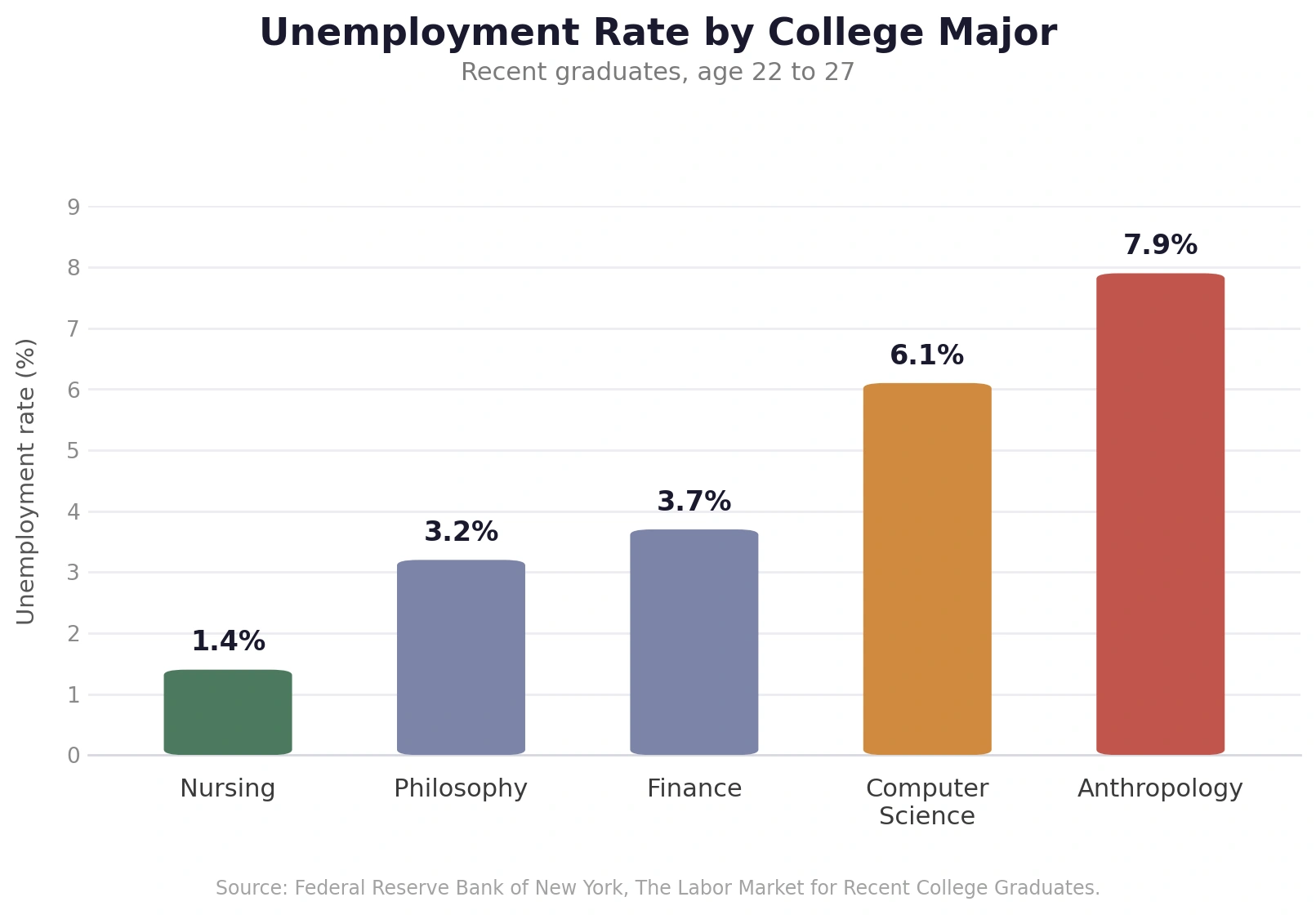
If the market in your field is closed right now, grad school is worth a careful look, not an automatic yes. It helps if it gets you into a pipeline field or lets you build the hands-on experience you missed. Piling on debt just to avoid a job search for a year isn't a plan on its own.
What Comes Next
Your degree still pays off in the long run. It's just the first step that's brutal right now.
Got an internship, a pipeline field, or skills that pair well with AI tools? You're in decent shape for 2026. If not, plan for a longer search than you expected. That's just the reality this year.
 The Real Risks Behind Social Media Screening
 Why Expanding Higher Ed Access in SIDS and LDCs Matters for Global Progress
 What the Education Department’s New Rules Mean for Your Career
 How AI Chatbots Shape Student Retention and Academic Navigation
 How AI Is Affecting the Job Market for New International Graduates