
Here's the honest answer to the degree vs experience debate: neither one wins on its own anymore. A degree is easy to check. Experience is messy, hard to compare, and often more useful. For university leaders, that gap matters. It's where your graduates either get ahead or fall behind once they leave campus.
A Degree Is Easy to Check. Experience Isn't.
A degree has a date, a school, and a standard behind it. Anyone can verify it in minutes. Experience doesn't work that way. Two people can both list "five years in project management" and have totally different levels of real responsibility.
Employers lean on years of experience as a shortcut, but it's not a great one. Merit Systems Board research found that years of job experience only weakly predict future job performance, with a validity score of just .18. That's a shaky signal at best. Time spent in a low-responsibility role tells an employer almost nothing.
For your students, this cuts both ways. Employers are watching experience more closely than ever, but they still don't have a clean way to measure it. Programs that build real, applied work into the degree give your graduates a head start.
Factor | Education | Experience |
|---|---|---|
Easy to verify | Yes, in minutes | Not really |
Consistent | Same across schools | Changes by role and company |
Skill type | Theory | Applied |
Time to build | 2 to 4 years | Ongoing, no end date |
What Employers Actually Want
There's no single answer here. It depends on the role, the industry, and honestly, the person doing the hiring.
Northeastern's survey of 750 HR leaders found that 60% value years of experience over education, and 74% said experience can substitute for a degree in plenty of roles.
LinkedIn's recruiting data backs this up. One in five U.S. job posts no longer asks for a four-year degree, and recruiters are 50% more likely to search by skill than by years on the job.
But here's the catch. Saying you're skills-based and actually hiring that way are two different things. A joint Harvard and Burning Glass study found that 85% of companies claim to use skills-based hiring, but dropping degree requirements only changed the outcome for about 1 in 700 hires. The talk is way ahead of the action.
The 70-30 Rule Explained
The idea is simple: hire someone who checks 70% of the boxes and let them grow into the rest. Hiring for a perfect 100% match often backfires. That person gets bored fast and leaves within a year because there's nothing left to learn.
There's a related idea worth knowing too, called the 70-20-10 model. It says people pick up about 70% of their skills on the job, 20% from other people, and only 10% from formal classes. Classroom time matters, but it's a small slice of how anyone actually learns to do a job well.
If a student studies business but spends two summers helping run a small nonprofit's budget, for example, that hands-on stretch often means more to a hiring manager than the finance elective on the transcript.
Where Experience Pulls Ahead
When a hiring pool is stacked with people who all have the same degree, the degree stops being special. It's just the entry fee. What separates people at that point is what they've actually done.
Plenty of hiring managers rank internships, part-time jobs, and volunteer work above GPA when they're deciding who's ready for the job. Grades still count, but they rarely settle the decision once everyone in the room is credentialed.
This gap shows up hardest for international students. AACU research found that fewer than half of employers think college grads are actually ready in skills like critical thinking and teamwork. Add a foreign transcript an employer can't easily read, and applied experience starts carrying even more weight. That's exactly the kind of gap credential evaluation services like Scholaro exist to close, by translating a student's academic record into something a U.S. employer or school can actually understand.
Jobs That Skip the Degree
Big companies have already moved on from degree requirements for plenty of roles. Google, Netflix, Apple, IBM, and Bank of America have all cut back on the four-year degree ask. Apple has said close to half its U.S. workforce doesn't hold one.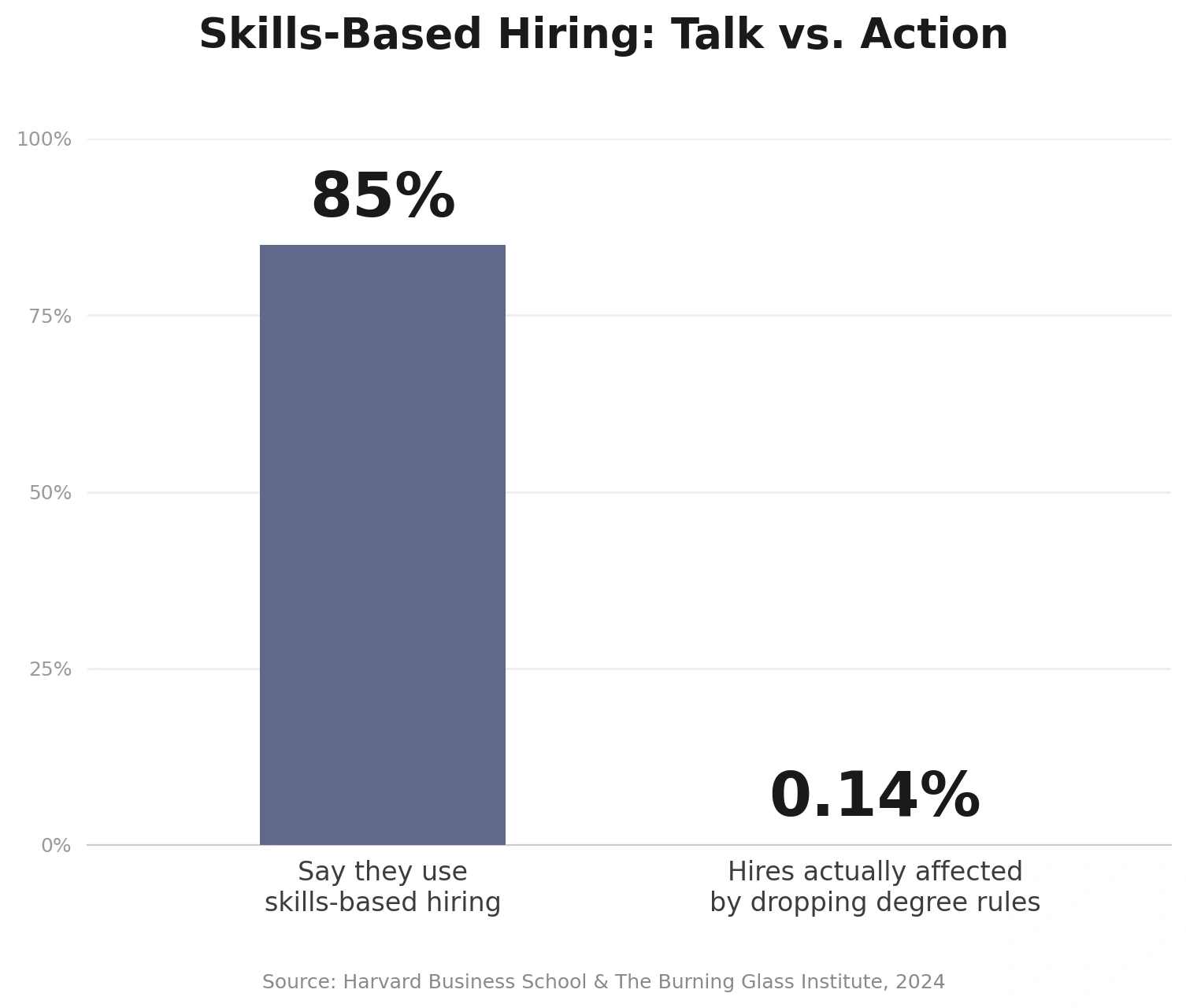
The roles most open to this: software development, cybersecurity, project management, skilled trades, and data work. What they all have in common is a skill you can actually test and prove, rather than only claim on paper.
The winning move is stacking a credential on top of real, provable work. Nearly 70% of employers say they'd rather hire someone with a degree plus a few microcredentials than a degree alone.
How to Show Both on Your Resume
You've got seconds, not minutes, to make an impression. Recruiters spend about 7.4 seconds scanning a resume before forming a first opinion, so don't bury your best material.
List jobs and education in reverse order, most recent first
Use 3 to 5 bullets per job, never a paragraph
Lead each bullet with a number: revenue, team size, projects finished
Cut roles older than 10 to 15 years unless they're directly relevant
Once you've got a degree and a few years of work, move education below experience
Add certifications and microcredentials right under your degree
If you're a year or two out of school, put education first. Once you've got three or more years of solid work behind you, flip it and lead with experience.
So Which One Wins?
Neither, really. A degree gets you noticed. Experience gets you hired and promoted. Schools that build real, applied work into the degree are giving their students both at once, and that's the combination employers keep asking for.
 How Politics Is Shaping College Enrollment
 How Top Performers Land US Job Offers
 The College Majors Foreign Students Regret Choosing
 The Tightest Job Market in Years for College Grads
 How Universities Are Adapting Health Programs to a Moderating Job Market