
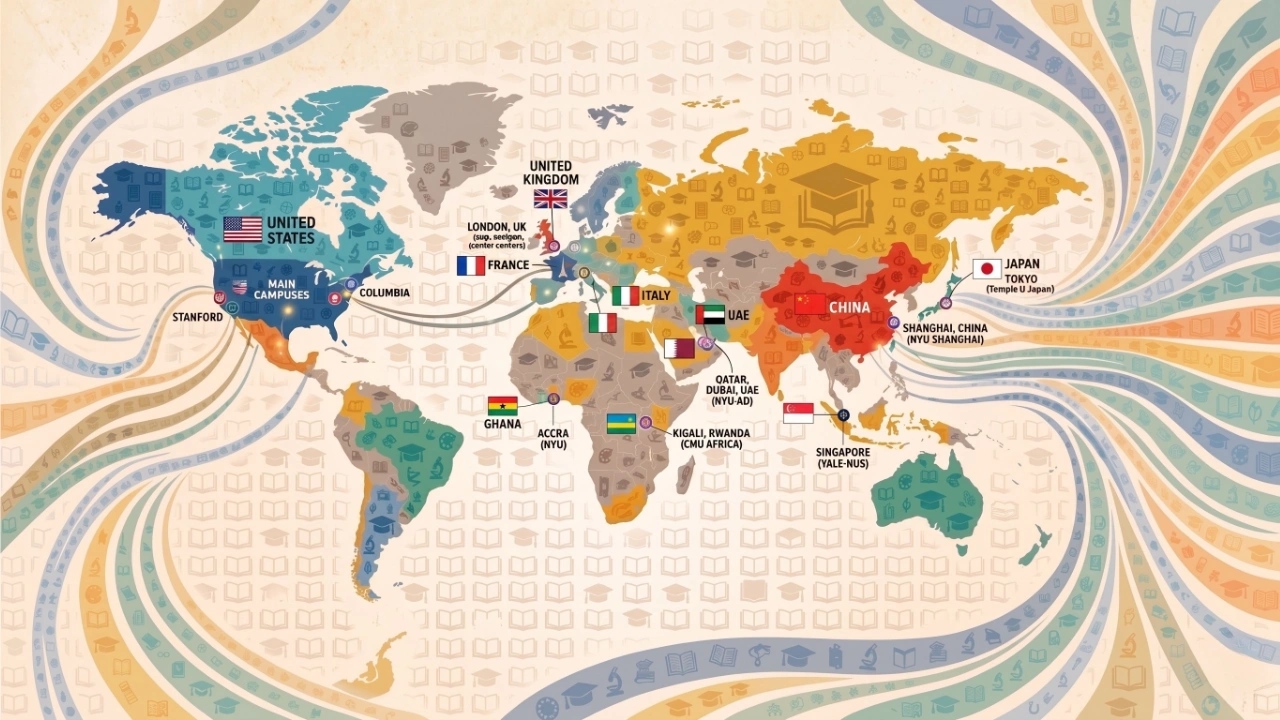
Something is shifting fast in US higher education. Universities that built their reputations attracting the best students globally now go to those students instead. International branch campuses, physical outposts of US universities in other countries, are having a moment. The timing is no coincidence.
Pressure Point | What's Happening |
|---|---|
New international student enrollment | Down 17% in Fall 2025, the largest nonpandemic drop in 11 years (Institute of International Education) |
Revenue lost from enrollment decline | $1.1 billion estimated loss (NAFSA, Nov 2025) |
F-1 visa refusal rate, 2025 | 35% worldwide, a decade high, with some countries above 90% |
Federal research funding frozen or cut | $11 billion+ across US universities since early 2025 (NPR) |
Why this is happening now
US universities are getting squeezed from every direction at once.
On one side, federal research funding has been frozen or canceled at institutions across the country. Harvard, Columbia, Cornell, Northwestern, and Penn were all hit. The cuts have rattled campus budgets and forced universities to rethink how much they lean on federal grants as a revenue base.
On the other side, international enrollment has collapsed. Visa offices rejected applications at a decade-high rate in 2025, and parts of Africa and the Middle East saw rejection rates above 90%. This double-digit collapse in enrollment means hundreds of lecture halls sit half empty, and the resulting budget gap is forcing immediate hiring freezes and program cuts at campuses that relied on that tuition.
Then there's the demographic cliff. US birth rates have fallen for years, which means fewer domestic students entering college. International tuition has quietly subsidized the system. NAFSA estimates that for every three international students, one US job is created or supported. Pull that support out, and a lot of institutions face real financial trouble.
For instance, San Diego State University projected a rise in new international students for Fall 2025 based on admission activity. Instead, many admitted students couldn't secure visa appointments over the summer. Enrollment fell. It's a story playing out at hundreds of campuses right now.
Universities under the microscope
Scrutiny of higher education has intensified in recent years. Federal investigations into antisemitism and foreign funding have touched dozens of institutions, with some universities reaching financial settlements to restore frozen grants.
Institutions including Harvard, the University of Pennsylvania, UC Berkeley, and the University of Michigan faced scrutiny under a federal law requiring disclosure of financial ties with foreign sources. The investigations prompted many schools to review compliance, restructure agreements, and in some cases pay significant sums to resolve outstanding issues.
The pattern shows how exposed US universities are when federal money gets used as leverage, and why diversifying revenue away from Washington suddenly looks smart.
Is it safe to study in the US right now?
For international students, the honest answer is: it depends on where you're from, and the uncertainty is real. Thousands of student visas were revoked in 2025. Some students were detained. Even students already enrolled saw their immigration status deactivated without warning.
The perception problem is compounding the policy problem. Students are sharing visa rejection stories in group chats, and that's reshaping where prospective students apply before they even get to the visa stage. The UK, Australia, and Ireland are all picking up applicants who've decided the US isn't worth the risk.
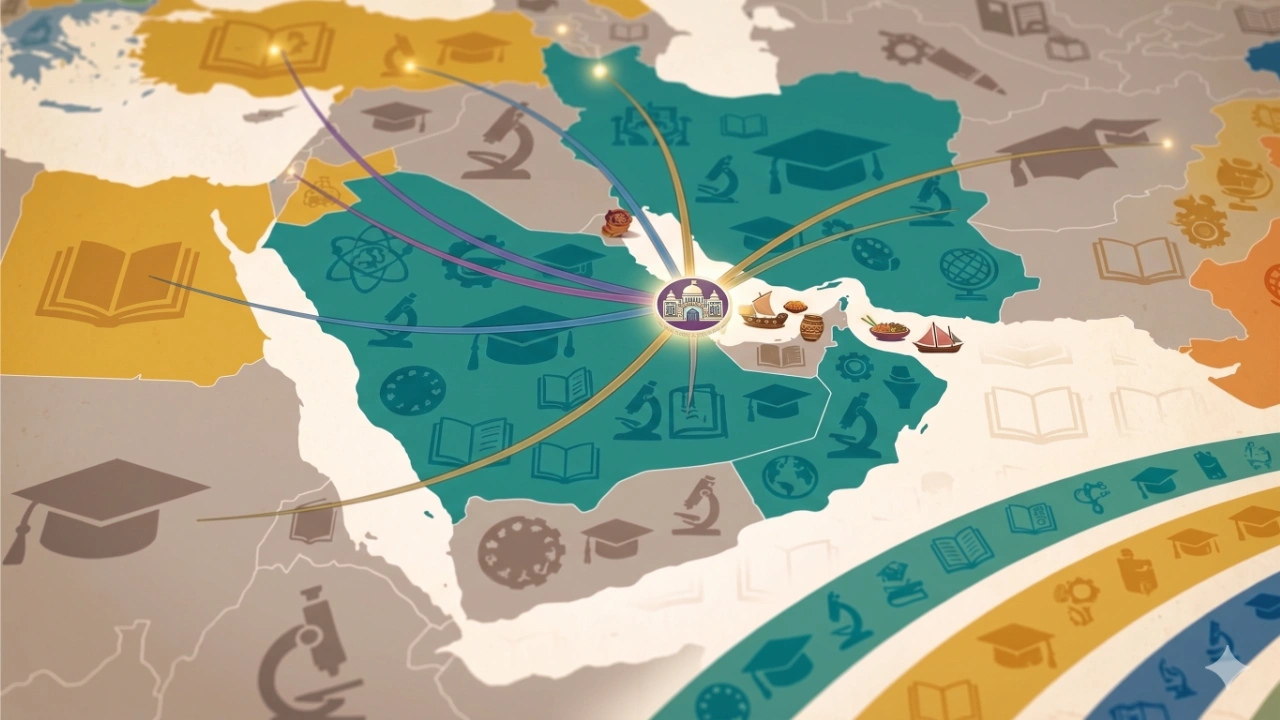
For university leaders, this is part of why international branch campuses are appealing right now. A student earning a US-accredited degree in Abu Dhabi faces none of these risks. That's a genuine selling point.
What a campus abroad actually offers students
If you can't get a US visa, an international branch campus is the next best thing. You earn a fully accredited US degree, taught by faculty who meet the same qualification standards as the home campus, without setting foot in the US.
Most campuses are concentrated in the Gulf states: UAE, Qatar, and Saudi Arabia, with growing presences in India, Malaysia, and Singapore. Qatar's Education City hosts six US universities in a single district, with government subsidies that keep tuition well below US rates.
Illinois Institute of Technology just announced a Mumbai campus. Georgetown renewed its Qatar contract for another 10 years. NYU Abu Dhabi has been running since 2010 and is widely considered the model for how to do this well.
You get a US-accredited degree without a US visa
Tuition is often lower, especially in government-subsidized hubs
Programs mirror the home campus curriculum
Some campuses offer strong financial aid packages
Will it work? The honest answer
The record is mixed. And anyone telling you otherwise is selling something.
Michigan State's Dubai campus closed. So did UNLV's Singapore campus. Both were described not as failures of ambition but failures of execution, specifically mismatches between institutional reach and actual capacity. Building a branch campus isn't duplicating your brand. It's building a new institution, in a foreign regulatory environment, under a different legal system, with dual accreditation requirements.
That last point matters. Branch campuses need to meet US accreditation standards and the host country's own requirements. That's expensive and slow.
There are also harder questions around academic freedom. Gulf states have different rules on speech, gender, and religion. Universities operating there have to manage those sensitivities, and that tension doesn't go away.
The same tension shows up in faculty recruitment. Asking tenure-track professors to teach under speech restrictions they wouldn't accept at home is a tough sell, and some scholars turn down posts at Gulf branch campuses for that exact reason.
Texas A&M's board voted to close its Qatar campus in 2024, officially citing "regional instability," with the wind-down running through 2028. The campus became collateral damage in a geopolitical dispute neither the university nor its students controlled.
The case for going ahead anyway
Despite the risks, the logic for well-positioned universities is real.
Demand is genuine. Millions of students want US degrees but face visa barriers
Gulf governments actively fund and subsidize IBCs as economic development tools, sharing the financial risk
Diversifying revenue away from federal grants reduces exposure to funding uncertainty
A branch campus extends institutional reach and brand in regions where US education still carries weight
Host governments use IBCs to slow brain drain, keeping top local students and future workers at home instead of losing them to study abroad. The university gets revenue, the host country keeps its talent
Take a student from Nigeria: with sub-Saharan visa rejections averaging 64%, and spiking even higher in neighboring regions, an IBC is her safest option. The demand is real and growing.
What success actually requires
Universities that have made this work share a few things in common. They treated the branch campus as a strategically distinct venture, not a satellite office or a marketing exercise. They committed leadership, resources, and time before expecting returns.
The ones that failed typically did the opposite. They moved fast, underestimated local complexity, and discovered too late that you can't export a campus the way you'd export a product.
Specifically, you need:
Brand that travels. If students in your target market don't know your institution, no amount of proximity helps.
Financial runway. International branch campuses (overseas campuses operating under a US university's name and accreditation) rarely break even in the short term, so you need to plan for several years of operating costs before expecting a return.
Local leadership. The home campus structure doesn't translate. You need people who understand the local regulatory, cultural, and political environment.
Dual accreditation. You need to satisfy both US accreditation standards and the host country's own requirements, which takes time and significant budget to get right.
So, will it work?
International branch campuses are not a cure for everything ailing US higher education. They can't replace federal research funding, fix the demographic cliff, or resolve the pressures happening at home. But for universities with the brand, resources, and leadership to do it right, they offer something real: a way to reach students who can no longer reach you.
The institutions most likely to succeed are the ones that go in with their eyes open, treating this as a long-term strategic investment rather than a crisis response. The ones that rush? They'll be the next case study in branch campus closures.
 5 ways colleges can make career prep 'unavoidable' for students
 The Real Economics Behind Entry-Level Gigs
 Can 3-Year Degrees Solve the Teacher Shortage?
 Does College Public Speaking Really Matter in Today’s Job Market?
 Strategies for Communicating Tuition and Outcomes to Prospective Students