College students use AI more than ever and trust it less than they did a year ago. That split now shapes what students want from college, and it shows up in their major choices long before it shows up in campus policy.

More than half of U.S. college students use AI for coursework at least weekly, and about one in five use it daily, according to a 2026 Lumina Foundation-Gallup study. In the same stretch, a separate Gallup survey of Gen Z recorded a sharp drop in excitement about AI and a rise in anger toward it.
The Study Partner Students Don't Trust
Ask students why they open a chatbot and most won't say "to cheat." In the Lumina Foundation-Gallup data, close to nine in ten students who use AI monthly or more said making sense of difficult material is a key reason. Roughly two in three turn to it weekly for help with confusing coursework, about six in ten use it to check homework answers, and just over half use it to polish writing or condense lecture notes. One respondent in Inside Higher Ed's Student Voice survey called it a "24/7 tutor."
That tutor is getting a lot more screen time. American University's Kogod School of Business tracked students over three years and found heavy AI use climbing fast: the share using AI more than ten times a week grew from about one in sixteen to nearly three in ten, with brainstorming as the top use every year.
Goodwill hasn't kept pace. When the Walton Family Foundation, GSV Ventures and Gallup polled more than 1,500 people ages 14 to 29 in early 2026, weekly use had risen only four points, to just over half. Over that same year, excitement about AI fell from 36% to 22%, anger rose from 22% to 31%, and the share who believed AI helps them learn faster slipped from 53% to 46%. Gallup described the relationship as "stabilizing but not deepening."
Much of that sourness traces back to jobs. Close to half of Gen Z workers in the survey said AI's downsides at work outweigh its upsides, an 11-point jump in one year.
Fear of Losing the Ability to Think
Plagiarism isn't what keeps most students up at night. Gallup found eight in ten Gen Zers expect that leaning on AI for speed now will make learning harder later, and four in ten students in an Inside Higher Ed survey worried AI is wearing down their ability to think for themselves. One undergraduate in a UK survey by the Higher Education Policy Institute put it bluntly: "I'm not using my brain at all," according to the HEPI student AI survey.
Lab evidence suggests that instinct isn't off base. When MIT Media Lab researchers monitored 54 participants writing essays, those using ChatGPT showed lower brain engagement than unaided writers and struggled to recall lines from essays they had just finished. English teachers who graded the work described the AI-assisted essays as "soulless." The study was small and hadn't been peer reviewed at release, but one detail matters for anyone designing courses: students who drafted on their own first and brought in ChatGPT afterward stayed far more engaged.
If a student relies on AI for every first-year lab report, for example, a sophomore course that requires writing from a blank page can feel like starting over.
Trust between classmates is wearing thin as well. An NBER working paper on undergraduate AI use found students suspect peers of misusing AI far more often than they admit to it themselves, even as more than nine in ten agree the technology hurts student writing.
Grading Has to Change Before the Rules Do
Students who already think take-home work is unfair won't be reassured by a new policy memo. A team of UC Berkeley researchers at the Center for Studies in Higher Education reviewed responses from more than 95,000 students at 20 large public research universities and found AI-related cheating varies widely from field to field.
Their answer is to rethink how professors grade. Where an instructor needs proof of individual skill, the researchers favor in-class, oral or practical exams. For other work, they suggest grading the process, with students showing their reasoning and pointing out where AI got things wrong, backed by faculty training on what the tools can actually do. Because use differs so much by discipline, one campus-wide rule is unlikely to fit every department.
AI Anxiety Is Redrawing Major Choices
Nearly half of enrolled students (47%) have thought about switching majors because of AI's possible effect on jobs, the Lumina Foundation-Gallup study found, and that rises to 56% among associate degree students. About one in six have already switched. Men switched more often than women (21% vs. 12%), vocational and technology students switched most, and healthcare and natural science students were the least likely to seriously consider a change.
Where those switchers went says a lot. Of the students who changed majors over AI, about a quarter moved into social sciences, 17% into business and 13% into technology, according to Business Insider's reporting on where switchers landed. So some students are fleeing tech while others are heading toward it, sometimes in the same graduating class.
These choices start in the first semester. About one in ten students in the entering 2025 class had already changed majors over AI-related job worries, according to EAB's first-year survey.
For international students, a switch can carry immigration consequences. The U.S. Department of Homeland Security (DHS) uses CIP codes to decide which degrees qualify for the STEM OPT extension, through its STEM Designated Degree list. Leaving computer science for a program whose CIP code isn't on that list can cost a student the extension, so advising on major changes has to cover visa eligibility along with credits and timelines.
Computer Science Loses Students to Health Fields
For years, computer science was the safe bet. The National Student Clearinghouse Research Center reported that undergraduate computer science enrollment fell 8.1% at four-year colleges in fall 2025, from about 659,700 students to about 606,100. This fall, the drop sped up at every level while health majors kept growing.
Level (fall 2026, preliminary) | Computer and information science | Health majors |
|---|---|---|
Undergraduate, four-year | Down 12.4% | Up 6.2% |
Undergraduate, two-year | Down 12.3% | Up 4.3% |
Graduate | Down 10.4% | Up 2.0% |
These figures come from the Clearinghouse's preliminary fall report, which draws on early data from about 46% of institutions. Final numbers are due in January 2027.
The shift isn't a retreat from technical study. Undergraduate health professions enrollment grew for a third straight year in spring 2026 and passed two million students nationwide, led by nursing. That same spring, four-year engineering enrollment rose 6.8%, based on Inside Higher Ed's analysis of Clearinghouse data.
Students Want AI Taught, Not Banned
On paper, many campuses still treat AI as a problem to contain. In the Lumina Foundation-Gallup study, 42% of students said their school discourages AI and 11% said it bans AI outright, while about four in ten said their school encourages it, usually with limits.
Students aren't asking for a free-for-all, though. Inside Higher Ed's Student Voice survey found 97% want their schools to do something about cheating, but most oppose a policing approach. Many would rather use AI openly, with optional training on how to use it ethically at work.
Job interviewers aren't waiting for campuses to decide. In the Kogod survey, the share of students asked about their AI skills by potential employers jumped from about one in nine in 2024 to more than four in ten in 2026. A graduate who spent four years in courses where AI was off-limits can now walk into an interview where questions about AI skills are increasingly common.
Career Results and Human Contact Define Value
When students size up a college, they look at what happens after graduation. EAB's research shows students rate job placement, internships and practical experience as the most valuable parts of their education. Which AI skills belong in the curriculum is less settled, since an ITHAKA S+R analysis found employers rank AI skills differently than instructors do, with employers focused on AI-assisted workflows and working alongside AI tools.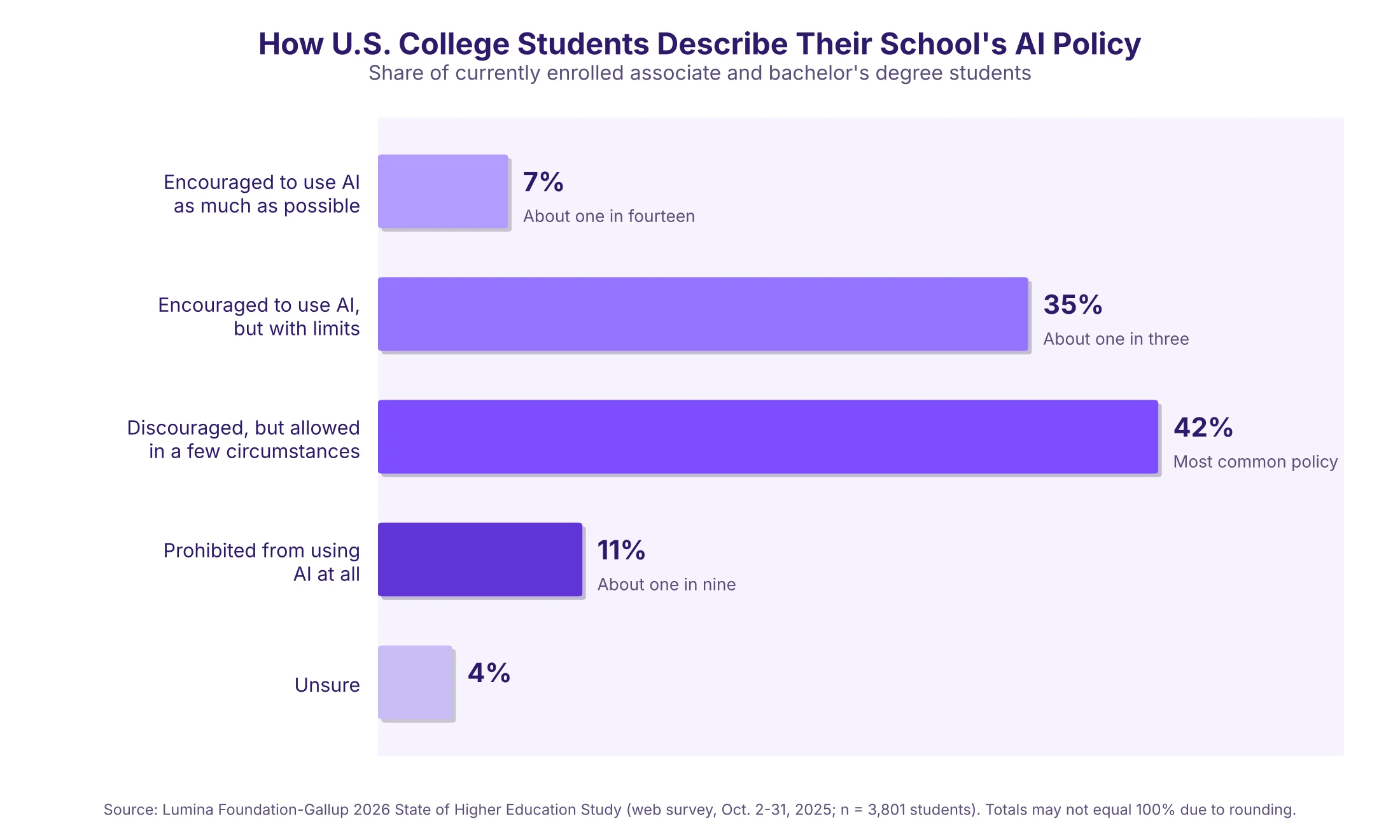
Heavy AI use hasn't made students want less human help. Fewer than one in five Gen Zers would choose AI over a human for tutoring, financial advice or customer service, and most prefer a human for those tasks, according to the Walton-GSV-Gallup findings.
Students Are Already Deciding
Many campuses are still debating how much AI to allow, but students have already started voting with their enrollment choices. And for all their chatbot use, what they keep asking for is a person who will sit across the table and help them figure out what comes next.
 Why Students Are Fleeing the Humanities for Job Security
 How Universities Can Defend Against Evolving Cyberattacks
 How Non-Tech Graduates Can Showcase AI Fluency on an Entry-Level Resume
 How Caregiving Shapes Student Success and Career Readiness
 The Status of Higher Ed Accreditation Standards Under New Federal Guidance