Ransomware groups hit colleges hard in the third quarter of 2026. Attacks on higher education nearly doubled, from 24 in the second quarter to 45, while attacks on K-12 schools rose 24%. That gap puts university cybersecurity on the agenda for presidents, provosts, and boards.

Why Ransomware Groups Keep Choosing Colleges
Teaching and research depend on open networks and broad access, and that openness leaves a campus tougher to lock down than a typical corporate office. Quorum Cyber's 2026 outlook tied the constant churn of student and staff accounts to widespread credential theft. It also found ransomware groups taking advantage of decentralized campus IT and timing attacks around the busiest points in the academic year. Research universities also draw state-backed hackers targeting AI, quantum computing, and advanced materials.
Few security teams are staffed for this. More than half of higher education ransomware victims said their teams didn't have the know-how to catch and stop the attack in time, compared with roughly one-third across all sectors, in the Sophos 2026 survey of ransomware in education.
Hiring your way out of that gap is hard when budgets are tight. The 2027 EDUCAUSE Top 10, released this fall, flags resource limits, and EDUCAUSE reports that many campus technology teams lack the budget and staff they need, with burnout a recurring theme.
Some of the exposure sits outside your network entirely. In May, Instructure disclosed that an outside party had broken into its Canvas platform, which serves millions of K-12 and higher education users, and taken user names, email addresses, course names, and internal messages. A student's private note to an instructor about a family emergency or a late tuition bill is exactly the kind of message that sits on a vendor's servers, outside the university's control.
Stolen Logins Drive Most Campus Attacks
Identity attacks, from malicious email and phishing to stolen credentials and brute-force guessing, kicked off 86% of higher education ransomware attacks in the Sophos data. MFA hasn't fixed this. In education attacks that began with stolen credentials, nearly every victim (98%) already had MFA in place, usually push prompts or one-time codes. Of those Sophos asked, 81% had their data encrypted anyway.
Sophos warns that MFA often runs only on the cloud apps that require it, leaving VPN logins, firewall admin consoles, and older applications exposed. The StopRansomware Guide from the Cybersecurity and Infrastructure Security Agency (CISA) goes further: phishing-resistant MFA on every service, starting with email, VPNs, and accounts tied to critical systems, plus a zero trust architecture.
Rolling that out on a campus means winning over people who didn't ask for it. The 2027 EDUCAUSE Top 10 ranks the tension between security rules and user autonomy third, and EDUCAUSE frames the answer as a campus culture where security teams and users talk openly and trust each other.
Federal aid adds a harder edge. Under the FTC's Safeguards Rule text, Title IV schools need MFA on every information system. The only exception is a written sign-off from the institution's Qualified Individual approving controls that are just as strong or stronger.
The Department of Education weighs findings under that rule the same way it weighs any other Title IV compliance problem. If Federal Student Aid decides a school is a substantial security risk, it can shut off that school's access to FSA systems for a period or for good.
Phishing Training Built Around Real Roles
Nearly a third of higher education ransomware attacks in 2026 began with a malicious email, with stolen credentials behind 27% and phishing behind 23%. That makes everyone reading a campus inbox part of the security team.
A department coordinator gets an email that looks like it came from a faculty member, asking to update direct-deposit details before payroll closes. It reads like routine paperwork.
EDUCAUSE's research leadership names individual users as one of a campus's weakest points and argues for preparing people to make sound judgment calls on their own. Training tailored to each role's data, plus a one-click way to report suspicious messages, lets the security team block a sender before the email reaches the next office.
Segmentation on an Open Campus
A campus can't be sealed like a bank. One university information security head told Quorum Cyber that open collaboration is core to academic life, so universities can't seal off their systems the way some industries do.
Segmentation tops Sophos's recommended actions for education, paired with zero trust network access in place of legacy VPNs. On a flat network, a compromised residence hall laptop sits a few steps from payroll and the student information system. When attacks started with an exploited flaw, stolen credentials, or brute force, education victims traced them to:
Exposed applications and systems: 40%
User devices: 34%
Firewalls: 20%
Separate zones for residence halls, research labs, clinics, building controls, and guest Wi-Fi limit how far an intruder can move.
Patching Gains That May Not Last
Higher education cut exploited vulnerabilities from 35% of ransomware root causes in 2025 to 13% in 2026. Sophos expects that share to climb again as frontier AI tools turn up flaws faster than IT teams can fix them.
Every campus has a version of the same blind spot: an adjunct running a years-old lab server under a desk that central IT doesn't know exists. Unknown security gaps played a part in 38% of higher education attacks in the Sophos survey. For the systems IT can see, CISA's catalog of known exploited vulnerabilities offers a shared list for ranking which patches come first.
Firewalls caught 65% of education attacks before the ransomware ran. In 51% of those early catches, data was encrypted anyway, often because the firewall couldn't confirm the threat without input from other security tools. Sophos's fix list: patch internet-facing devices on a tight schedule, expose fewer admin logins and user portals to the internet, and plug firewall data into round-the-clock detection and response.
Backups, Drills, and Rising Recovery Costs
Many ransomware strains hunt for backups so they can delete or encrypt them, CISA's guide warns. Its answer is offline, encrypted copies of critical data, tested regularly in a recovery scenario. Colleges lean on those copies more than they did a year ago, yet recovery still costs more.
Higher education ransomware | 2025 | 2026 |
|---|---|---|
Restored data from backups | 47% | 69% |
Paid ransom and got data back | 54% | 51% |
Median ransom demand | $697,086 | $889,200 |
Average recovery cost, ransom excluded | $0.90 million | $1.99 million |
Source: Sophos, The State of Ransomware in Education 2026.
Recovery costs more than doubled in a single year. A quarter of higher education victims needed one to three months to fully recover, against 14% across all sectors.
Those months bring decisions only senior leaders can make: closures, notifications, and ransom payments. The Safeguards Rule requires a written incident response plan that spells out roles and decision-making authority, and tabletop drills with the president, provost, general counsel, and communications staff are where that authority gets tested. Title IV schools also report breaches to Federal Student Aid through the intake form on its FSA cybersecurity page.
The fallout lands on leadership too. After an attack, 53% of higher education IT teams reported more pressure from senior leaders, and 29% saw their team's leadership replaced.
AI Tools Need Data Rules
Readiness for AI-driven attacks trails expectations. In LevelBlue's 2026 research on US state and local government and higher education, 45% of executives expected AI-powered attacks but only 28% felt prepared, and nearly half saw a much higher volume of attacks than a year earlier.
The internal risk is quieter. A grant administrator racing a deadline pastes an unpublished proposal, budget figures and collaborator names included, into a free public chatbot to tighten the narrative. That research now sits outside the institution's control. EDUCAUSE's 2027 list ranks designing AI structures for responsible innovation fourth.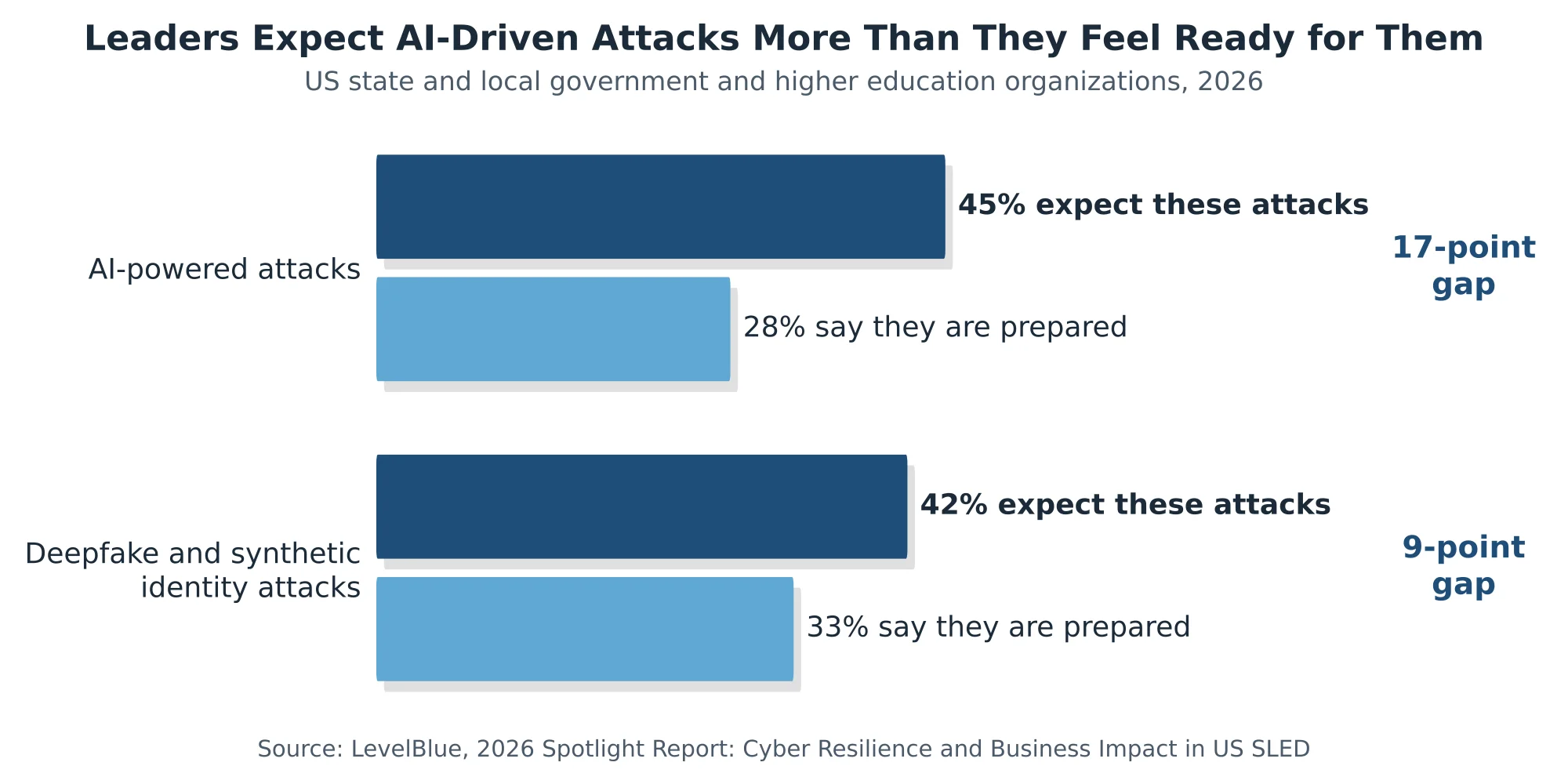
Federal guidance is still catching up. The National Institute of Standards and Technology (NIST) released a preliminary draft of its Cyber AI Profile in December 2025, adapting the Cybersecurity Framework 2.0 to AI, and is now revising its AI risk framework.
A three-tier policy puts that guidance to work: public content at the bottom, internal documents without personal data in the middle, and student records, aid data, research, and admissions decisions at the top, limited to approved tools.
What Boards Should See Each Year
For Title IV schools, board oversight of security is already a federal requirement. The Safeguards Rule calls for a written information security program, a Qualified Individual to run it, and a written report to the board at least once a year covering risk decisions, vendor arrangements, test results, and security events. NIST's Cybersecurity Framework 2.0 gives that report a structure through its Govern function, which covers organizational context, risk strategy, roles, policy, oversight, and supply chain risk.
What to Bring to the Next Board Meeting
A CIO or provost can bring three agenda items the board can track:
Every system where logins still skip phishing-resistant MFA, starting with email, VPNs, and financial aid systems
The date and result of the last full restore from offline backups
The approved AI tools for each tier of campus data
All three feed the annual report the Safeguards Rule already requires. Gaps in any of them are the kind of weakness that can put a school's access to federal aid systems in question.
 How Non-Tech Graduates Can Showcase AI Fluency on an Entry-Level Resume
 How Caregiving Shapes Student Success and Career Readiness
 The Status of Higher Ed Accreditation Standards Under New Federal Guidance
 How Campus Surveillance Affects Students
 4 Strategies Universities Can Use to Elevate International Placement Rates