U.S. colleges awarded 164,847 humanities bachelor's degrees in 2025, the fewest since 1991. The American Academy of Arts and Sciences tracks the humanities enrollment decline through its Humanities Indicators project, and its latest degree report puts the field at 8.1% of all bachelor's degrees awarded that year.

Completion counts reflect choices students made four years earlier, so enrollment data gives the clearer view of what comes next. The academy's September 2026 enrollment data brief, built on National Student Clearinghouse records, counted 398,589 students with a humanities first major in fall 2025. That is just 4.8% of everyone working toward a bachelor's degree. Engineering, including computer science, drew 1,223,577.
Debt and Job Fears Outrun the Labor Data
Among student loan borrowers, 82% are moderately or very worried about struggling to repay, according to the Lumina Foundation and Gallup 2026 State of Higher Education study. More than half of borrowers, 52%, say their debt has delayed at least one major life event, and the share rises to 67% for Gen Z borrowers.
Public trust is slipping alongside those worries. A Gallup survey conducted in June 2026 found that 38% of U.S. adults have a great deal or quite a lot of confidence in higher education, down from 42% in 2025. Among people who lack confidence, 30% named cost as the reason, the Gallup confidence poll reported. Recent federal student loan changes add to the pressure on families to justify every major in financial terms.
Humanities fields absorb much of that pressure because their career paths are harder to name. The author of the academy's report told Inside Higher Ed that many students have trouble naming a humanities career beyond teaching. As tuition climbs, a major with a clearly defined career path becomes the more attractive bet.
The labor data is more mixed than those fears suggest. Unemployment for bachelor's holders ages 22 to 27 fell to 5.2% in the third quarter of 2026, its lowest level in more than a year, while underemployment ticked up to 42.5%, according to the Federal Reserve Bank of New York's recent graduate tracker. The bank's outcomes-by-major table, based on 2024 Census data and updated in February 2026, shows that majors often treated as the safe choice don't always post the lowest unemployment.
Major | Unemployment | Underemployment | Early career median pay | Mid-career median pay |
|---|---|---|---|---|
Philosophy | 5.1% | 47.1% | $52,000 | $80,000 |
Computer science | 7.0% | 19.1% | $87,000 | $120,000 |
Computer engineering | 7.8% | 15.8% | $90,000 | $131,000 |
Philosophy graduates find work at a higher rate than computer science graduates, yet they start at roughly $35,000 less and nearly half work in jobs that don't need a degree. More than half eventually earn a graduate degree, and their median pay reaches $80,000 by mid-career. Unemployment, starting pay, and graduate study each tell part of the story, and the same trade-offs come up in discussions of college major regret.
Communication, English, and Religion Shrink the Fastest
Business, engineering, the natural sciences, and health fields all reached their highest enrollment levels of the past 11 years after the pandemic, while humanities majors kept falling. The academy's research ties the slide to worries about employability, high-stakes standardized testing in humanities subjects, and fading interest in teaching careers. Reading plays a part too: the academy links students' discomfort with long-form text partly to short-form social media habits, and it suggests making reading skills part of required introductory courses.
Fall 2025 Clearinghouse figures show where the losses have concentrated:
Communication had 127,279 enrolled majors and posted the biggest drop in raw numbers of any humanities field.
English language and literature had 92,329, with the second largest raw decline.
Religion had 6,603 majors, after holding near 6,700 for three straight years.
Cultural, ethnic, and gender studies fell sharply after 2023.
Philosophy grew in both 2024 and 2025.
The humanistic study of the arts, which covers fields like art history and film, grew almost every year through 2024 before dipping slightly in 2025.
State enrollment rules add pressure on programs with few graduates. Indiana requires a bachelor's program to produce an average of 15 graduates a year over three years or seek state approval to continue. Ohio sets its bar at an average of five degrees a year.
Completions Steady as Enrolled Majors Keep Falling
Humanities degrees dropped 2.1% from 2023 to 2024 and only 0.4% from 2024 to 2025, the smallest yearly decline in more than a decade.
Enrolled majors tell a different story. Since fall 2020, the number of humanities majors has fallen an average of 3.8% a year, even as most other fields that dipped during the pandemic recovered. The academy expects degree completions to decline again as these smaller groups of majors move toward graduation.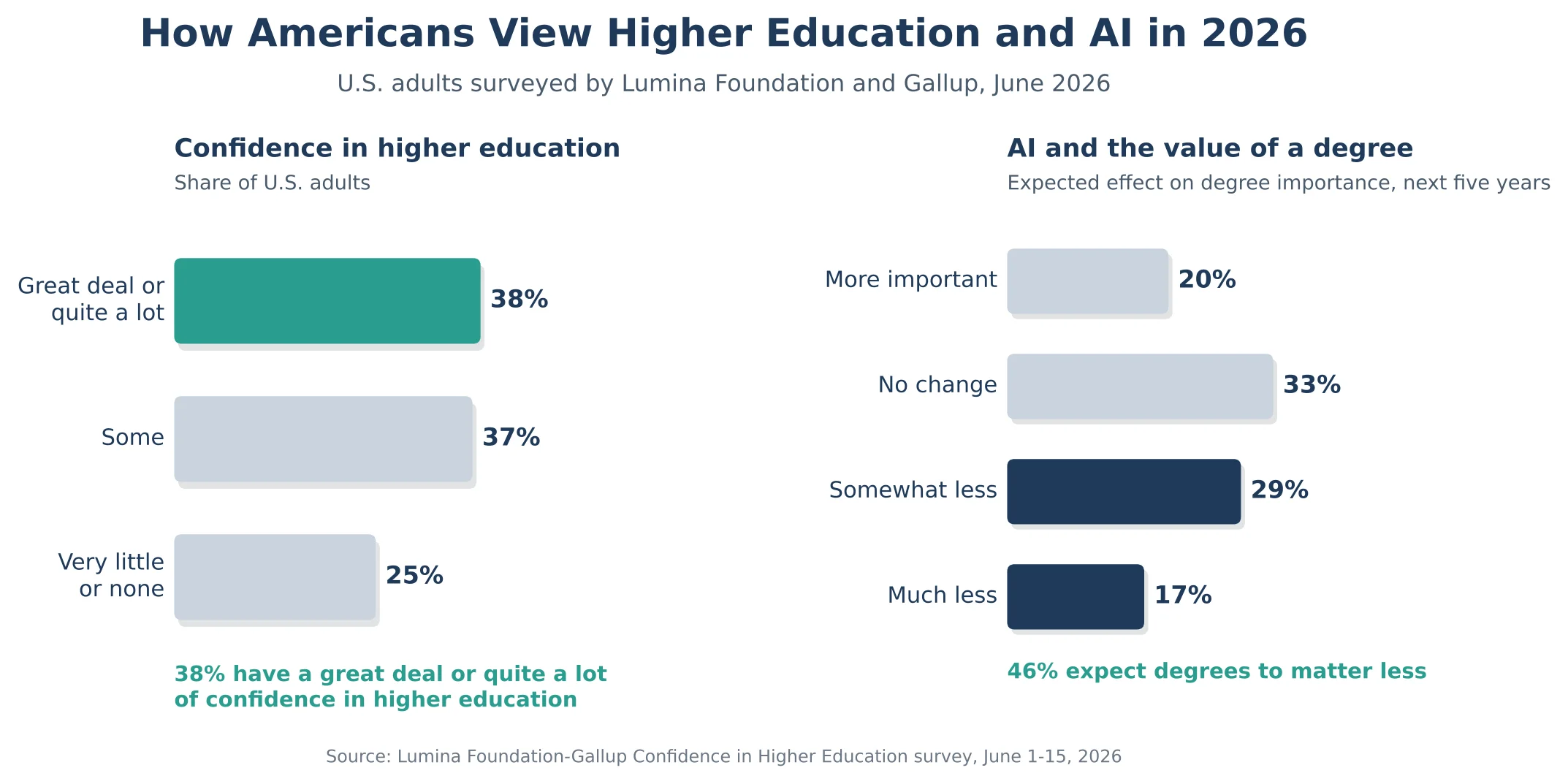
AI is now part of how students choose. In a Lumina Foundation and Gallup survey fielded in October 2025, 42% of bachelor's degree students said AI had led them to give at least a fair amount of thought to changing majors, and 13% had already switched because of it, the Gallup AI survey found. The academy argues that humanities training in fact-checking and clear writing helps catch and correct the shortcomings of AI-generated work, while conceding that getting people to recognize that value is the hard part.
The public isn't convinced yet. Gallup's June 2026 polling found that 46% of U.S. adults expect AI to make college degrees less important over the next five years, compared with 20% who expect degrees to matter more. Clearinghouse data still shows humanities enrollment falling overall in 2025, with philosophy as the clearest exception, so institutions planning around AI in higher education have skills demand on their side but not enrollment momentum.
Earnings Tests and State Laws Force Program Cuts
The One Big Beautiful Bill Act requires undergraduate degree programs to produce median earnings above those of working adults ages 25 to 34 with only a high school diploma. Graduate programs are measured against adults with only a bachelor's degree. A program that fails two out of three years loses access to federal Direct Loans.
The U.S. Department of Education's own analysis projects that programs enrolling less than 1% of bachelor's students will fail the test, as The Institute for College Access and Success notes in its final rule analysis. Under the statute, the first programs could lose loan eligibility in 2028, with a one-year delay for certain fields that rely on tipped income. Graduate programs face a higher bar because their benchmark is bachelor's degree earnings.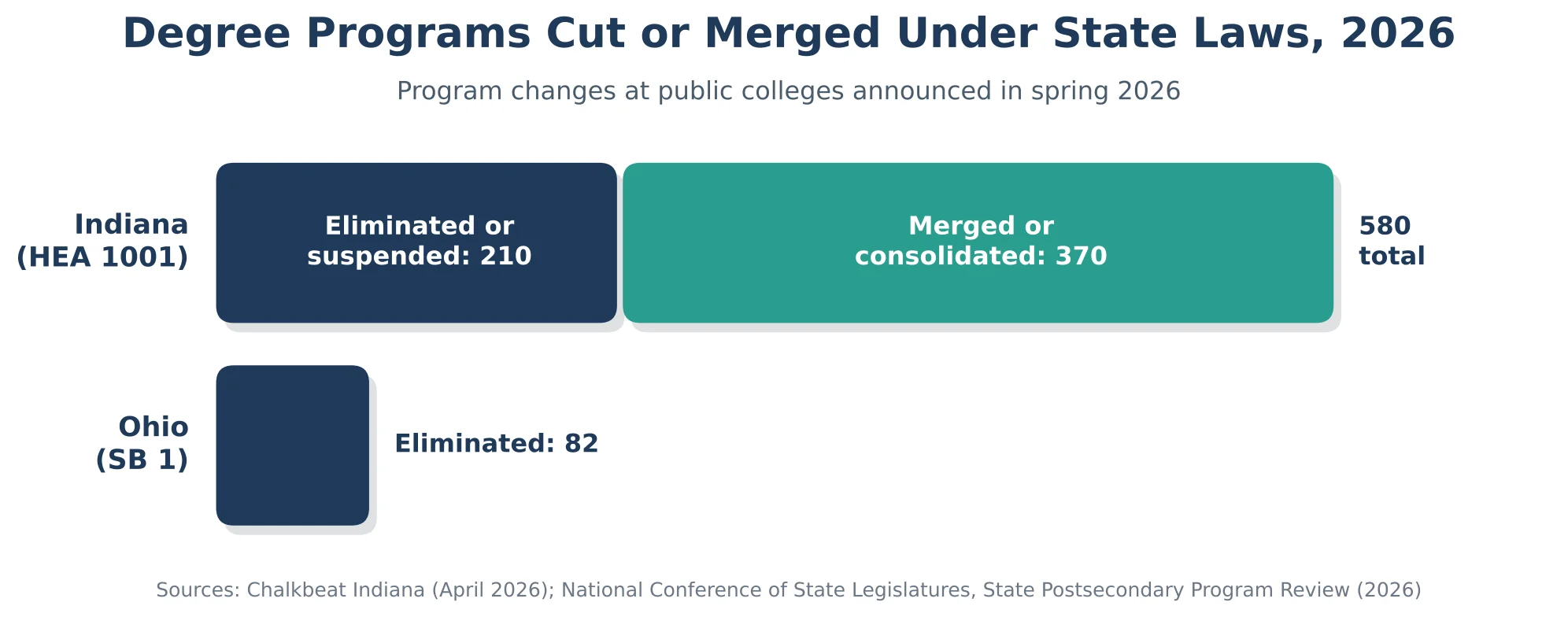
State legislatures have moved faster than federal regulators:
Indiana's public colleges will eliminate or suspend 210 degree programs and merge or consolidate 370 more under HEA 1001. The programs targeted for suspension or elimination enroll just 0.6% of the state's students, Chalkbeat reported in April.
Indiana's SB 199 requires Commission for Higher Education approval to continue any program flagged as low earning. The state expects the federal list of those programs in 2027.
Ohio's SB 1 review led to 82 program eliminations announced in spring 2026, several of them in the humanities.
At least nine states considered bills in 2026 that would cut state funding for low-earning programs.
The National Conference of State Legislatures follows these measures in its program review tracker. The academy's report author has warned that a program is very hard to restore once it's cut, so a short enrollment slump can turn into a permanent loss.
Small Humanities Programs Face the Tightest Deadline
Humanities completions have steadied, but the academy expects them to drop again as today's smaller groups of majors graduate. Programs with few graduates now face state enrollment minimums, federal earnings tests, and falling demand at the same time. Reviewing declared majors by discipline now leaves room to weigh mergers or redesigns before those rules force the decision.
 How Universities Can Defend Against Evolving Cyberattacks
 How Non-Tech Graduates Can Showcase AI Fluency on an Entry-Level Resume
 How Caregiving Shapes Student Success and Career Readiness
 The Status of Higher Ed Accreditation Standards Under New Federal Guidance
 How Campus Surveillance Affects Students