

Most STEM graduates are sitting on more career options than they realize. If you're trying to figure out what to do with a STEM major, the honest answer is: the field is wide open. Modern STEM careers span software, engineering, data science, healthcare, research, and plenty of cross-functional roles that don't fit neatly into a single box.
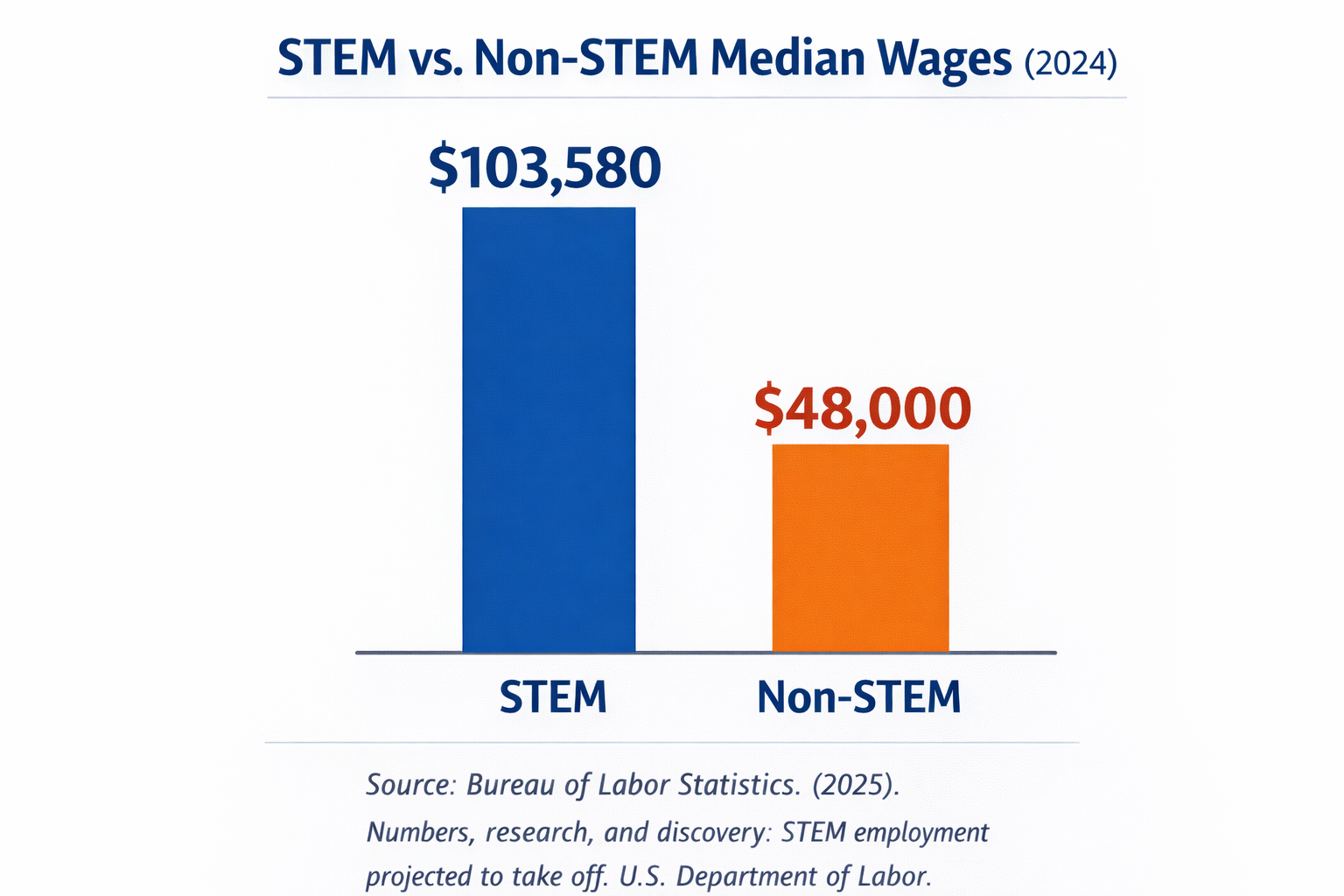
The financial incentive is clear. According to recent Bureau of Labor Statistics data, the median wage for STEM occupations sits at $103,580, more than double the $48,000 median for non-STEM jobs. That earnings gap is hard to ignore.
Below, I'll walk you through what the job market actually looks like, where the highest earning potential sits, how AI is reshaping entry-level roles, and how to map out your smartest next move.
Career Options by STEM Discipline
STEM careers generally cluster into four broad technical areas. Here's how they break down in practice.
1. Technology and Computing
Tech roles continue to drive the lion's share of STEM job growth. Software development roles alone are projected to grow 15% through 2034, far outpacing the national average for all occupations.
Role | Median Salary | Projected Growth | Core Responsibility |
|---|---|---|---|
IT Manager | $171,200 | 15% | Oversee technology infrastructure and tech operations. |
Software Developer | $133,080 | 15% | Build, test, and maintain applications and platforms. |
Information Security Analyst | $124,910 | 29% | Protect systems, networks, and data from cyber threats. |
Data Scientist | $112,590 | 34% | Analyze complex datasets to guide business strategy. |
Other notable roles: Database administrators, network architects, and cloud engineers.
One computer science graduate secured three job offers before graduation. She chose a mid-size company over a big tech firm to get hands-on code ownership faster. Two years in, she's already leading her own small software engineering team.
2. Engineering Fields
Engineering delivers some of the strongest early-career wages and lowest unemployment rates in the country. According to the NY Fed, engineering majors command starting salaries between $70,000 and $80,000 right out of school.
Discipline | Median Salary | Core Focus |
|---|---|---|
$134,830 | Design, test, and manufacture aircraft, spacecraft, or advanced hardware systems. | |
$111,910 | Develop electrical components, circuits, and large-scale power grids. | |
$102,320 | Design and build physical systems, from medical robotics to automotive engines. | |
$99,590 | Plan, build, and oversee infrastructure like bridges, roads, and water networks. |
Census Bureau data shows that roughly 51% to 52% of engineering and computer science majors stay in STEM occupations long-term, the highest retention rate among all STEM disciplines.
3. Healthcare and Life Sciences
Life science fields frequently require advanced degrees to reach executive tracks, but the clinical, research, and commercial payoffs are substantial.
Role | Median Salary / Outlook | Core Focus |
|---|---|---|
Head of Clinical Operations | $200,000+ | Senior leadership overseeing clinical drug trial pipelines. |
Biotech / Pharma Researcher | $102,380 | Conduct R&D for therapeutics, gene therapy, or medical devices. |
$83,980 (16% growth) | Analyze disease patterns, public health data, and preventative policy. |
Take someone who finished a biology degree with no interest in medical school. She stepped into an entry-level role in clinical trial coordination. By learning the operational side of pharmaceuticals from the ground up, she moved into clinical operations management at a fast-growing biotech firm within four years, crossing the six-figure mark without ever going back to graduate school.
Note: Pre-med students with biology or chemistry degrees are often counted as "leaving STEM" when they become physicians. In reality, they apply deep STEM training daily in clinical medicine.
4. Pure Sciences and Mathematics
These fields suit analytical thinkers aiming for deep research, academia, or high-level risk modeling. Many roles reward early planning for specialized graduate programs.
Role | Median Salary | Employment Outlook |
|---|---|---|
Physicist / Astronomer | $152,430 | High-level analytical and computational research; typically requires a Ph.D. |
$125,770 | 22% projected growth; analyze and manage financial risk for insurance and investment firms. | |
Mathematician / Statistician | $104,860 | High demand for data modeling roles in tech, aerospace, and government. |
Environmental Scientist | $78,980 | Advise on sustainability, climate modeling, conservation, or environmental compliance. |
The Highest-Paying STEM Jobs
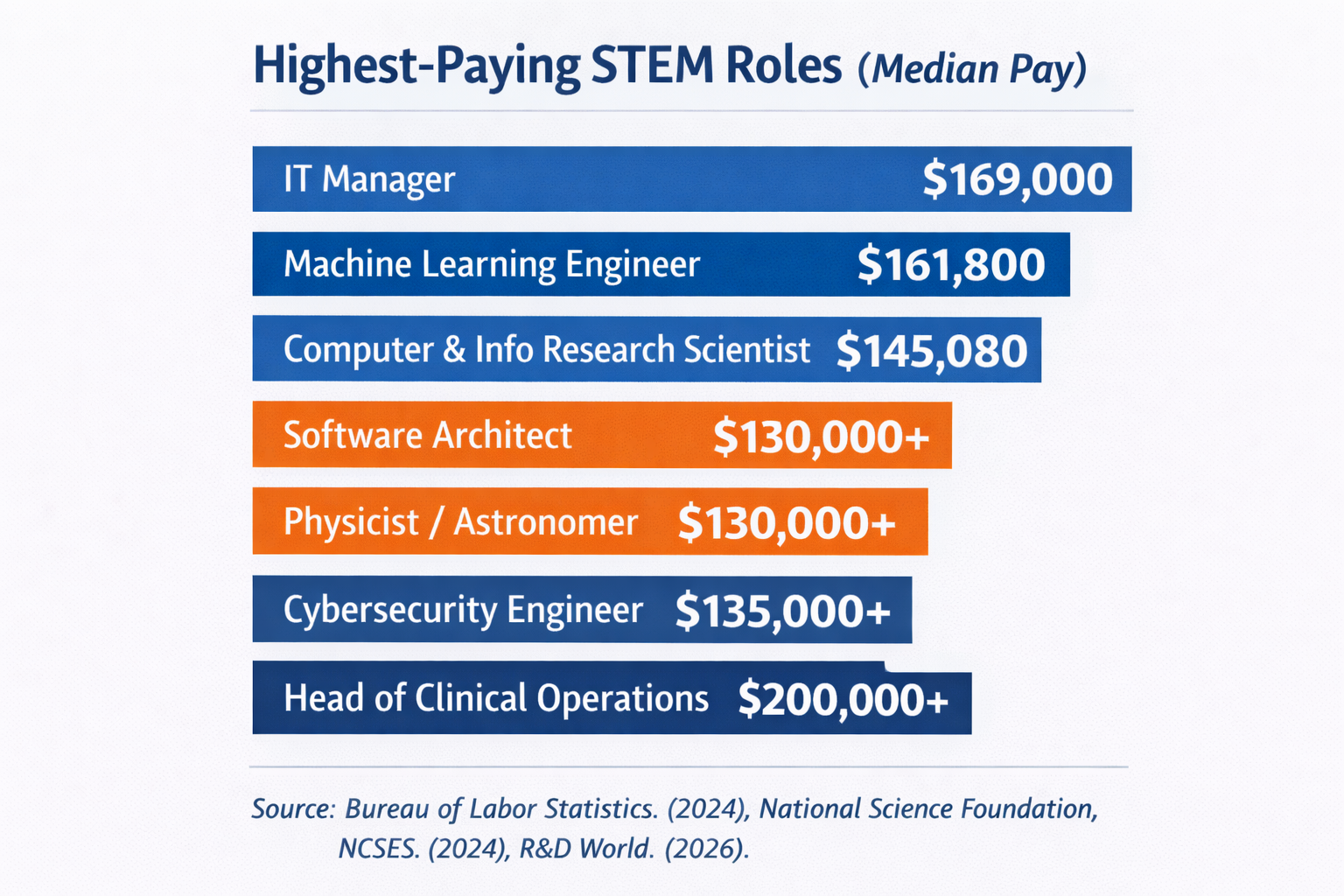
If financial return is your primary career driver, the top-earning roles span tech management, AI infrastructure, and advanced data architecture. Here's where the highest earnings ceilings sit:
Role | Median Salary | Projected Growth / Market Context |
|---|---|---|
Head of Clinical Operations | $200,000+ | Requires significant clinical industry tenure and pipeline management experience. |
$171,200 | Strong 15% projected growth through 2034 as businesses modernize infrastructure. | |
Machine Learning Engineer | $160,000+ | High demand across tech, logistics, and automation platforms. |
$140,910 | 20% projected growth for researchers pushing technological breakthroughs. | |
$133,080 | 15% projected growth; consistently ranks among the best overall career paths. | |
$124,910 | 29% growth, driven by shifting cloud environments and evolving cyber threats. | |
$112,590 | 34% projected growth, the fastest-growing job profile on this list. |
A quick note on geography: Location shifts these numbers significantly. States like California, Washington, Massachusetts, and New York lead in raw average STEM salaries, but also carry high living costs. Always weigh local purchasing power and net income, not just gross salary figures.
The baseline floor across the industry is stable: roughly 90 out of 100 STEM jobs pay comfortably above the national median wage.
What About AI and Automation?
This is the question on every computer science, tech, and mathematics student's mind right now, and it's a fair one. Generative AI tools are actively shifting what entry-level tasks look like, particularly in standard software coding, basic QA, and entry-level data work.
The realistic take: AI is replacing repetitive technical tasks, not complete jobs. What it is doing is raising the expectations floor for junior hires. You won't be competing against AI tools; you'll be expected to use them to double your output from day one.
Here's what that looks like in practice. An AI can write a working block of code in seconds. What it can't do is audit that code against a sprawling enterprise architecture, identify where it breaks at scale, or explain the tradeoffs to a non-technical stakeholder. Those are the skills that make a junior hire worth keeping. The roles and skills most insulated from automation are those grounded in human judgment:
Complex architecture design: Knowing how systems connect, scale, and stay secure.
Cross-functional alignment: Translating vague business problems into clear technical logic.
Risk and governance management: Making sure automated outputs meet regulatory or security standards.
Stakeholder discovery: Figuring out what clients actually need, not just what they say they want.
Treat AI fluency as a baseline requirement, and put your energy into systems thinking and cross-functional communication. That's what separates a replaceable task-runner from a genuinely valuable engineer.
Is a STEM Major Worth It?
The short answer is yes. But a balanced look requires weighing both sides.
The Upside
STEM jobs are projected to grow 8.1% through 2034, compared to just 3% for all other occupations. Long-term demand is concentrated in cybersecurity, data systems, and AI-related infrastructure.
STEM skills also transfer well into business. Data from the Economic Innovation Group shows that 36% of STEM majors working in non-STEM roles earn more than those who stay in purely technical positions. Your quantitative training holds real value on Wall Street, in consulting, and in corporate strategy.
The Catch
Research from Harvard shows that while STEM majors enjoy a strong wage advantage in their 20s, that gap tends to narrow over time. Non-STEM peers often close the salary distance within a decade as they move into broader management roles.
Technical skills also carry a fast depreciation rate. The coding languages and tools you master in college could be outdated in five years. Committing to a STEM career means committing to continuous upskilling through certifications, employer training, or ongoing self-learning.
Work vs. Graduate School vs. Certifications
This is the classic decision most upperclassmen struggle with. Here's a practical framework to guide your choice.
Option 1: Go Straight to Work If...
Your target field prioritizes execution over credentials: Web development, cloud support, network infrastructure, and data analysis value portfolio work above all.
You need immediate financial freedom: Entering the market stops student loans from compounding and starts your retirement savings earlier.
You want corporate tuition sponsorship: Many employers offer tuition reimbursement, effectively paying for your graduate degree while you earn a full salary.
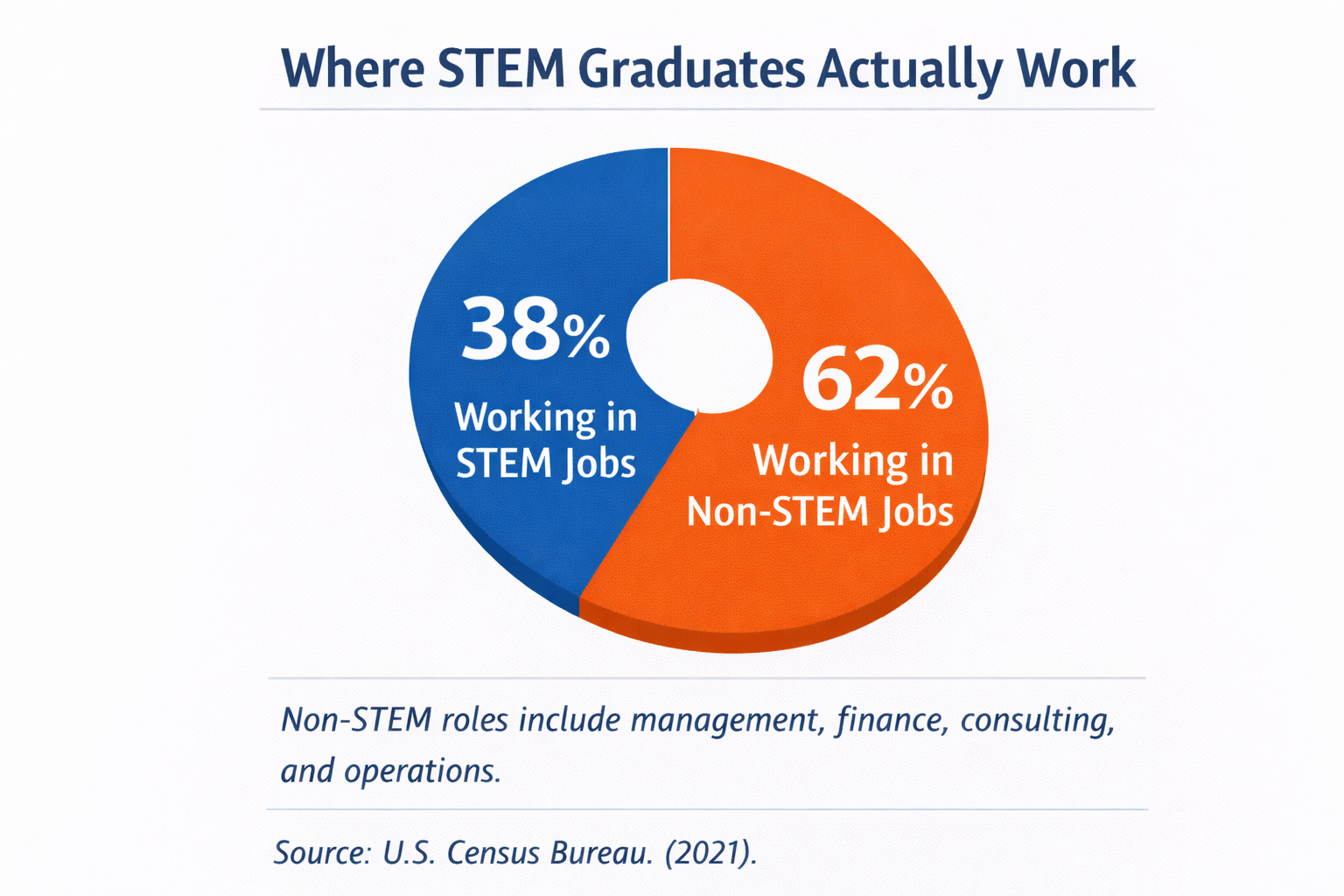
Census Bureau data shows roughly 62% of STEM degree holders end up working in non-STEM environments like management, venture capital, or operations. Starting early gives you maximum room to experiment and pivot.
Option 2: Graduate School Makes Sense If...
Your career path requires it: Deep research, academia, and medical innovation tracks need specific postgraduate credentials.
You're in a specialized scientific field: Biotechnology, astrophysics, quantum computing, and materials science reward advanced theoretical training.
You want a higher long-term ceiling: The NSF confirms that STEM professionals with graduate degrees earn an average of $24,000 more annually than peers with only a bachelor's degree.
If a top MBA or leadership role is your goal, remember that elite business programs favor applicants with 3 to 5 years of real-world experience first.
Here's a good example of timing it right: a chemistry graduate spent two years in manufacturing quality control to understand real industrial friction. He then used his company's partial tuition assistance to complete a master's in materials science. He moved into a high-level R&D role within a year, minimizing debt while maximizing his market value.
Option 3: Certifications Add the Best Value When...
You're making a targeted pivot within tech: For example, shifting an IT degree into a cloud architecture role via an AWS or Azure Solutions Architect credential.
You need a rapid skill injection: Certifications let you refresh your resume in months without a two-year tuition bill.
Your field respects vendor standards: In cybersecurity and project management, credentials like CISSP, AWS, or PMP carry real weight with recruiters.
Finding Your Personal Career Alignment
There's no single "perfect" STEM career path. It depends on what you're trying to solve for:
Maximizing early compensation: Target machine learning engineering, enterprise data architecture, or algorithmic finance.
Long-term job security: Look toward cloud cybersecurity, healthcare data systems, or public infrastructure engineering.
Cutting-edge discovery: Commit early to a specialized Ph.D. program aimed at corporate R&D, clean-energy labs, or academia.
Location flexibility: Focus on backend software engineering, cloud computing, or statistical modeling, which have strong remote-work setups.
Geographic hubs: Position your search around Boston, the San Francisco Bay Area, Austin, or Seattle.
How to Strategically Position Yourself Right Now

Prioritize practical proof over GPA. Co-ops, internships, and open-source contributions matter. A verified GitHub portfolio or engineering prototype frequently beats a perfect 4.0 in a competitive hiring market.
Master AI tool co-piloting. Become proficient with developer assistants, automated testing modules, and data cleaning scripts. Show recruiters you know how to build fast with modern tools.
Proactively fight skill depreciation. Step outside your department curriculum. Take technical business electives, learn cloud orchestration, and track industry trends daily.
Secure pipeline connections early. Large employers source entry-level cohorts through targeted pipelines. Engage with technical associations, niche career fairs, and industry conferences.
Mine real job board data. Requirements vary wildly by sector. Audit active job descriptions on LinkedIn, Indeed, and Dice to map out which frameworks and credentials employers actually ask for today.
Do informational interviews. Talking directly with working engineers or analysts gives you unvarnished truth that job descriptions leave out. Ask about daily friction, workplace culture, and what they'd do differently if they started over.
Wrapping It Up
Holding a STEM degree puts you in a strong starting position. With median wages doubling the national average, fast market growth, and analytical skills that transfer into corporate leadership, you have real leverage. Your first entry-level role is just a launchpad; it doesn't lock you into a rigid path forever.
If you're evaluating international options, assessing degrees from abroad, or planning a global career move, Scholaro's evaluation tools can help you translate your academic credentials into recognized qualifications for the U.S. job market.
 How Universities Are Adapting Health Programs to a Moderating Job Market
 How Flexible Are PhDs in a Changing Job Market
 Understanding the Decline of International Enrollment in American Universities
 Why AI Writing Polish Can Flatten Student Expression
 Connecting International Talent to Inclusive Careers