
Federal work colleges are a small group of schools where every student living on campus has to work as part of earning a degree. There are only ten of them nationwide under current federal rules, and the setup can cut your tuition bill sharply or wipe it out entirely. If you want a low-debt path through college and don't mind a required job on top of your classes, this model is worth a close look. Here's what you need to know before you apply.
Before you go further, here's a quick look at each school that currently or recently held the federal designation.
College | State | Typical Work Requirement | Status |
|---|---|---|---|
Alice Lloyd College | Kentucky | 10 hours a week | Active |
Antioch College | Ohio | Set by program | Active, designated 2024 |
Berea College | Kentucky | 10 hours a week minimum | Active |
Blackburn College | Illinois | Set by program | Active |
College of the Ozarks | Missouri | Set by program | Active |
Ecclesia College | Arkansas | Set by program | Active |
Kuyper College | Michigan | Set by program | Active |
Paul Quinn College | Texas | Set by program | Active |
Sterling College | Vermont | Was set by program | Closed after spring 2026 |
Warren Wilson College | North Carolina | Set by program | Active |
Important note on availability: Sterling College ended its degree programs after the spring 2026 semester due to enrollment and budget pressure. This brings the number of operating federal work colleges down to nine, even though ten schools legally hold the federal designation. Check each school's site directly for the most current updates.
What Actually Makes a School a "Work College"
A federal work college isn't only a school with part-time campus jobs on the side. Its legal basis sits in Section 448 federal statute, part of the Higher Education Act.
To hold this designation, a school has to operate as a public or private nonprofit, four-year, degree-granting institution with a stated commitment to community service, under the oversight of the U.S. Department of Education.
Beyond that, a school has to enforce this framework:
Universal mandate: the school must run a comprehensive work-learning-service program that covers every student living on campus, plus at least half of all full-time students overall
No exceptions by major or need: jobs are required regardless of a student's major or financial background
The work-study difference: unlike optional Federal Work-Study, which is based entirely on financial need, work at these colleges is a mandatory condition of enrollment built into your degree plan from day one
Because this labor-based tuition offset takes a large institutional and financial commitment, the model has stayed small, and some schools with fewer resources have struggled to keep it going.
The Schools and Their Profiles
The nine active work colleges range from roughly 120 to 1,600 students, and they cover a wide range of institutional missions. The roster includes Christian, secular, and outdoor and environmental-focused schools. Paul Quinn College is the only historically Black work college and the only designated work college located west of the Mississippi.
If you're comparing these schools, look closely at their admissions processes. Several use holistic review rather than test-heavy criteria, which opens the door for non-traditional applicants.
What the Work Requirement Looks Like Day to Day
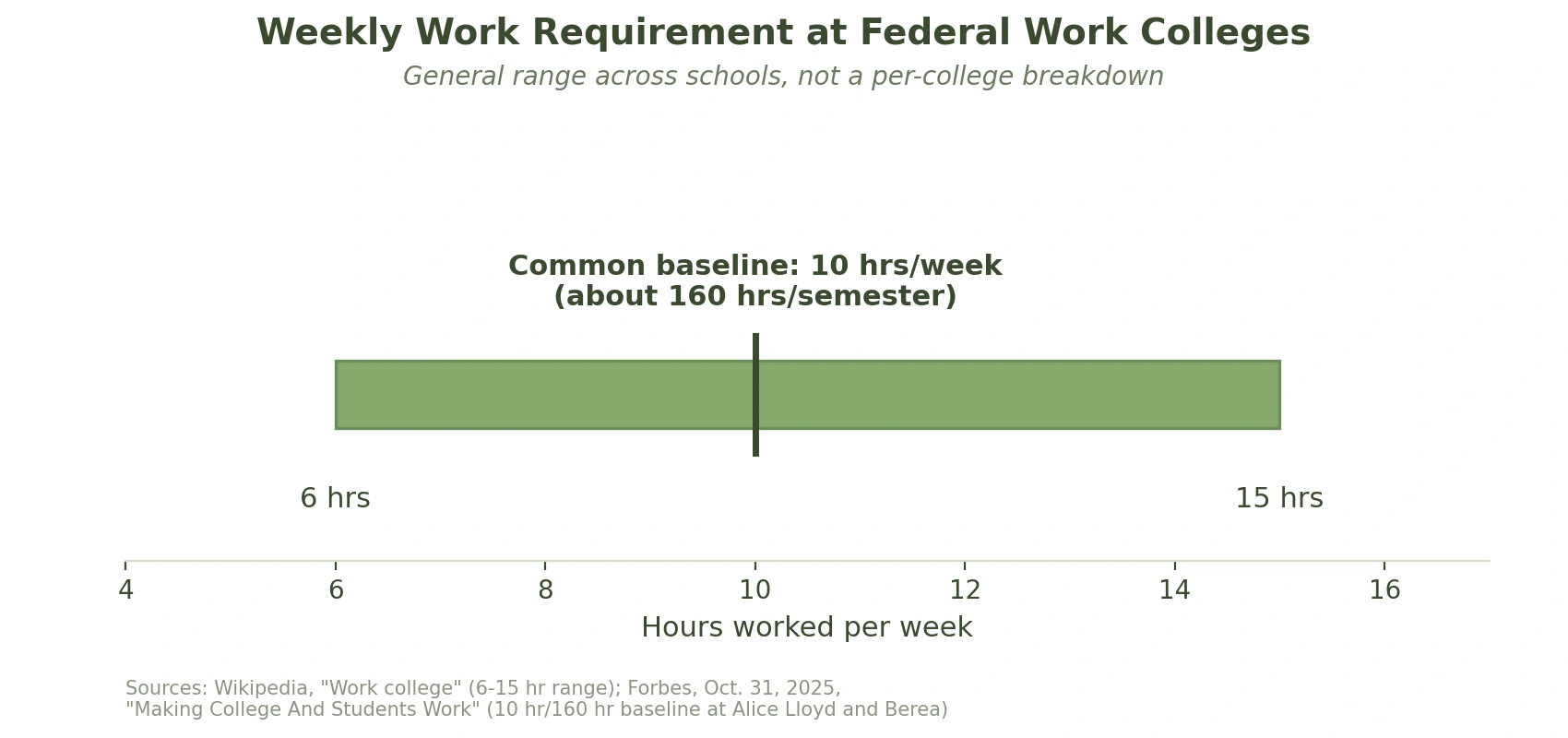
Expect to work somewhere between 6 and 15 hours a week, with 10 hours a week, or about 160 hours a semester, as the common baseline.
Types of campus jobs: work assignments keep the whole campus running, and typically include:
Grounds crew and landscaping
Food service and cafeteria operations
IT support and tech helpdesks
Office administration and academic department assistance
Off-campus community service placements, often tied to your major
Accountability matters: your job is an actual class requirement, not a formality. Students get routine performance evaluations. If you consistently fail to show up or do the work, the school can dismiss you. This differs from a typical part-time student job, where quitting has no bearing on your enrollment.
The financial payoff: the reward varies by school. Berea College covers full tuition for its roughly 1,600 students and is the only work college that pays students directly through a labor scholarship disbursement, on top of the tuition coverage. At Alice Lloyd College, 68% of last year's graduating class left owing nothing.
The Origins: Older Than the Law
The work college model is older than the federal legislation that funds it. Berea College, founded in 1855, is the oldest of the group, predating federal recognition by more than a century. Through the 1900s, several other schools independently built their own work programs.
Formal coordination began in the early 1970s, when these schools started comparing notes. That groundwork helped set the stage for the 1992 reauthorization of the Higher Education Act, which officially established the federal designation and opened up dedicated federal funding.
Today, the Work Colleges Consortium supports member schools with compliance, student outcome research, and shared best practices. Most, though not all, of the designated schools belong to the Consortium.
Is a Work College the Right Fit for You
Graduating with little to no debt is the big draw, but the trade-off asks for a specific mindset.
The pros: real financial relief, four years of guaranteed, resume-building work experience, and a strong sense of campus community
The cons: you give up a good amount of free time. If you want full control over your non-class hours to socialize, join Greek life, or relax, this schedule may feel restrictive
Academic considerations: many work colleges offer a narrower set of majors than large state universities. Confirm the school actually offers your target degree program before you commit to the lifestyle.
What International Students Must Check First
If you're applying from outside the United States, the work requirement adds a layer you need to research directly with each school. On-campus employment rules for F-1 visa holders differ from standard domestic student rules, and a mandatory work-learning-service program has to be structured by the school to stay compliant with U.S. visa regulations.
Disclaimer: this section covers general background only and isn't immigration or legal advice. Contact each college's international student office directly to confirm how their work program applies to your visa status before you apply.
Summary Checklist Before You Apply
Confirm status: double check current enrollment caps and active programs, since only nine of the ten designated schools are currently operating
Compare aid packages: weigh a work college against standard need-blind financial aid offers from conventional universities to see which gives you the better long-term value
Audit the majors: confirm your target school offers the exact degree program you want
Visa verification: if you're an international applicant, clear your F-1 work status with the school's international office first
 How Universities Use Zero-Waste Swap Programs to Cut Student Costs
 How Industry Partnerships Shape Modern Curricula
 How Post-COVID Aid Programs Help Universities Rebuild Admissions
 Beyond the Acceptance Rate and How Colleges Decide Who Gets In
 How Leveraging Job Placement Strategies Can Reenroll Returning Students