

Imagine finishing your bachelor's degree a full year early, with $15,000 less in debt, while your classmates are still grinding through their junior year. That's exactly what the 3-year degree offers and it's no longer an experiment. It's a real, accredited U.S. bachelor's degree option at a growing number of American colleges. But is it right for you? Let's get into it.
What is a 3-year degree?
Feature | 3-Year Degree | Traditional 4-Year |
|---|---|---|
Credits required | 90-96 | 120 |
Tuition savings | ~25% | N/A |
Financial aid eligible | Yes | Yes |
Summers free (some programs) | Yes | Yes |
Grad school-ready | Varies | Generally yes |
A U.S. 3-year degree is a domestic bachelor's program, not a foreign credential, built around 90-96 credits instead of the traditional 120. This is distinct from the 3-year bachelor's degrees common in the UK, Australia, and Europe, which operate under entirely different academic systems. What we're talking about here is a fully accredited American bachelor's degree that simply requires fewer credits to complete.
It gets there by cutting electives and focusing your coursework tightly on your major.
Two versions exist:
The overloaded route: You take extra classes each semester and skip summers to hit 120 credits in three years. Technically possible, but brutal. Think 18-credit semesters every term with zero summers off. Only a small share of students actually pull it off.
The reduced-credit route: A purpose-built 90-96 credit program, designed and accredited specifically for three-year completion. This is the new model gaining serious traction.
One first-year student in JWU's criminal justice program put it simply: "Since I need to do less credits to graduate, I don't really have to take random electives like a lot of other people do. It's also one less year of tuition, which is very helpful."
A new academic model
This isn't schools quietly trimming coursework. It's a structural redesign backed by policy and accreditation.
Indiana's Senate Bill 8 passed unanimously from both chambers, requiring public colleges and universities, except Ivy Tech Community College and Vincennes University, to offer at least one 3-year degree program by July 2025. Utah created an entirely new degree category for programs between 90 and 120 credits. The College-in-3 Exchange, an organization promoting the model, had 59 member institutions by mid-2025.
Consider this: a nursing support student at a Utah public college can now finish a fully accredited Bachelor of Applied Studies in three years, enter the workforce, and start earning while her former classmates are still completing year four. That's the practical reality this policy shift makes possible.
Colleges offering 3-year degree programs
The list is growing fast. Here are the schools currently leading the way:
Johnson & Wales University: Offers 90-96 credit bachelor's programs in Computer Science, Criminal Justice, Graphic Design, and Hospitality Management. Available in person in Providence and online. Students complete 600 hours of work-integrated learning as part of the degree.
BYU-Idaho / Ensign College: Fully online 3-year degrees in Applied Business Management, Information Technology, Communication, Family and Human Services, and Software Development. Offered through BYU-Pathway Worldwide. Total cost runs around $7,200.
Northwood University: Offers a 90-credit Bachelor of Applied Science in Cybersecurity, approved by the Higher Learning Commission. Students can choose the 3-year track or the traditional 120-credit path.
Several other institutions, including Plymouth State University, Merrimack College, and the University of Maine System, have approvals in progress or recently confirmed.
Accreditor acceptance
The biggest roadblock used to be accreditation. That wall has come down.
Most U.S. accrediting agencies have now implemented or clarified their policies to allow colleges to propose degrees with fewer than 120 credits, a significant shift from 2023, when most accreditors were still skeptical. That said, the New England Commission of Higher Education plans to complete a multi-year assessment of learning outcomes for 3-year degrees to evaluate whether they match a traditional four-year bachelor's. Accreditation is there. It's just still being watched.
Faculty pushback
Not everyone is enthusiastic.
Critics argue that reduced-credit programs sacrifice breadth for speed, limiting critical thinking through fewer electives. Faculty worry about a two-tier system emerging, where students from higher-income backgrounds opt for traditional four-year programs complete with internships and clubs, while others get pushed toward a more vocational track.
A first-generation student enrolls in a 3-year business program because it's cheaper and faster. Midway through, she realizes she wants to go into corporate law. But her reduced-credit transcript puts her at a disadvantage with law schools that expect 120 credits. A student from a wealthier background, with the luxury of a traditional four-year degree, doesn't face that same wall. That's exactly the two-tier outcome faculty are worried about.
The 5 most regretted degrees
Here's the honest context for why people are rethinking college in general.
The Federal Reserve's Economic Well-Being of U.S. Households in 2023 report found the most regretted majors among graduates are:
Social and behavioral sciences, 44% regret it
Humanities and arts, 43%
Life sciences, 43%
Law, 41%
Education, 38%
A ZipRecruiter survey of the class of 2025 found that political science, international relations, and public policy topped the list, with 46.3% of those graduates expressing dissatisfaction.
Picture a 2024 political science graduate carrying $42,000 in student debt, working a customer support job that uses nothing from his degree. A 3-year IT degree would have cost less, taken less time, and put him directly on track for the roles he's now trying to break into. The major matters as much as the timeline.
The real benefits
Let's get specific about what you actually gain from a 3-year degree.
Lower tuition. Students in JWU's 3-year programs pay 25% less in tuition while staying eligible for the same financial aid as 4-year students.
One more year of income. Take a cybersecurity graduate from Northwood's 3-year program. He finished at 21, landed a $58,000 entry-level analyst role, and had a full year of work experience before his college roommate even graduated.
Less debt. Less time in school means less borrowed. For a student taking $15,000 in loans per year, finishing a year early means $15,000 less in debt before interest.
Employer acceptance. JWU's chancellor contacted the top 30 employers of graduates in each field and asked whether they'd hire a 3-year degree graduate for the same roles. The answer came back without hesitation: yes.
Real-world experience built in. At JWU, the removed elective coursework is replaced with 600 hours of work-integrated learning, actual jobs, internships, and professional experience.
The drawbacks
DRAWBACK 1
Cramming 120 credits into 3 years on your own
Without a purpose-built program, you're looking at 21-credit semesters and no summers off. Burnout is common and grades suffer.
DRAWBACK 2
Grad school red flags
Many grad programs still require 120 credits. A reduced-credit transcript can close doors. Check requirements before you commit.
DRAWBACK 3
Missing out on the full experience
Clubs, competitions, and campus connections take time to find. One less year means fewer chances for the moments that lead to unexpected opportunities.
Before you sign the enrollment form
Think through these questions honestly before committing:
Do you have a clear career goal that doesn't require grad school?
Are you comfortable with a focused curriculum and no elective flexibility?
Is the school you're looking at offering a proper reduced-credit program, not just a 120-credit load crammed into three years?
Are you okay trading some of the broader college experience for speed and savings?
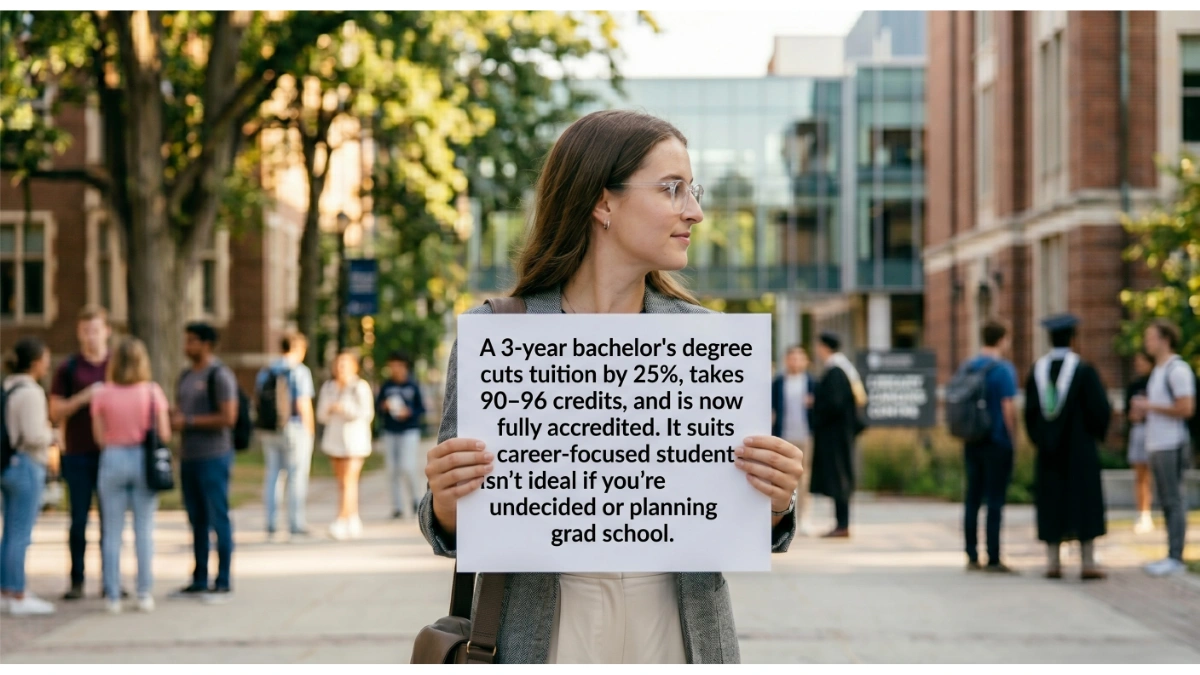
A 3-year degree makes sense if you're career-focused, cost-conscious, and picking a field with solid job market demand, tech, healthcare support, criminal justice, business. It's probably not the right call if you're undecided on your major, planning on a grad school that requires 120 credits, or genuinely want the complete four-year experience.
Run the numbers before you decide
The 3-year degree is real, accredited, and growing. It's cheaper, faster, and for the right student, a smart move. But it's not a shortcut for everyone. A student who finishes a 3-year cybersecurity degree debt-light and employed at 21 made a great call. A student who rushed through a humanities degree and still ended up underemployed just got there faster. Know your career plan, check what grad schools require, and pick your program carefully. One less year of tuition only matters if the degree you walk away with still opens the doors you need.
 How Universities Use Zero-Waste Swap Programs to Cut Student Costs
 How Industry Partnerships Shape Modern Curricula
 How Post-COVID Aid Programs Help Universities Rebuild Admissions
 Beyond the Acceptance Rate and How Colleges Decide Who Gets In
 How Leveraging Job Placement Strategies Can Reenroll Returning Students