
Your paycheck might soon decide if you get to stay in the U.S. and work. Starting with visas processed this spring, the government stopped picking H-1B winners by random draw. Instead, it runs an earnings test, where higher salary offers get better odds. If you are an international student thinking about your future in the U.S., this is one of the biggest changes to hit the visa process in years, and it changes how you should plan your job search right now.
Let me break down what actually changed, who benefits, and what you can do about it.
Current status (as of July 2026): Both the H-1B wage rule and the Duration of Status rule face active court challenges. Immigration policy can shift fast, so talk to your school's international student office or a qualified immigration attorney before you make career decisions based on this article.
What the Earnings Test Actually Does
The U.S. Citizenship and Immigration Services replaced the old random H-1B lottery with a wage-weighted system. The final rule details took effect on February 27, 2026, right before the FY2027 registration window opened in March.
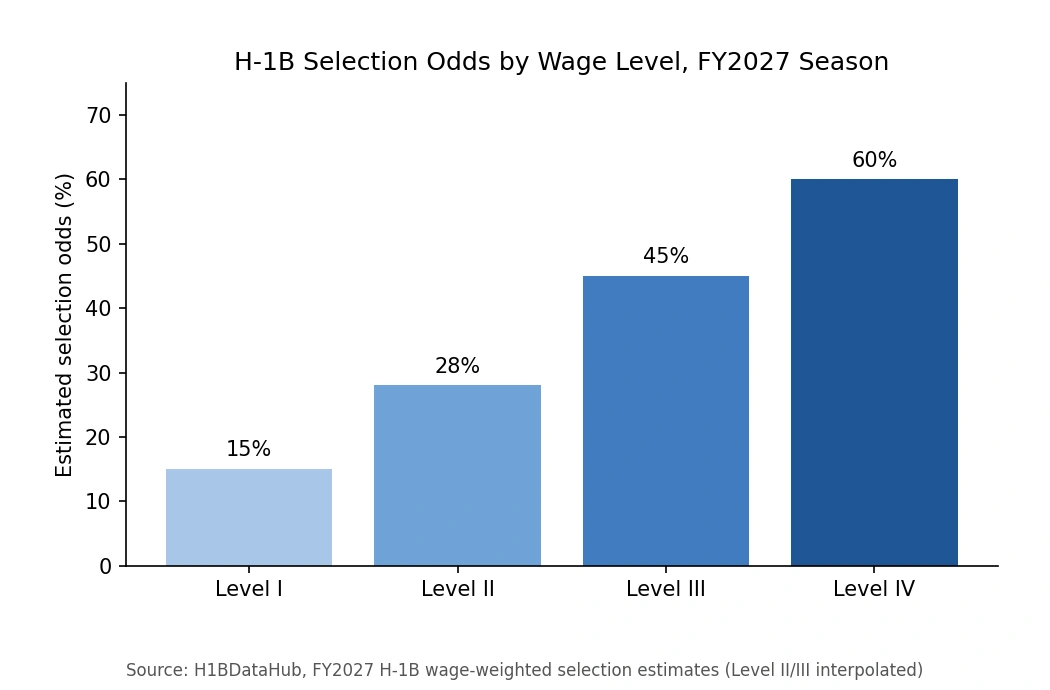
Here is the simple version. Every H-1B job offer gets sorted into one of four wage levels based on Department of Labor pay data for that job and location. The higher your wage level, the more entries you get in the selection pool.
Wage Level | What It Means | Lottery Entries |
|---|---|---|
Level I | Entry-level pay | 1 |
Level II | Qualified, some experience | 2 |
Level III | Experienced, complex duties | 3 |
Level IV | Senior, fully competent | 4 |
So a Level IV job offer gets four shots at selection. A Level I offer gets one. Same lottery, very different odds.
Picture a recent computer science graduate who lands two distinct offers: one entry-level role at a massive corporation, and a specialized machine learning role at a smaller firm that pays more. Under the old system, both offers had the same shot at an H-1B. Under the earnings test, the second offer gives that graduate a much stronger chance.
Why Your Job Offer Matters More Than Ever
This new system does not block anyone based on their field. It simply tilts the odds. If your job offer lands at Level III or IV, you are in a strong position. If it lands at Level I, you are competing for a much smaller slice of the visa pool.
High-Probability Fields (Higher Wage Levels) | At-Risk Fields (Lower Wage Levels) |
|---|---|
AI and machine learning roles | General business and entry-level marketing roles |
Data science and advanced analytics | Junior roles at large staffing or consulting firms |
Cybersecurity and security engineering | Fields with lower average starting pay nationally |
Senior or specialized software engineering | N/A |
None of this means you are stuck if your field pays less. It just means you need to think differently about your job search. Ask about wage level early. Push for roles with more responsibility if you can. Look at smaller or specialized employers who tend to pay above the entry-level bar, since a higher wage level can outweigh company size.
What Happens to Duration of Status
There is a second change worth knowing about, and it lands around the same time. DHS just finalized the duration of status rule, ending the old setup that let you stay enrolled as long as you kept full-time status with no fixed end date. Starting September 15, 2026, you get a fixed admission period instead, capped at four years for most degree programs.
If your program runs longer than that window, you will need to file for an extension instead of just continuing on automatically. This makes timing tighter for everyone, but it especially matters if you are also navigating the new H-1B odds. Miss a deadline on one side, and it can throw off your whole plan on the other.
Who Is Actually Staying, and Who Is Leaving
Here is the bigger picture. Optional Practical Training numbers keep climbing even as new international enrollment slows down. The Open Doors report from the Institute of International Education found OPT participation jumped 21 percent for the 2024 to 2025 academic year, reaching close to 294,000 students, even as new enrollment that same year dipped 7 percent.
The same Open Doors release also included a fall 2025 snapshot survey of hundreds of U.S. colleges, which found new enrollment down 17 percent that fall, with overall international enrollment dipping about 1 percent, driven mostly by fewer new students and a notable drop in graduate enrollment.
Put those two trends together and you get a clearer story. Fewer students are arriving, but the ones already here are staying longer to work. The earnings test adds a new filter on top of that. Landing a spot no longer comes down to your major alone. It comes down to your paycheck clearing the bar.
Take a master's student who spends a full year on OPT building up experience and negotiating a stronger salary before her employer registers her for the H-1B. That extra year of leverage puts her offer at a higher wage level than she would have qualified for straight out of school.
What You Can Do Right Now
A few practical moves make a real difference here.
Ask about wage level during your job search, not after you accept an offer.
Consider a STEM OPT extension to build more experience and negotiating power before H-1B registration.
Look at cap-exempt employers like universities and research institutions, since they are not part of this lottery at all.
Track your program's new fixed admission period so you are not caught off guard once duration of status ends.
None of these guarantee an outcome. But they put you in a stronger position than just hoping for good luck, which is not really an option anymore anyway.
 How Universities Use Zero-Waste Swap Programs to Cut Student Costs
 How Industry Partnerships Shape Modern Curricula
 How Post-COVID Aid Programs Help Universities Rebuild Admissions
 Beyond the Acceptance Rate and How Colleges Decide Who Gets In
 How Leveraging Job Placement Strategies Can Reenroll Returning Students