The international enrollment decline in American universities isn't a forecast anymore. Fall 2026 numbers are coming in, and they confirm what last year's warning signs suggested: fewer international students are showing up on U.S. campuses.
If a student in Nigeria gets into a data science master's program, for example, a strong application isn't enough anymore. A travel ban can block the visa before the first class starts. Multiply that by thousands of students across dozens of countries, and you get the drop colleges are reporting this fall.
Here's what the newest numbers show, what's driving them, and what it costs the U.S.
Fall 2026 Numbers Confirm the Slide
Campus reports are the first hard data for the fall term, and they aren't pretty. A roundup of campus enrollment reports shows public universities across the country losing international students this fall:
One public university system in the West saw international enrollment fall 17.8%, with international grad enrollment down 22.5%.
A large public university in Texas lost more than 1,300 international students, which drove most of its overall enrollment drop.
A 13-campus public system in the Midwest lost 1,732 students overall. About 1,100 of them were international students.
A Midwest flagship saw enrollment from China fall 20.7%, even as its total enrollment grew.
National numbers will take longer. IIE's Fall 2026 Snapshot is due later this fall, and federal visa data hasn't caught up yet. Until then, the best national estimate comes from NAFSA: Association of International Educators and JB International, which project up to 111,000 fewer international students this fall, a drop of about 9.5%.
Here's how the latest figures stack up:
Metric | Figure | Source |
|---|---|---|
Projected enrollment loss, fall 2026 | Up to 111,000 students (about 9.5%) | NAFSA and JB International |
International PhD applications, fall 2026 | Down 21% | AAU Data Exchange |
International first-year applicants, 2026/27 cycle | Down 10% | Common App |
New international students, fall 2025 | Down 17% | IIE Fall 2025 Snapshot |
International graduate students, fall 2025 | Down 12% | IIE Fall 2025 Snapshot |
Last Fall Sent the First Warning
This fall's drop didn't come out of nowhere. The Institute of International Education's Fall Snapshot findings flagged the problem a year ago:
New international enrollment fell 17% in fall 2025, after a 7% drop the year before.
Graduate enrollment fell 12%.
57% of reporting schools saw fewer new international students.
The Association of American Universities points out that the grad student decline nearly matched the 12.1% record drop from 2020, the first year of COVID.
You might see a different headline in older coverage. IIE's Open Doors report counted a record 1.18 million international students for 2024/25. But that count looks backward, and it includes graduates working on Optional Practical Training (OPT). OPT grew because of big grad classes from 2020 to 2023, which hid the slowdown in new arrivals. As those smaller recent classes graduate, the cushion shrinks.
Visa Delays Keep Admitted Students Stuck at Home
Ask colleges what went wrong, and you'll hear one answer. The American Council on Education notes in ACE's Open Doors summary that 96% of institutions named visa concerns, including delays and denials, as the main reason for fewer new students.
Timing made it worse. On May 27, 2025, the U.S. Department of State paused new interview scheduling for student visas while it rolled out expanded social media vetting. That pause landed at the worst possible moment. In 2024, about seven in ten student visas were issued between May and August, so losing a few weeks there can mean losing a semester.
If a student in India books a visa interview for June, for example, then gets bumped to late August, the math gets ugly. Orientation starts, housing deadlines pass, and the start date slips away. Many schools offer a deferral, and some students take it. Others give up and pick a program in another country.
The 2026 cycle piled on more friction:
Competing priorities: The State Department offered priority visa processing to FIFA tournament ticket holders during peak student season.
Appointment backlogs: NAFSA reports limited appointments at consulates in India, China, and parts of Europe. India and China are the top two countries sending students to the U.S.
Missing data: The State Department's most recent published visa issuance data only runs through September 2025, so admissions teams are planning half blind.
Travel Bans Shut Out Entire Countries
Visa delays slow students down. Travel bans stop them cold. According to NAFSA, a December 2025 presidential order restricted travel from 39 countries, with no exceptions for F-1 students or J-1 exchange visitors. The list includes Iran and Nigeria, two countries that send large numbers of students to U.S. campuses.
You can see the effect in application data. The Common App deadline update from March 2026 showed international submissions falling across key markets:
Ghana: down 34%
Nigeria: down 17%
India: down 14%
Notice India on that list. It isn't under the ban, but students there face appointment backlogs and mixed signals about post-study work. A ban hits some countries directly, and the uncertainty spreads to everyone else.
Shifting Rules Turn a Degree Into a Gamble
Students don't pick a college for one semester. They pick a two-year master's or a five-year PhD, plus a few years of work after. When the rules keep changing, that plan starts to look risky.
The fight over duration of status
Right now, F-1 students can stay as long as they're enrolled and following the rules. The U.S. Department of Homeland Security wants to replace that with a fixed end date. DHS finalized the duration of status rule on July 17, 2026. On September 14, one day before it was set to take effect, a federal court in Massachusetts blocked it nationwide. The lawsuit, led by NAFSA and the Presidents' Alliance on Higher Education and Immigration, is still moving through the courts, and the government is expected to appeal.
If a student is weighing a five-year PhD in chemistry, for example, a fixed end date raises a scary question. What happens if lab research runs a semester long? Under the new rule, that student would need to file for an extension and wait.
OPT under a cloud
DHS has confirmed it's reviewing the scope and length of OPT, and an OPT fee proposal cleared federal review in September 2026. Nothing is final yet. But for students who count on post-graduation work to justify the cost of a U.S. degree, a maybe is enough to shop around.
The H-1B fee ping-pong
In September 2025, a presidential proclamation added a $100,000 payment to certain new H-1B petitions, mostly for workers outside the U.S. Then the courts stepped in:
June 8, 2026: A federal court in Massachusetts struck the fee down.
July 24, 2026: An appeals court left that court order vacating the fee in place.
September 2026: The White House extended the fee policy, though it stays blocked for now.
For most F-1 students switching to H-1B from inside the U.S., the fee wasn't the main target. But students overseas saw the headline, not the fine print. Add in recent H-1B lottery changes, and the path from degree to job looks bumpier than it used to.
The Pipeline Points Down for Fall 2027 Too
If you hoped this fall would be the bottom, the application data won't cheer you up:
Undergrad applications: The Common App's end-of-season report showed a record applicant drop, with international first-year applicants down 10% while domestic applicants rose.
PhD applications: AAU's doctoral admissions data shows international PhD applications down 21% and admissions down 17%.
School forecasts: In IIE's Spring Snapshot survey, nearly two-thirds of schools expect more declines in 2026/27, and some expect grad drops as high as 40%.
Schools are hedging. IIE found 72% offered deferrals to spring 2026, and 56% offered deferrals to fall 2026. That keeps students on the books, but a deferred student isn't paying tuition this term. Smaller incoming classes this year also mean fewer students moving into OPT and second-year programs next year.
The Price Tag Lands on Every State
International students don't only pay tuition. They pay rent, buy groceries, and eat at the pizza place down the street. When they don't show up, local economies feel it.
NAFSA's fall enrollment outlook, built with JB International, projects the fall 2026 drop could cost up to $3.4 billion in lost economic activity and nearly 40,000 U.S. jobs. That's about 9% of the jobs international students supported the year before.
Every state loses something. The biggest projected hits:
California: $499.6 million
New York: $470.3 million
Massachusetts: $284.0 million
Michigan: $284.0 million
Texas: $199.1 million
Illinois: $191.6 million
NAFSA says grad student losses drive most of this, especially at schools that host the most international students.
STEM Labs and Startups Take the Longer Hit
The tuition loss shows up this year. The innovation loss shows up in ten.
International students power U.S. STEM programs. According to the National Foundation for American Policy, they make up 80% of full-time grad students in computer and information sciences at U.S. universities. Many stay and build things. NFAP's billion-dollar companies brief found that nearly one in four U.S. startups worth $1 billion or more has a founder who first came to America as an international student.
The Peterson Institute for International Economics put a number on the long-term economic cost. If the number of foreign STEM grads trained in the U.S. falls by a third over the next decade, the institute estimates U.S. GDP could lose $240 billion to $481 billion. The same research found foreign-born workers make up about half of U.S. STEM workers with a PhD. Fewer PhD students today means fewer researchers, fewer patents, and fewer founders down the road.
Mid-Sized and Grad-Heavy Schools Feel It First
Not every campus takes the same hit. NAFSA grouped schools into four tiers by how many international students they host:
Grad enrollment is projected to fall at every tier, by 6.75% to 15%.
Second-tier schools could see undergrad drops of 10% to 15%.
The biggest hosts face the largest total losses because they have the most exposure.
The fall 2026 campus reports back this up. Grad programs are taking the biggest hits, and regional universities with large master's programs sit in the danger zone. Many built those programs around international demand, especially in computer science, data analytics, and engineering. When a cohort shrinks by a fifth or more, some programs stop making financial sense.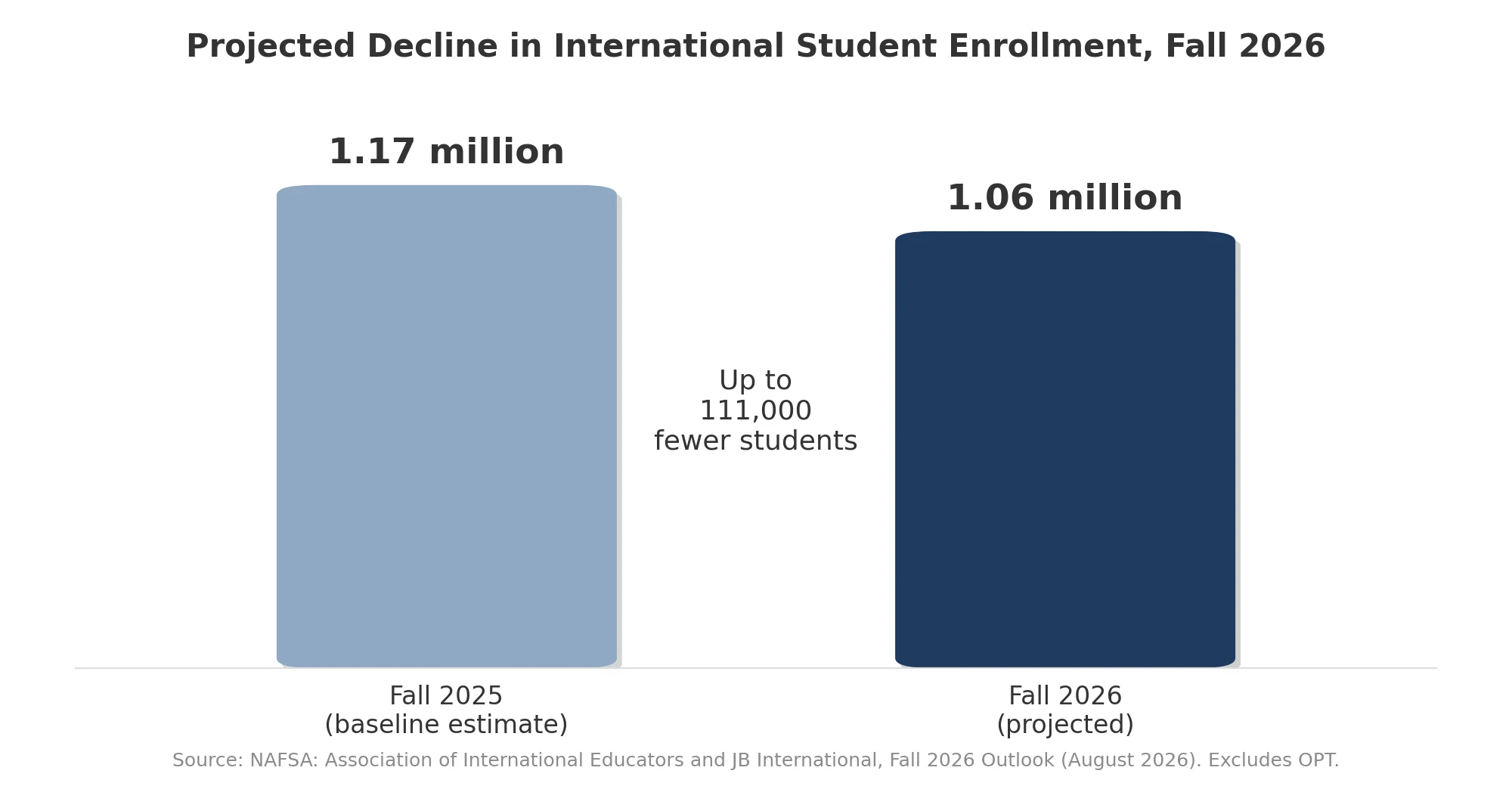
If a student is already studying at a U.S. community college, for example, four-year schools now want that student more than ever. Many are recruiting international students already in the country, where visas aren't an issue. Accurate credential evaluation reports help those transfers move faster.
Plan Now for the Next Snapshot
IIE's Fall 2026 Snapshot is due later this fall, and it'll show how far new enrollment fell nationwide. You don't need to wait for it to act.
If you're a prospective student
Book early: Schedule your visa interview as soon as you have your I-20 and have paid the SEVIS fee, and check for earlier slots often.
Ask about deferrals: Find out your school's deferral policy before you pay a deposit.
Plan for longer programs: If you're heading into a PhD, track the duration of status case so you know what an extension would involve.
If you work in admissions or run a program
Budget conservatively: Plan for smaller grad cohorts in 2026/27 and 2027/28.
Recruit closer to home: Reach international students already studying in the U.S., including community college transfers.
Stay flexible on start dates: Offer spring starts and deferrals for students caught in visa delays.
Keep an eye on the courts, too. The duration of status, OPT, and H-1B fights will shape the next few years.
 The Real Economics Behind Entry-Level Gigs
 Can 3-Year Degrees Solve the Teacher Shortage?
 Does College Public Speaking Really Matter in Today’s Job Market?
 Strategies for Communicating Tuition and Outcomes to Prospective Students
 How Politics Is Shaping College Enrollment