
College students are arriving with math skills weaker than at any recorded point in recent history. The Nation's Report Card found that 12th-grade math scores hit their lowest levels on record in 2024.
At one large public research university, the share of incoming students placing below the college-level math cutoff jumped from under 1% in 2020 to nearly 12% by 2025. Most of those students had strong high school grades.
"In 2024, more than a quarter of students placed into that university's remedial math course had earned a perfect 4.0 in their high school math courses."
So what are university leaders actually doing about it? Here is a breakdown of the approaches gaining the most traction.
Indicator | What the data shows | Source |
|---|---|---|
12th-grade NAEP math scores | Lowest on record (2024) | NAEP |
Students placing below college-level math at one UC campus | Under 1% in 2020, ~12% by 2025 | UC Admissions Workgroup Report |
California graduates rated college-ready by test scores | 22% (2024) | Public Policy Institute of California |
ACT math college-readiness benchmark met | 27% of girls, 32% of boys (2024) | ACT 2024 Profile Report |
UC faculty signed petition on math standards | More than 1,000 (May 2026) | Inside Higher Ed |
The Corequisite Shift
For decades, universities handled underprepared math students the same way: put them in remedial courses for a semester or two, then let them start on real coursework. The problem is that model rarely worked. Students would grind through non-credit developmental classes and drop out before they ever reached a credit-bearing course.
The corequisite model flips that. Students go straight into a college-level math course on day one, with a support session running alongside it in the same term. Think of it as a built-in safety net rather than a holding pen.
Take a student who places slightly below the cutoff for introductory statistics. Under the old system, that means a full semester in a remedial course that earns no degree credit. Under the corequisite model, the same student is in the statistics class from the start, with extra instructional support built into her schedule. She earns credit either way. The difference is that one path keeps her moving forward.
The research backs it up. A randomized controlled trial at a large urban public university system found that students assigned to a corequisite statistics course were more likely to complete a college-level math course within one year (14 percentage points), and 19 points more likely within three years, compared to the traditional developmental path.
The corequisite model has now been fully or partially adopted in at least 29 states as of 2025.
That said, it is not a universal fix. Research on one state's corequisite reform found that students with the lowest placement scores were still more likely to drop out than peers who placed directly into college-level courses. The model works best for students close to the readiness threshold. For those arriving with gaps going back to middle school, additional structural support is needed.
The chart below shows the difference in college-level math completion rates between the corequisite model and the traditional developmental sequence, based on findings from a randomized controlled trial at a large public university system.
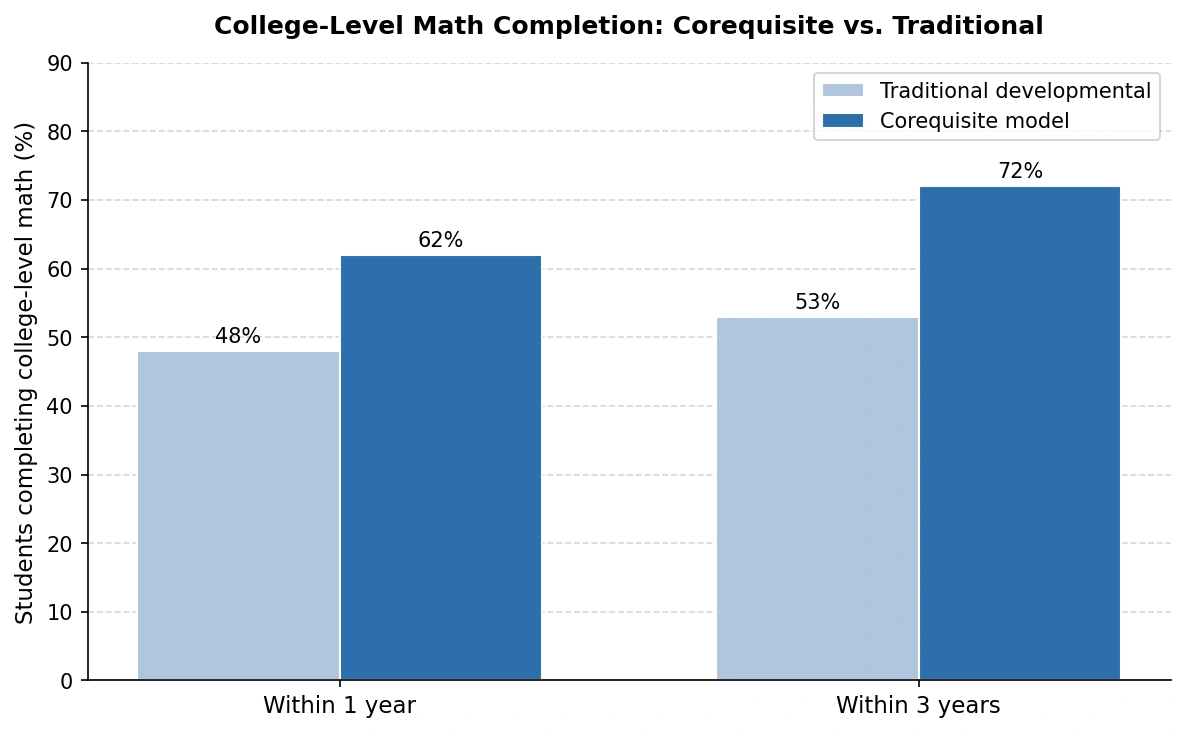 The gap widens over time. That is partly because corequisite students never hit the dropout risk that comes with transitioning between developmental courses and credit-bearing ones.
Math Pathways Matched to the Major
Routing students into the right pathway requires knowing where their skills sit and what their program actually demands. A nursing student and a physics major do not need the same gateway course. Yet for years, many colleges ran all underprepared students through the same algebra sequence regardless of what they were studying.
Math pathways fix that by routing students into a credit-bearing course that fits their program of study from day one. The Dana Center Mathematics Pathways model, developed at the University of Texas at Austin, organizes those routes into three main tracks:
STEM Pathway (Algebra-to-Calculus): For engineering, physics, and computer science majors.
Statistics Pathway: For social sciences, health professions, and education majors.
Quantitative Reasoning Pathway: For humanities and liberal arts students.
A 2023 randomized controlled trial following students over five years found that those offered Dana Center pathways services were 5.6 percentage points more likely to complete their first college-level math course than the control group.
For academic affairs teams, the practical lift is in coordination. Advisors, math faculty, and program chairs need to agree on which pathway fits which major, and placement systems need to route students accordingly from day one rather than defaulting to a single remedial sequence.
Assessment Before Day One
But routing students into the right pathway requires knowing exactly where their skills sit before they ever step into a lecture hall. That means placement testing before the semester starts, not during week two after students are already enrolled in the wrong course.
Some institutions pair early placement with summer programs that give underprepared students time to close gaps before classes begin. One mid-sized university runs a five-week virtual math boot camp for incoming students who do not test into their target course, with an optional in-person session the week before orientation. Another offers one- and two-week pre-semester programs focused on algebra and precalculus.
About half of math department chairs at one large university system reported that the number of first-year students unable to start in college-level precalculus doubled between fall 2020 and fall 2025. The other half said it tripled. Summer programs do not replace corequisite or pathway reforms, but they give students with gaps structured time to close them before the semester clock starts ticking.
The practical sequence: assess early, offer a bridge, place correctly.
AI-Assisted and Peer Tutoring at Scale
As remediation loads increase, math departments face a staffing problem. You cannot hire enough instructors to give every underprepared student individualized support. That is where AI-assisted tutoring and structured peer programs come in.
A Brookings Institution review found that AI tutoring platforms produce substantial learning gains, with particular benefits around knowledge transfer, student engagement, and efficiency. Students can access support at any hour, work at their own pace, and get immediate feedback without waiting for office hours.
One well-documented example involves a tool called Tutor CoPilot, which feeds AI-generated prompts to human peer tutors during sessions. A peer-reviewed research study found that students whose tutors used the tool were 4 percentage points more likely to progress through math assessment benchmarks successfully. For students working with lower-rated tutors, the gains were up to 9 percentage points, nearly closing the gap with students taught by more experienced tutors.
"You can take a less experienced tutor, give them AI-assisted prompting, and get results close to what your best tutors produce. That matters when you are scaling support across hundreds of underprepared students."
The caveat: AI tutoring tools introduce real concerns around accuracy and student dependence. Leaders should evaluate any tool against outcome data and pair AI support with human oversight rather than deploying it as a standalone fix.
The Confidence Problem
Math readiness is not only about content. Many students who could succeed in college math have already decided they are not math people before they set foot on campus. That belief, reinforced by years of difficult math experiences, limits what any structural intervention can achieve.
A student who scraped through high school math and internalized the idea that she is just bad at it will often arrive at a college-level statistics course already feeling behind. Even with the right corequisite support in place, she disengages faster, asks fewer questions, and gives up sooner than a student with the same skills but more confidence.
This is what researchers call math identity, and it is a real barrier. Practical responses include:
Growth mindset framing built into corequisite course instruction
Peer learning communities where students see others like them succeeding
Instructor practices that reduce the anxiety of high-stakes testing
Academic identity programs that connect students' sense of belonging to their coursework
A 2024 study in Scientific Reports found that a living-learning community organized around academic identity improved first-generation students' belonging, confidence, motivation, and grades, and reduced STEM anxiety compared to a control group. It also increased retention in science majors a full year after the program ended.
For leaders, this is an argument for integrating identity-focused support into math programs rather than leaving it entirely to student affairs. It works better when it is built in, not bolted on.
The Admissions Data Problem
Here is the part that is harder to talk about. Grade inflation is masking skill deflation, and the gap is now showing up inside classrooms in ways that are hard to ignore.
In 2024, the average high school math GPA for students placed into one university's middle-school-level remedial course was 3.65. The transcript said ready. The placement test said otherwise. High school grades have become a poor proxy for actual mathematical preparedness, especially in an era when grading standards vary widely across districts.
In May 2026, more than 1,000 University of California faculty, including seven of nine math department chairs, signed an open letter calling on the system to reinstate standardized math testing requirements for STEM applicants. The letter, reported by Inside Higher Ed, was a direct response to what faculty described as a growing gap in mathematical preparation levels within the same classroom. This was more than an admissions policy argument. Faculty were describing a classroom reality: students with strong GPAs sitting alongside peers with genuine college-level fluency, and instructors unable to pitch course content to both groups at once.
"Failing to measure preparation gaps does not remove barriers; it moves them into the classroom, where they become harder to overcome." - UC faculty open letter, May 2026
Institutions that want to reduce their remediation burden need to ask if their admissions data is capturing what students actually know, beyond the grades they received.
What a Coordinated Response Looks Like
No single intervention closes the math-readiness gap on its own. The institutions making the most progress combine early assessment, summer bridge access, corequisite support, program-aligned pathways, scaled tutoring, and identity-focused instruction into a coordinated system rather than a patchwork of separate programs.
The students who benefit most are the ones who get the right support at the right time, before they fall behind and before they decide it is too late to catch up.
 Strategies for Communicating Tuition and Outcomes to Prospective Students
 How Politics Is Shaping College Enrollment
 How Top Performers Land US Job Offers
 The College Majors Foreign Students Regret Choosing
 The Tightest Job Market in Years for College Grads