Picture this. A professor grades a stack of essays that all read like they came from the same brilliant, slightly robotic student. Then exam day comes, and half those "brilliant" students can't explain their own thesis out loud. That gap is exactly why colleges are rethinking how they test you, and why some classrooms are becoming what people now call un-cheatable.
The old system ran on trust. You wrote a paper at home, turned it in, and nobody checked how you got there. AI blew a hole in that model almost overnight. So schools are rebuilding assessment from the ground up, and the changes are bigger than just banning chatbots.
Old model | New model |
|---|---|
Single final essay or exam | Staged drafts, revisions, oral defense |
Trust-based honor code | Proctored or in-person components |
AI use banned outright | AI use disclosed and evaluated |
Detection software as gatekeeper | Process evidence as gatekeeper |
Why the Old Trust System Broke
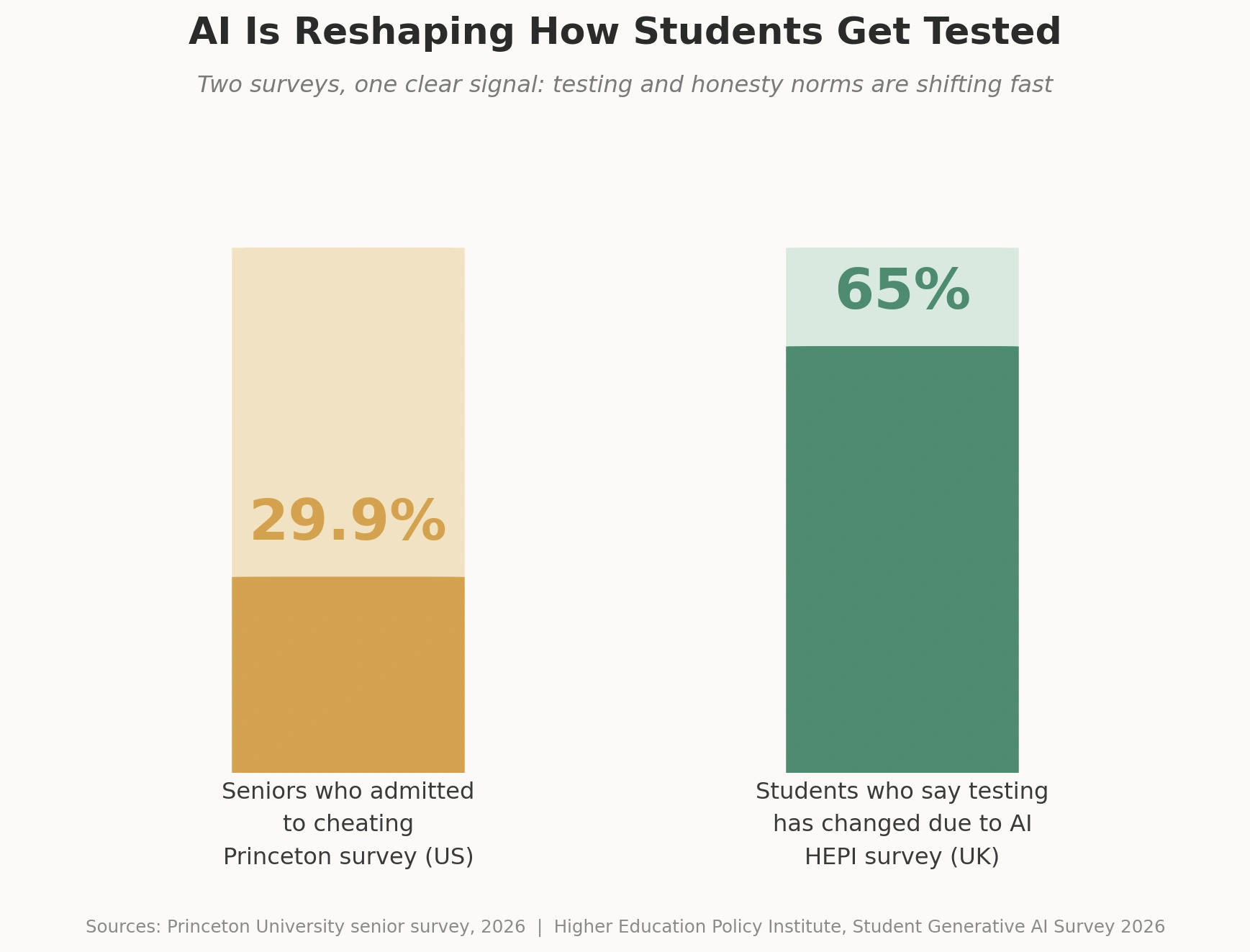
Princeton University recently ended 133 years of relying solely on an unproctored honor code. The reason was blunt. Their own student survey found nearly 30 percent of seniors admitted to cheating, while almost none ever reported a classmate who did.
That is not a small crack. That is the whole foundation giving way. A 2026 student survey from the Higher Education Policy Institute found nearly two-thirds of students say assessment has changed significantly because of AI.
A flawless ten-page paper followed by a blank stare when a professor asks the student to explain their own argument tells you everything you need to know. Perfect homework paired with a blank stare has become the clearest red flag on campus.
Multi-Stage Projects Slow Everything Down (On Purpose)
Instead of one big paper due at the end of the semester, more courses now break assignments into stages. You submit an early outline, then a rough draft, then a revision memo explaining what you changed and why.
Some engineering programs take this further. Students use AI to help design a project, then have to verify every calculation by hand and show their work at each checkpoint. The AI can get you started, but it cannot walk through your reasoning for you at every stage.
Showing up with a pristine final paper but zero draft history, outline, or working notes is becoming an immediate red flag. Real learning leaves a paper trail. AI shortcuts usually do not.
Oral Exams and Debates Are Making a Comeback
This is the format getting the most buzz right now, and for good reason. You cannot have a chatbot sit in for you when a professor asks you to explain your work face to face.
Some biomedical engineering courses at Cornell University now require what they call an oral defense. No laptop, no notes, just you answering questions about material you supposedly already mastered. One professor put it simply: you cannot talk your way through an oral exam if you never actually learned the content.
Other departments are leaning on cold calls, in-class debates, and short one-on-one check-ins during office hours. NYU's vice provost for AI and technology in education described it as needing to look students in the eye and ask directly whether they know the material. The University of Pennsylvania is pairing oral exams with written papers in some seminar classes for the same reason.
Picture two students who both turned in the same polished essay. One can walk you through every argument on the spot. The other stumbles the moment a professor asks a follow-up question. That gap is exactly what the oral component is built to catch.
The tradeoff is real. Oral exams take more time to run, especially in big lecture classes. That is why some schools are testing recorded spoken responses with AI-assisted grading and human review, so professors get the benefits of oral assessment without burning out.
In-Class Deliverables Bring Back the Basics
Sometimes the simplest fix is the best one. Plenty of courses are going back to in-person, pen-and-paper exams for at least part of the grade. No devices, no internet, no way to quietly open a new tab.
The classic blue book exam is having a moment again. It is not glamorous, but it works. If you cannot use AI in the room, the test measures exactly what you know right now.
This approach has limits, though. It does not test whether you can use AI well, and employers increasingly expect graduates to know how to work alongside these tools. That is why in-class exams tend to show up as one piece of a bigger mix, not the whole solution.
AI Partnering Instead of AI Banning
Here is a shift that surprises a lot of people. Some schools are not trying to remove AI from the classroom at all. They are teaching you how to use it well, then grading you on that skill directly.
The University of Surrey rebuilt its entire curriculum around this process over output idea starting in 2026. Engineering students now use AI to help draft a project, then have to catch and correct its mistakes by hand. Literature students still write essays, but they also submit drafts and short notes proving the work is actually theirs.
The bigger goal here is what some call AI fluency. Instead of just banning tools, schools are defining what every graduate should know about using AI responsibly, including how to disclose when and how they used it.
Consider the difference between two approaches: using AI to outline ideas with full disclosure versus pasting raw outputs as your own. Transparency is becoming the actual line, not AI use itself.
Dropping the Software That Does Not Work
Here is something a lot of university leaders do not love admitting. Plenty of AI detection tools just are not reliable. They flag honest students and miss actual AI-generated work, which helps nobody.
Some universities are ditching their old traffic-light detection systems entirely. The University of Bath is replacing its system with a simpler two-lane approach built around clear principles instead of software flags, and Cardiff University is following that lead.
The logic is straightforward. If your detection software cannot keep up with new AI models, and it never really could, betting everything on that software is a losing game. Betting on how you design the assignment in the first place is a much safer bet.
What This Shift Really Means for You
None of this is about catching cheaters. It is about making sure a diploma still means something. Build assessments around process, conversation, and honest disclosure, and AI stops being a threat. It just becomes another tool students learn to use well.
Staged drafts and revision memos leave a trail that a rushed AI shortcut simply cannot fake.
Speaking under pressure exposes gaps a polished paper can hide for an entire semester.
A pen-and-paper exam still works, but only as one piece of a bigger testing mix.
Disclosure, not detection, is quickly becoming the real measure of academic honesty.
Software built to catch AI keeps missing the mark, so smarter assignment design is filling the gap.
 How Universities Use Zero-Waste Swap Programs to Cut Student Costs
 How Industry Partnerships Shape Modern Curricula
 How Post-COVID Aid Programs Help Universities Rebuild Admissions
 Beyond the Acceptance Rate and How Colleges Decide Who Gets In
 How Leveraging Job Placement Strategies Can Reenroll Returning Students