If you graduated recently and your inbox feels like a ghost town, you're not imagining it. The college grad job market has stayed tough all year, and the numbers back you up.
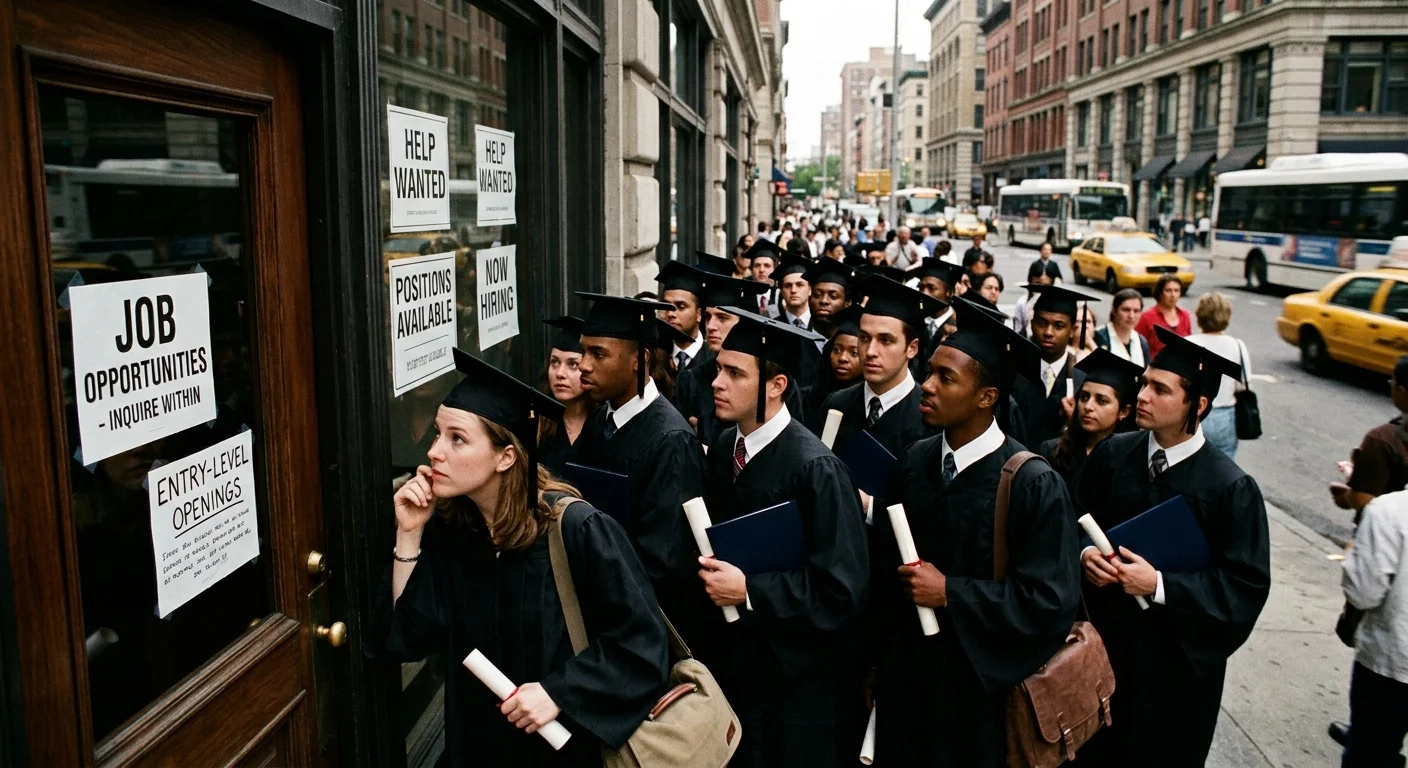
The Federal Reserve Bank of New York's recent grad labor data puts unemployment for graduates ages 22 to 27 at about 5.6% through the second quarter of 2026. Underemployment edged up to 42%.
National unemployment sits at 4.2%, according to the U.S. Bureau of Labor Statistics' latest jobs report. Recent grads face a higher jobless rate than that, plus rising underemployment.
Let that sink in. A fresh bachelor's degree now gets you worse odds than the average worker. That turns the deal you were sold on its head.
I'll walk you through what's happening in the college grad job market, why, and what you can do about it.
Measure | Latest figure | Period | Source |
|---|---|---|---|
Recent grad unemployment (ages 22 to 27) | About 5.6% | Q2 2026 | Federal Reserve Bank of New York |
Recent grad underemployment | 42% | Q2 2026 | Federal Reserve Bank of New York |
Overall unemployment | 4.2% | September 2026 | U.S. Bureau of Labor Statistics |
Monthly hires rate | 3.3% | August 2026 | U.S. Bureau of Labor Statistics |
Monthly quits rate | 1.9% | August 2026 | U.S. Bureau of Labor Statistics |
Young workers in AI-exposed jobs vs. expected level | About 19% below | August 2026 update | Stanford Digital Economy Lab |
Your Degree Isn't Beating the Average Worker Anymore
For decades, a bachelor's degree meant lower unemployment than everyone else. That edge is shrinking fast.
Recent grads now sit above the national unemployment rate. And the gap between young college grads and young high school grads keeps closing.
A Cleveland Fed analysis found that gap has narrowed steadily since the 2008 financial crisis. It recently hit its lowest point since the late 1970s.
Picture a business grad who wraps up in May and expects a few interviews by July. Instead, they send 60 applications, land two phone screens, and watch summer slip by.
Here's what that looks like on the ground:
Fewer callbacks per application
Longer gaps between graduation and a first paycheck
More competition from people with a few years of experience
None of this means your degree is worthless. It means the payoff takes longer to show up right now.
Why Nearly Half of Grads Work Jobs That Skip the Degree
Underemployment means you have a bachelor's degree but work a job that doesn't usually need one. Think barista, retail associate, or front desk clerk.
The New York Fed puts that number at 42% for recent grads. That's close to half of everyone who just finished school.
There's some good news buried in the data, though. The New York Fed has noted that many underemployed grads hold fairly skilled, decent-paying non-college jobs and move into better roles once they gain experience.
The catch? Where you start matters. The Burning Glass Institute's internship gap findings make this clear. Five years after graduation, 54% of grads without an internship were still underemployed. Among grads who did one, it was 41%.
Say you take a coffee shop job "just for a few months." Those months can turn into two years, and the longer you stay, the harder it gets to explain on a resume.
So a bridge job is fine. Just don't let it become the whole road.
Trade Workers Are Getting the Head Start
While grads wait for callbacks, young people without degrees are doing better than they have in a long time.
The Burning Glass Institute found unemployment for workers ages 22 to 34 without a degree sits near its lowest level in more than 20 years. Its non-degree worker trends also show the jobless gap between grads and non-grads at its smallest in about 30 years.
Students have noticed. The National Student Clearinghouse Research Center reported in its Clearinghouse enrollment report that trade-focused public two-year colleges grew 11.7% in spring 2025, up almost 20% since 2020.
Growth cooled to 2.8% in spring 2026, but some programs keep climbing. Two-year HVAC programs grew another 16.7% this year after a jump of nearly 29% in 2025, according to HVAC enrollment figures based on Clearinghouse data.
Here's a familiar story. Your high school friend skipped college for an electrician apprenticeship. Four years later, they're earning steady pay while you're still hunting for a first offer.
A couple of reality checks before you rethink everything:
Enrolling in a trade program doesn't guarantee a job
Apprenticeship spots are limited in many trades
Trade work is physical and often starts with early hours
4 Reasons Grads Are Stuck Right Now
No single factor explains the slump. Four forces are stacking on top of each other.
1. Employers Stopped Hiring (and Stopped Firing)
This one's the biggest. Companies aren't laying people off much, but they aren't adding many people either.
The Bureau of Labor Statistics' job turnover survey shows hires held at 5.2 million in August, a hires rate of 3.3%. Quits sat at 1.9% and layoffs at 1.0%.
Think of it like musical chairs where nobody stands up. Current workers stay put, so few seats open for newcomers. And you're the newcomer.
The Economic Policy Institute's hires rate analysis calls the low hires rate a major cause of weak job prospects for the Class of 2026.
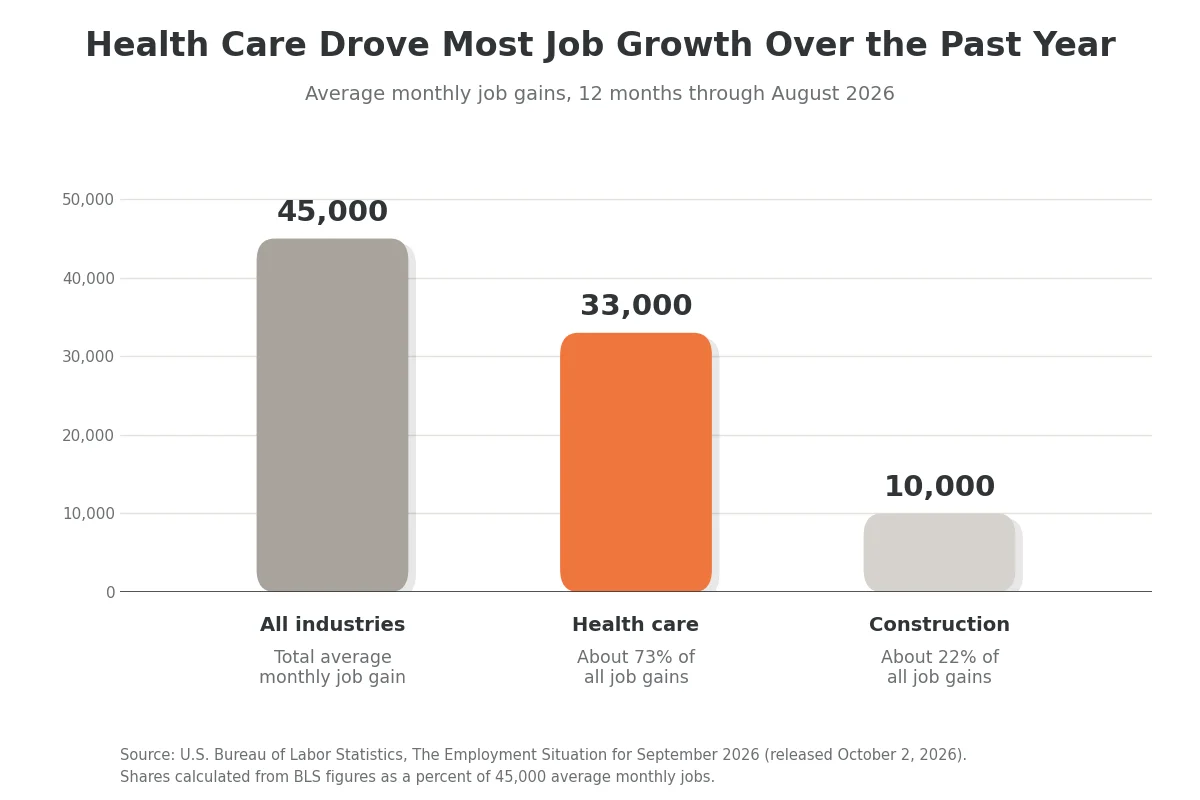
2. Job Growth Moved to Health Care
Over the past year, one sector carried the job market on its back.
Bureau of Labor Statistics health care hiring data shows health care and social assistance added 680,500 jobs from March 2025 to March 2026. Over the same stretch:
Professional and business services lost 40,000 jobs
Information, which includes tech and media, lost 76,000 jobs
Total payroll employment barely changed
Consider a communications major aiming for tech or media. They're targeting two of the sectors that shed the most jobs this past year.
One fair point from the Economic Policy Institute: the information sector employs only 2.3% of young grads. So tech layoffs get headlines, but they don't explain the whole slowdown.
3. AI Is Eating Entry-Level Tasks
AI isn't wiping out whole professions. It's taking the junior tasks that used to train new hires.
The Stanford Digital Economy Lab's August 2026 update, covered in this Stanford payroll study summary, found employment for workers ages 22 to 25 in the most AI-exposed jobs runs about 19% below where it would be otherwise. A year earlier, that gap was 15%.
Here's the pattern the researchers found:
Losses cluster in jobs where AI does the task, such as customer service and software development
Jobs where AI helps workers do their tasks faster held up better
Older workers in the same jobs didn't see the same drop
Still, don't pin everything on AI. The Economic Policy Institute has cautioned that blaming AI entirely for grad unemployment is premature. Hiring rates had already been falling for three years.
4. Too Many Grads, Too Few Degree Jobs
U.S. colleges award about 2 million bachelor's degrees a year, according to federal degree counts from the National Center for Education Statistics.
Now compare that to the jobs. Of the hundreds of occupations the Bureau of Labor Statistics tracks, just 178 typically require a bachelor's degree to get in, per its BLS education requirements breakdown.
That's a lot of grads lining up for a narrow set of doors. And at the entry level, you're often up against people with two or three years of experience.
The Burning Glass Institute's Burning Glass report names this "graduate glut" as one of four drivers. The others: AI taking junior tasks, lean post-pandemic staffing, and AI speeding up both.
5 Steps to Get Hired When Hiring Is Slow
You can't fix the economy. You can change how you compete in it.
Aim where hiring happens. Health care drives most recent job growth, and it hires for far more than nurses. Look for business, data, and admin roles inside it.
Get real experience before you graduate. An internship, a co-op, or a paid campus project all count. The Burning Glass data shows it cuts your odds of getting stuck.
Learn to use AI on the job. Employers cut tasks AI can do alone. Show them you can use AI to do more, faster.
Put a deadline on bridge jobs. Pick one that builds a skill you can name on a resume, and give yourself a set number of months.
Lean on people, not postings. When few jobs get posted, referrals carry more weight. Message alumni, former managers, and professors.
Even 20 minutes a day of messaging alumni in health care administration can pay off. You'll often hear about a role before it hits a job board.
Many employers say they value proven skills, so lead every application with what you can do, not only your degree.
Keep Your Search Moving
The college grad job market is slow, not closed. Target the sectors still hiring, build experience early, and keep showing up. The grads who land jobs this year are the ones who don't stop applying.
 How Universities Are Adapting Health Programs to a Moderating Job Market
 How Flexible Are PhDs in a Changing Job Market
 Understanding the Decline of International Enrollment in American Universities
 Why AI Writing Polish Can Flatten Student Expression
 Connecting International Talent to Inclusive Careers