Thinking about a PhD, or finishing one, and wondering if it boxes you in? Fair question. The PhD job market looks very different than it did even two years ago.

Here's the headline. Research universities are taking fewer doctoral students. According to the Association of American Universities (AAU), its latest admissions data shows doctoral admissions at 55 member schools fell 15% in fall 2026 compared with fall 2025. That's the second year in a row of big cuts.
So how flexible is a PhD right now? Pretty flexible, if you plan for it. I'll walk you through where the degree bends, where it breaks, and what you can do about it.
Let's start with where new PhDs land. The National Center for Science and Engineering Statistics (NCSES) tracks this every year in its Survey of Earned Doctorates. The newest data covers PhDs who graduated by June 2025. Here's what new graduates with definite US plans had lined up.
What new PhDs lined up | 2005 | 2024 | 2025 |
|---|---|---|---|
Academic job | 34.8% | 24.0% | 24.0% |
Industry or business job | 14.6% | 24.5% | 24.1% |
Government job | 4.4% | 4.6% | 4.3% |
Nonprofit job | 3.4% | 3.9% | 4.1% |
Other or unknown | 6.9% | 3.6% | 3.6% |
Postdoc | 35.9% | 39.4% | 39.9% |
Look at the first two rows. In 2005, academic jobs outnumbered industry jobs more than two to one. By 2025, they were dead even. Postdocs still make up a big slice, and NCSES data shows most of those postdocs are based at universities.
That shift tells you two things. The professor path is tighter. And plenty of other doors are already open.
What Your PhD Can and Can't Do Right Now
The Professor Track Keeps Getting Narrower
If you pictured a tenure-track job at the end of your PhD, here's the hard part. Those jobs have been shrinking as a share of all faculty jobs for decades.
The American Association of University Professors (AAUP) found that about 68% of US faculty held contingent appointments in fall 2023, based on its faculty appointment data. Contingent means no shot at tenure. Think adjuncts, lecturers, and fixed-term contracts. Back in 1987, that figure sat around 47%. Full-time tenured and tenure-track roles fell from about 53% of faculty to about 32% over the same stretch.
Money is the other squeeze. The AAU reports that some universities now let departments admit new PhD students only if they have federal research money or other support lined up. Fewer funded labs means fewer students now and fewer faculty openings later.
Your field matters too. Here's the share of 2025 graduates with definite US plans who took academic jobs, according to NCSES:
Humanities and arts: 53%
Engineering: 9%
Physical sciences: 8%
If a student in a humanities program applies only for faculty jobs, for example, one hiring freeze in their subfield can wipe out most of the openings they were counting on. Humanities PhDs lean hardest on academic hiring, so a tight faculty market hits them first.
That's the tough news. Here's why it's not the whole story.
Your PhD Still Pays Off Outside Campus
The U.S. Bureau of Labor Statistics (BLS) still shows a strong payoff for doctoral degrees. In its latest earnings data, full-time workers age 25 and older with a doctorate earned a median $2,307 a week in 2025. That works out to roughly $120,000 a year.
Here's how that stacks up:
Doctoral degree: $2,307 a week, 1.8% unemployment
Master's degree: $1,876 a week, 2.6% unemployment
Bachelor's degree: $1,578 a week, 2.8% unemployment
All workers: $1,268 a week, 3.4% unemployment
One caveat. BLS reported a 1.2% doctoral unemployment rate for 2024. But its 2025 annual figures skip October because of the federal government shutdown, so BLS warns they don't compare cleanly with earlier years.
So where are the jobs? Mostly off campus. NCSES data shows the share of new PhDs heading straight into industry or business jobs rose from about 15% in 2005 to about 24% in 2025. Your skills transfer. The real question is if employers can tell.
Hiring Managers Don't Speak Academic
This is where a lot of PhDs get stuck. Your skills travel fine. Your vocabulary doesn't.
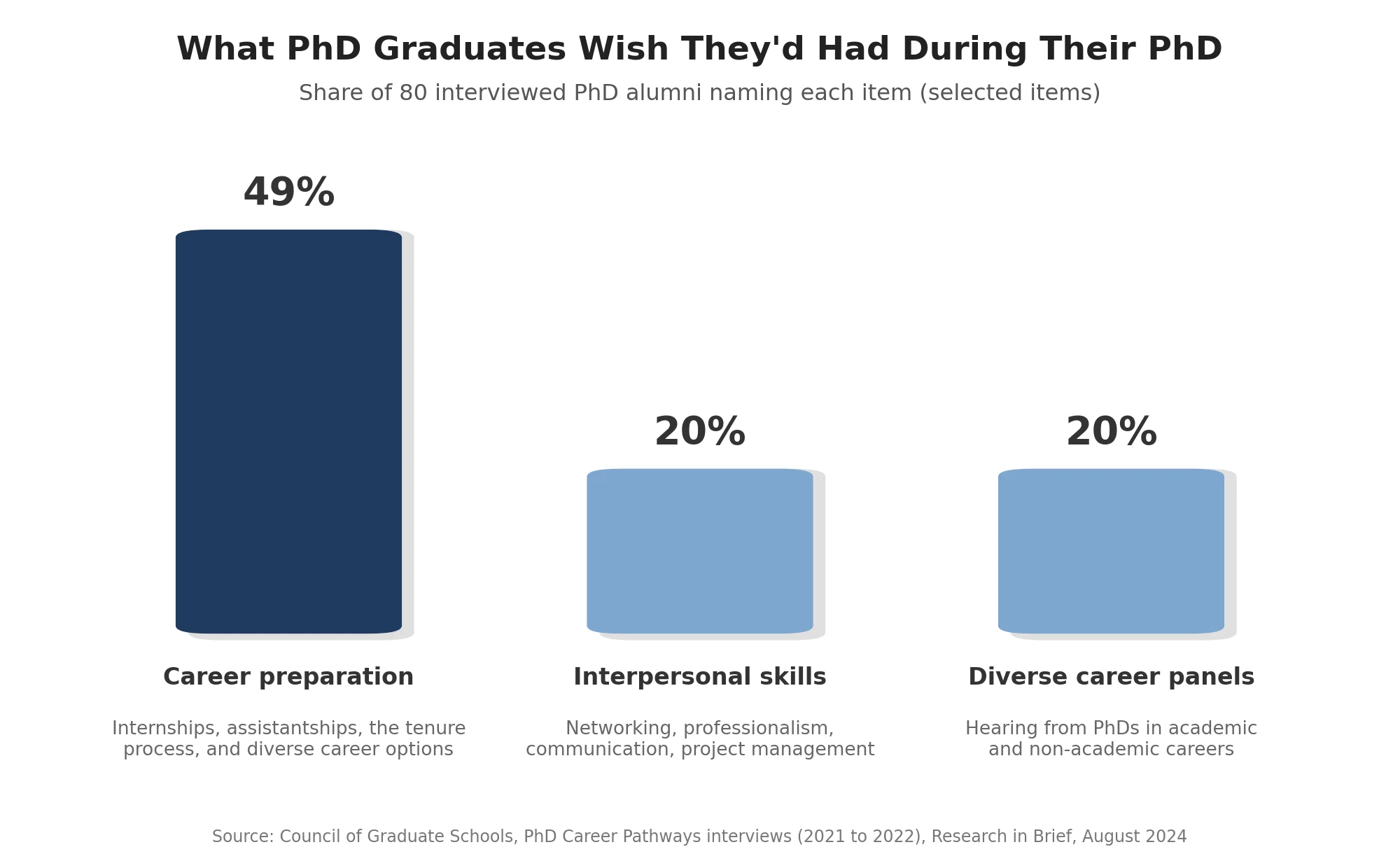
The Council of Graduate Schools (CGS) interviewed 80 PhD graduates for its PhD career research. Graduates said their programs gave no guidance on turning PhD skills into a resume for non-academic jobs. Some also said the faculty advising them lacked industry connections.
Here's what that looks like in real life. If a student spends five years running health surveys in rural clinics, for example, their CV might say "dissertation on healthcare access." A hiring manager skims right past it.
What the manager needed to see:
Ran a five-year research project from start to finish
Managed a project budget
Coordinated with a dozen partner sites
Presented results to funders
Same work. Different language. That gap costs real interviews. The good news? It's fixable, and I'll show you how below.
Data Skills Open the Most Doors
If you want one skill that travels across fields, it's data. BLS projects in its data scientist outlook that data scientist jobs will grow 35% from 2025 to 2035, one of the fastest rates of any occupation. That's about 24,800 openings a year, with a median wage of $120,230 in May 2025.
The SED backs this up. In 2025, 54% of new computer and information science PhDs and 48% of new engineering PhDs with definite US plans went straight into industry jobs.
You don't need to become a data scientist. But stats, coding, and clear charts make you useful in policy, health, finance, education, and tech.
Cross-field fluency helps too. Research methods move between fields more easily than subject expertise. A sociologist who can run regression models can talk shop with economists, marketers, and public health teams.
If a student in a psychology program learns Python to clean up messy experiment data, for example, that same skill fits a user research job, a hospital analytics team, or a nonprofit evaluation role. One skill, three career paths.
Recruiters also lean on software to sort applicants, so it helps to know how AI screens resumes before you hit send.
4 Ways to Stretch Your PhD Further
Knowing the market is half the battle. The other half is what you do with it. Flexibility doesn't show up on its own. You build it during your program, not after you defend.
Ditch the Plan B Guilt
Let's get this out of the way first. Plenty of PhDs feel like leaving academia means they failed. Some advisors still call non-faculty jobs "alternative careers," as if everything else is a consolation prize.
Here's a reality check. Look back at that table. In 2025, as many new PhDs took industry jobs as academic jobs, and that's before you count government and nonprofit roles. That's not the backup plan. That's the main road.
If a student feels guilty telling their advisor they're applying to a policy think tank, for example, it helps to remember they're still doing research. They're just doing it for a different audience.
Your PhD trained you to ask hard questions and find answers. That's who you are, no matter where you work.
Grab Coffee With People Who Left Academia
Once you've made peace with the idea, start talking to people who've done it. Informational interviews are short chats with people doing jobs you might want. You're not asking for a job. You're asking questions.
They also fill the mentor gap CGS flagged. If nobody in your department knows anyone in industry, you build those contacts yourself.
Here's how to do it:
Start in your second or third year, not your final semester.
Find PhD alumni from your program through your graduate school, professional associations, or online professional networks.
Ask for 20 minutes, and stick to 20.
Ask three questions: What do you do day to day? Which PhD skills do you use most? What do you wish you'd learned sooner?
Send a thank-you note within a day.
Not sure what to say? Copy, paste, and tweak this:
Subject: Quick question from a fellow [field] PhD
Hi [Name],
I'm a [year]-year PhD student in [field] at [your school]. I found your profile while looking at alumni who moved into [industry or role], and I'd love to hear how you made the switch.
Would you be open to a 20-minute call in the next few weeks? I'm happy to work around your schedule.
Thanks so much for considering it,
[Your name]
Short and specific wins. Most people like talking about their own career path, so you're asking for less than you think.
If a student in a chemistry program talks to five alumni in one semester, for example, they might learn that regulatory affairs roles want lab experience plus strong writing. That's a path nobody in their lab ever mentioned.
Build Proof a Recruiter Can See
Conversations give you direction. Proof gets you hired. Employers trust what they can see, and a finished project tells them a lot more than a degree title.
Markers that read well outside academia:
An internship or short consulting project, even part-time
A code portfolio or public data project you can link to
A short certificate in project management or data analysis
Plain-language writing samples, like policy briefs or blog posts
Teaching experience, framed as coaching and communication
Pick two and build them alongside your research. The growing shift toward skills-based hiring means proof often matters more than titles.
If a student in a history program writes a few short op-eds for a local news site during their fourth year, for example, they walk into a communications interview with clips in hand instead of a 300-page dissertation nobody will read.
Swap Jargon for Plain English
You've got the proof. Now make sure people understand it. Plain language is the cheapest upgrade you can make. Start here:
Turn your CV into a one- or two-page resume.
Write a one-sentence research pitch your neighbor would get.
Lead with results and numbers, not methods.
Here's a quick cheat sheet for common translations:
On your CV | On your resume |
|---|---|
Dissertation | Multi-year independent research project |
Teaching assistant | Trained and assessed 60 students per term |
Conference presentation | Presented findings to audiences of 100 or more |
Literature review | Researched and summarized 200 sources for decision-makers |
Peer reviewer | Quality assurance and cross-functional review of technical work |
Grant application | Wrote funding proposals for research budgets |
If a student rewrites "investigated mechanisms of protein misfolding" as "ran 300 lab experiments to find why proteins fail, and cut testing time by a third," for example, a biotech recruiter gets it in five seconds.
Once your resume reads clean, test it on real listings. You can browse open roles and see which ones match your skills.
Keep Two Doors Open
The professor track is narrower than it used to be. Your PhD isn't. Drop the guilt, build proof employers can see, and send your first outreach message this week.
 Understanding the Decline of International Enrollment in American Universities
 Why AI Writing Polish Can Flatten Student Expression
 Connecting International Talent to Inclusive Careers
 How to Find Legitimate College Scholarships
 Strategic Choice in Times of Uncertainty: Insights for Campus Leaders