
For three years, healthcare carried the U.S. job market. Now that engine is slowing down, and university health programs feel it first.
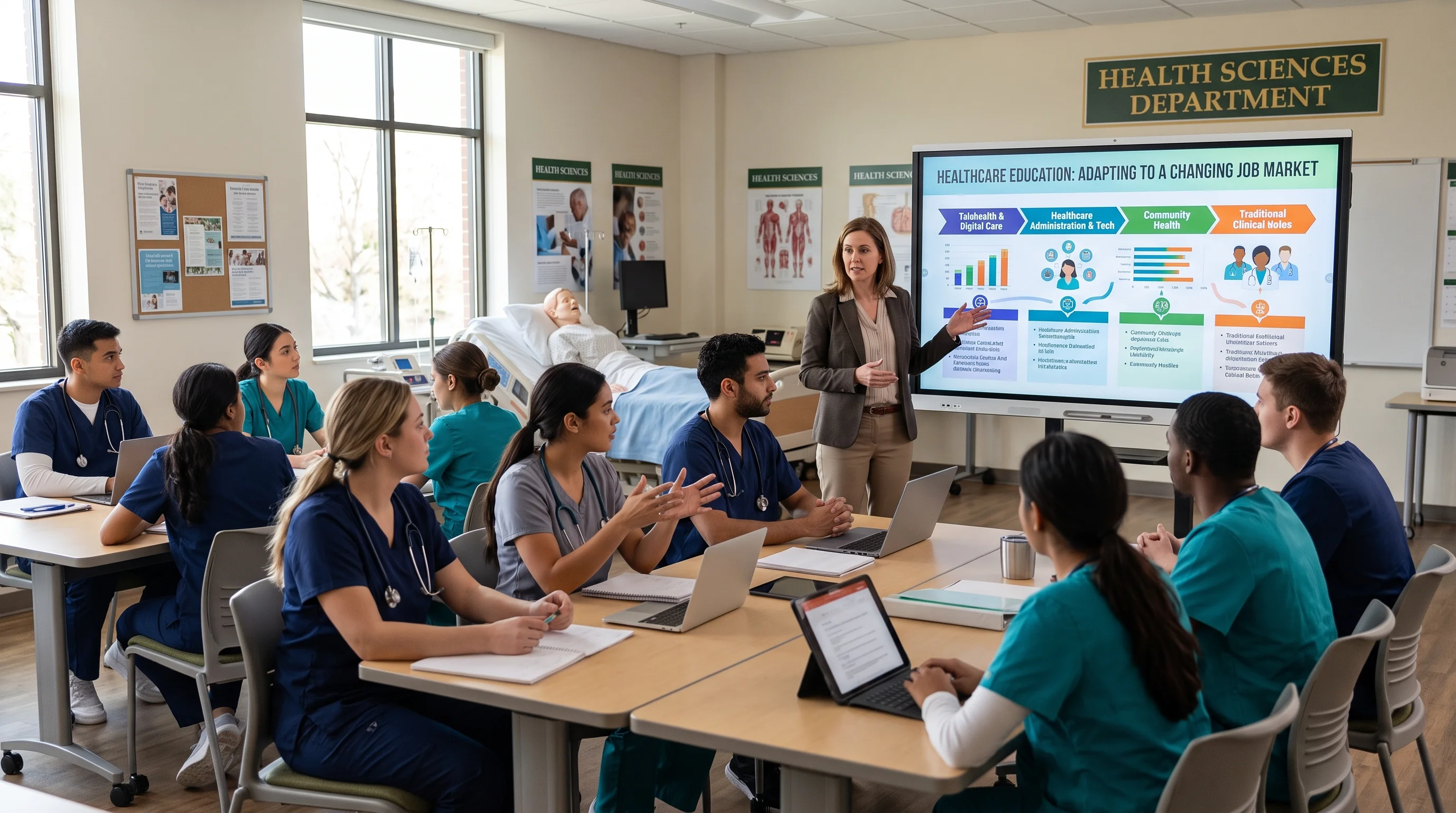
Demand for care keeps rising. But hiring is cooling, faculty are scarce, and new federal loan caps just changed the math on graduate study.
To adapt, higher education leaders are redesigning clinical pipelines, restructuring cost models, and lining up directly with health system hiring needs. Here is what's working, and what you can put in place on your campus.
Face the Triple Squeeze on Health Programs
Three pressures now hit health programs at the same time. Think of it as the Triple Squeeze:
Slower hiring: Employers add fewer jobs each month and get pickier about who they hire.
Scarce faculty: You can't add seats without teachers to fill them.
Loan caps: New federal limits shrink what many graduate students can borrow.
You can manage any one of these alone. Together, they force a rethink of how health programs run.
Hiring Is Slowing, Not Stalling
Here is how fast healthcare hiring has cooled, based on the Yale Budget Lab analysis and the most recent federal jobs data.
Period | Monthly job gains | Change | Source |
|---|---|---|---|
2017 to 2019 | About 40,000 | Pre-pandemic baseline | Yale Budget Lab |
2023 | Above 80,000 | Peak, about double the baseline | Yale Budget Lab |
2024 | About 70,000 | Down at least 12% from 2023 | Yale Budget Lab |
2025 to early 2026 | Below 60,000 | Down at least 25% from 2023 | Yale Budget Lab |
September 2026 | 17,000 | About 48% below the prior 12-month average of 33,000 | U.S. Bureau of Labor Statistics |
The September jobs report from the U.S. Bureau of Labor Statistics showed healthcare adding 17,000 jobs, about half its recent monthly average. Still, gains through early 2026 stayed above the pre-pandemic pace.
The long-term outlook holds up too. The latest BLS projections show healthcare support jobs growing 13.3 percent and healthcare practitioner jobs growing 8.0 percent from 2025 to 2035. Together, those two groups should account for almost one-third of all new U.S. jobs over the decade.
So what changed? Pace and mix.
Growth is uneven across roles. BLS projects registered nurse employment to grow 6 percent from 2025 to 2035, while support roles grow much faster.
Slower hiring gives employers room to be choosy, so graduates who need less ramp-up time get the edge.
For you, this means a health credential alone no longer sells itself. Speed, cost, and job fit matter more than ever.
Faculty Shortages Cap Your Growth
Even when students line up to enroll, many schools can't take them. AACN's faculty shortage data puts the national nurse faculty vacancy rate at 7.2 percent. Most nursing schools name faculty shortages as a top reason they turn qualified applicants away.
It gets worse down the line. Nursing PhD enrollment dropped for the 11th year in a row, so the pipeline of future professors keeps shrinking.
New Loan Caps Hit Graduate Health Students
Since July 1, 2026, federal loan limits cap what graduate students can borrow. The rules for nursing and other health fields are now tied up in court, which makes multi-year enrollment planning harder. You'll find the details and a planning approach in the cost section below.
Shrink the Time to a Clinical Career
The first move many schools make is simple: get students into paid clinical work faster.
Cut a Year Off Medical School
Three-year MD programs used to be a rare experiment. Not anymore.
An accelerated MD study of the Consortium of Accelerated Medical Pathway Programs found almost 20 percent of U.S. allopathic medical schools had or were building an accelerated track as of 2023. Responding programs produced 817 graduates between 2013 and 2023.
Most of them work the same way:
Students commit to a specialty or region early.
They finish the MD in three years.
They move straight into an affiliated residency if they meet program goals.
If a student already knows they want family medicine in their home region, for example, a three-year track saves them a full year of tuition and gets them earning a year sooner.
The catch? These tracks only suit students who are certain of their path. Build in an easy exit to the four-year track for students who change their minds.
Guarantee Undergrads a Medical School Seat
Combined bachelor's-to-MD programs aren't new, but they fit this moment well. Students lock in a medical school seat as undergraduates, and some programs shave a year or two off the total timeline.
For your institution, the payoff is retention. You keep strong students inside your own pipeline instead of losing them to another school's admissions cycle.
Move Working LPNs and RNs Up Online
Online bridge programs let licensed workers move up without quitting their jobs. Think LPN-to-RN, RN-to-BSN, and online master's programs.
Interest is creeping back. According to the American Association of Colleges of Nursing, RN-to-BSN enrollment grew 2 percent in 2025, adding 1,830 students after five straight years of decline. At 92,447 students, though, it's still far below the 2018 peak of 139,587.
The bigger story is the backlog. The AACN enrollment survey found nursing schools turned away 93,176 qualified applications in 2025. Entry-level BSN programs accounted for 75,255 of them.
If a student works night shifts as an LPN, for example, an online bridge lets them earn an RN credential between shifts. Their employer keeps a trained worker, and your program fills seats without building new classrooms.
Lower the Cost of Every Clinical Graduate
Health programs are expensive to run. Clinical sites, simulation labs, and small class sizes all add up. Slower hiring means you can't count on endless demand to cover those costs.
Share Simulation Labs and Placement Offices
Schools are cutting cost per graduate in a few practical ways:
Sharing simulation labs across nursing, medicine, and allied health
Moving lecture content online and saving in-person time for hands-on skills
Running one clinical placement office for all health programs instead of five
None of this is flashy. But it frees up money for the programs with the strongest job demand.
Borrow Faculty From the Hospital Floor
The faculty squeeze won't fix itself, so schools are getting creative about who teaches.
Here is what schools are trying:
Joint appointments, where a hospital clinician teaches part-time and the hospital shares the salary
Practice-based adjuncts who teach clinical courses only
Shared faculty across partner campuses for low-enrollment specialty courses
Price Graduate Programs Under Both Loan Tiers
This one hits graduate health programs hard. Under the One Big Beautiful Bill Act, the U.S. Department of Education set new federal loan limits that took effect July 1, 2026.
The final loan rule set two tiers:
Graduate programs: $20,500 per year and $100,000 total
Professional programs: $50,000 per year and $200,000 total
The original rule left nursing, physical therapy, and physician assistant programs in the lower tier. Then a federal court blocked that narrow definition in June. In response, the Department issued a temporary professional list of 29 programs, including the MSN, DNP, and nurse anesthesia doctorate.
The Department also suggested that schools with newly reclassified programs think about capping loans at the lower graduate tier anyway. That way, students won't get caught short if the classification flips back.
Three things to keep in mind:
The Department calls the change temporary and is still fighting to restore its original rule.
The court paused the definition, not the caps themselves.
Nursing PhD programs are still off the list, and an amended court complaint filed in August challenges that. The exclusion hits the same faculty pipeline you need to grow.
Here is why that matters. If a student enrolls in a nurse anesthesia doctorate that costs more than $100,000, for example, their borrowing limit could flip depending on how the case ends. That student needs a backup plan, and so does your budget.
My advice: price every graduate health program under both loan tiers now, and build a backup financing plan for students in programs that cost more than $100,000.
Teach Skills Automation Can't Easily Replace
Hospitals are rolling out AI for documentation, scheduling, and coding. That shifts what they want from new hires. Clinical skill is the baseline. Data skill and teamwork are the extras that get people hired.
Put Data Skills in Every Clinical Track
Health informatics is one of the clearest growth spots. The health informatics outlook from BLS projects 16 percent job growth for health information technologists and medical registrars from 2025 to 2035, with about 3,000 openings a year.
You don't need a new degree to respond. Try these instead:
An informatics minor open to nursing and pre-med students
Stackable certificates in clinical data or health analytics
One required data course inside existing clinical programs
If a student finishes a BSN with a clinical data certificate, for example, they can apply for bedside roles and informatics roles. That's two shots at a job instead of one.
Train Future Nurses and Doctors Side by Side
Real care happens in teams. So more schools build interprofessional hubs where nursing, medical, pharmacy, and therapy students learn together.
The Interprofessional Education Collaborative, a coalition of national associations of health professions schools, sets the shared standards. Its current core competencies, last updated in November 2023, frame team-based care around safer patient care and better population health.
There's a budget upside too. One shared hub can help several programs meet their accreditation requirements at once.
Co-Own Talent Pipelines With Health Systems
The most direct fix for a softer job market? Line up the employer before the student graduates.
Split the Cost, Share the Graduates
In co-owned pipelines, a health system invests in your program, and in return it gets first access to graduates. That investment can look like:
Funded seats or scholarships tied to a work commitment
Shared faculty salaries
Dedicated clinical units where students train every term
Both sides win. You get stable funding and clinical placements. The health system gets graduates who already know its workflows.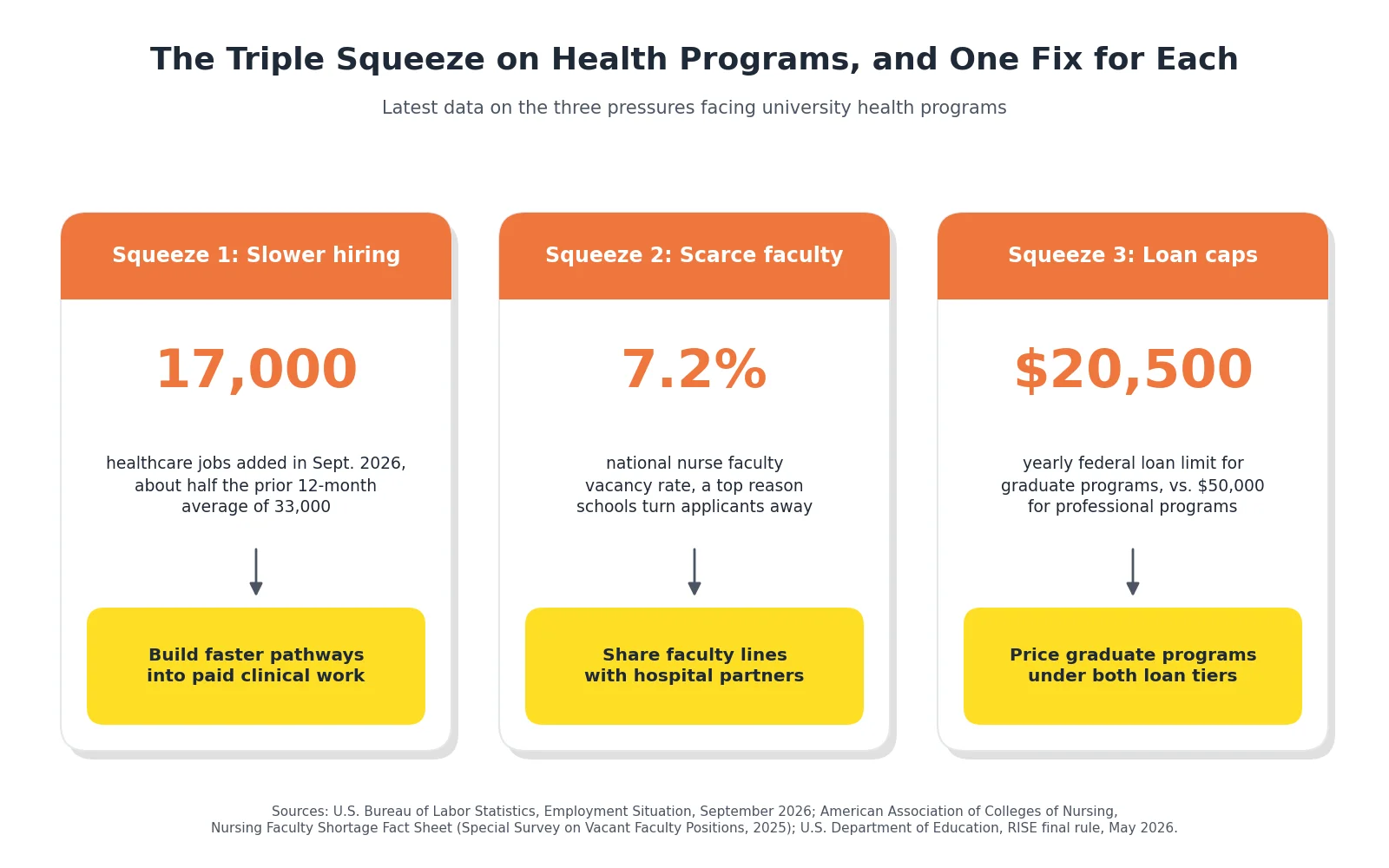
If your pipeline includes international nurses or physicians, plan early for how you'll assess foreign credentials. Agreeing on one evaluation standard up front keeps admissions decisions consistent across partner sites.
Turn Apprenticeships Into Degree Credit
Healthcare apprenticeships used to be rare. Not anymore. According to the U.S. Department of Labor, the number of registered apprentices in healthcare grew by more than 40 percent in five years.
Federal money is pushing the trend along. In January 2026, the Department announced an apprenticeship funding push of up to $145 million to expand Registered Apprenticeships across industries, including healthcare. Payments tie to measurable results instead of activity alone.
One Midwest health system now runs health system apprenticeships across 17 professions, from surgical techs to registered nurses. Before it started, up to 3 in 10 of its medical assistant, nursing assistant, and pharmacy tech jobs sat empty. Today, it's around 1 in 10.
Your role here is the classroom side:
Award academic credit for supervised on-the-job learning.
Deliver the required classroom instruction on a schedule that works for working adults.
Stack the apprenticeship into an associate or bachelor's degree.
If a student works as a nursing assistant at a partner hospital, for example, they can earn wages, log clinical hours, and collect credit toward an RN at the same time.
Pick One Fix for Each Squeeze
You don't need to do all of this at once. Match one move to each squeeze: a faster pathway for slower hiring, a shared faculty deal for the teacher shortage, and dual-tier pricing for the loan caps.
Start with whichever squeeze hurts your campus most. The job market will keep shifting, and programs built around speed, cost control, and real hiring pipelines will hold up best.
 How Flexible Are PhDs in a Changing Job Market
 Understanding the Decline of International Enrollment in American Universities
 Why AI Writing Polish Can Flatten Student Expression
 Connecting International Talent to Inclusive Careers
 How to Find Legitimate College Scholarships