If you read application essays for a living, you've probably felt it. The writing is cleaner than ever. It's also weirdly the same.
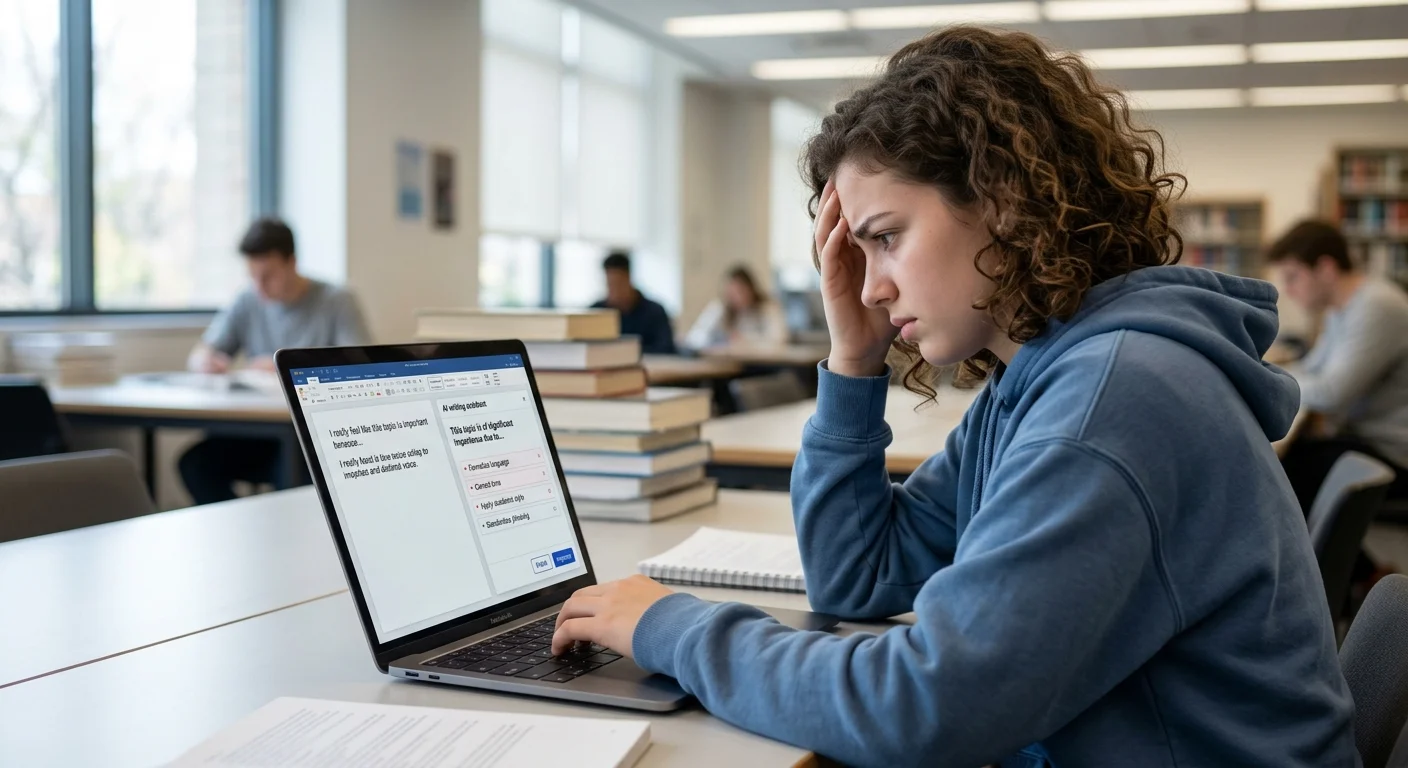
AI writing polish fixes grammar and smooths out clunky sentences. It also sands off the parts that tell you who actually wrote the thing.
Think of it like autotune on a singer. Every note lands, but you can't tell who's singing anymore.
Here's my core argument: when AI polish strips away individual style, it sets an equity trap for non-native writers and wipes out much of what makes an application essay worth reading in the first place.
I'll walk you through what the research says, who takes the biggest hit, where the policy lines sit, and what your admissions office and academic leadership can do about it. I've also included guidance you can pass straight to students.
See What the Research Says So Far
Here's a quick snapshot of the studies behind this article. Each one tests a different piece of the AI writing polish puzzle.
Who ran it | What they looked at | What they found |
|---|---|---|
Cornell and Carnegie Mellon researchers, 2026 | More than 80,000 applications to one selective university, 2020 to 2024 | Essays grew more alike after AI tools launched |
Cornell Information Science researchers, 2025 | Indian and American writers using an AI assistant | Writing converged, mostly at the cost of Indian styles |
Stanford Institute for Human-Centered Artificial Intelligence, 2023 | Seven AI detectors tested on non-native and U.S. student essays | Detectors flagged most non-native essays as AI-written |
MIT Media Lab, 2025 | Brain activity of people writing with and without ChatGPT | ChatGPT users showed the lowest engagement and ownership |
Economists at Dartmouth and Princeton, 2025 | Freelance coding job applications before and after ChatGPT | Tailored applications stopped earning a hiring premium |
Watch Essays Start to Sound Alike
So how does AI affect student writing? The short answer: it makes it tidier and more similar.
Researchers from Cornell and Carnegie Mellon looked at more than 80,000 applications to one selective university, submitted between 2020 and 2024. That window covers the years before and after ChatGPT arrived. They found essays became noticeably more alike once AI tools were widely available.
The shift wasn't even across the board. Coverage of the study notes the biggest convergence showed up among lower-income applicants and students the college rejected.
Why? The lead author points to access. Wealthier students tend to have counselors and teachers on top of ChatGPT. Students leaning on a free chatbot alone get the most generic output.
An earlier study from the same Cornell team found AI-generated admissions essays sound male and privileged when compared with real applicant writing. So the "neutral" default voice isn't neutral at all.
A fair warning before you panic: not every study agrees. One 2026 experiment found no homogenization effect in student essays. And the admissions study tracks patterns over time, so it can't prove AI caused the change on its own.
Still, the pattern shows up often enough that your readers should keep it in mind.
Notice What Disappears From a Student's Voice
Voice is the stuff that makes writing sound like a person. It's word choice, humor, the odd detail, and the moments where a writer admits they're unsure.
That last part matters more than you'd think. A study of second-language student essays, published in Frontiers in Education, found students lean on hedging words like "might," "probably," and "I think" more than ChatGPT does. Those small signals reflect personal voice and real thinking in progress.
AI polish tends to swap them for confident, smooth, general statements. The result reads well. It just doesn't read like anyone in particular.
If a student, for example, writes "I still don't know if quitting robotics was the right call," a chatbot might turn it into "This experience taught me valuable lessons about priorities." The first line makes you want to keep reading. The second one could come from any of the thousands of files on your desk.
Hiring Teams Are Seeing the Same Thing
Employers offer a useful preview of where this goes. Economists at Dartmouth and Princeton studied job applications on a large freelance platform. Before ChatGPT, employers paid more for workers who sent tailored applications. After ChatGPT, that premium disappeared.
When everyone can produce polished writing in seconds, the writing stops telling you much. That's the risk for your essay requirement too.
Recognize AI Polish as Forced Assimilation
Here's where the equity problem gets sharp.
Cornell Information Science researchers tested an AI writing assistant with writers from India and the United States. Both groups' writing drifted closer together, but mostly toward Western styles. Indian writers gave up more of their own way of expressing ideas.
If a student from Kenya, for example, writes about haggling at her aunt's market stall, she might include the Swahili phrase her aunt always used. Run that through a polish tool and the phrase may vanish. The stall becomes "a family business." The story still works, but the person behind it fades out.
For your readers, that phrase was the good part. It told them where she comes from and how she sees things.
Put those findings together and a pattern shows up. AI polish tidies writing, and it also nudges everyone toward one default: Western, fluent, and generic. For non-native writers, that's assimilation with a spell-checker's face on it.
The Detector Trap Makes It Worse
International students don't simply drift toward that default. Many get pushed.
Write in natural second-language English, and AI detectors may flag the essay as machine-written.
Polish with AI to sound "more native," and the flags go away, along with the student's background.
The first point isn't hypothetical. The Stanford Institute for Human-Centered Artificial Intelligence reported that seven popular detectors misclassified most TOEFL essays as AI-generated. The same detectors were near-perfect on essays by U.S. eighth graders.
The reason comes down to how detectors work. They reward complex, varied word choice. Non-native writers often use simpler, more predictable language, so the tools read them as machines.
The second point is the gut punch. When researchers had ChatGPT rewrite those same TOEFL essays with fancier vocabulary, the false flags dropped. In other words, the system rewards non-native students for erasing the signs of who they are.
So the student who keeps her own voice risks an integrity flag. The student who scrubs it gets through clean, and sounds like everyone else. Neither outcome gives your office an honest picture of the applicant.
The study's senior author advised against relying on detectors in settings with many non-native speakers. If your office uses them, that's worth a hard look. It also helps to read writing alongside a student's academic background, so your readers know what kind of English instruction the student actually had.
Remember That the Struggle Is the Point
Writing is hard because thinking is hard. That wrestling match with a blank page is where students figure out what they actually believe. Educators call it productive struggle.
AI polish can skip right past it.
The MIT Media Lab ran a study where people wrote essays using ChatGPT, a search engine, or nothing at all. Brain engagement dropped as tool use rose. The ChatGPT group also felt the least ownership over their essays.
Here's the part that stuck with me: ChatGPT users struggled to accurately quote essays they had just written. The words were on the page, but they never really passed through the writer's head.
If a student, for example, lets AI draft and polish a scholarship essay, she might sail through the application. Then your interviewer asks her to expand on her main point, and she has nothing to add. She never did the thinking. The chatbot did.
The good news hides in the same study. People who wrote on their own first and used ChatGPT later showed stronger engagement and better recall. Order matters. Think first, polish second.
One caveat: this was a small lab study, and the authors say the results may not apply to every writing task. Treat it as a strong signal, not the final word.
For academic leaders, the lesson is simple. If you only grade the final product, you reward students for skipping the struggle. Drafts, reflections, and in-class writing let you see the thinking behind the final product.
Learn Why Perfect Writing Feels Fake
You know that uneasy feeling when a robot looks almost human but not quite? Writing can hit the same uncanny valley.
Flawless prose with no rough edges, no specific details, and no risk starts to feel hollow. Your readers pick up on it, even when they can't explain why.
Common giveaways include:
A personal statement that sounds far more formal than the applicant's short answers
Big abstract words where a concrete memory should be
Every paragraph wrapped up with a neat life lesson
No hesitation, doubt, or humor anywhere
Perception matters here too. Researchers at foundry10 showed people the same essay with different backstories. Readers rated applicants who used ChatGPT as less authentic and ethical than applicants who got help from a paid admissions coach.
A 2026 study of a public policy master's program backs this up. Admissions officers could often tell AI essays from human ones, and they rated suspected AI essays more harshly.
So polish can backfire twice. It flattens the voice, and it makes readers trust the applicant less. That's a good reason to train your readers on what AI polish looks like, and on what it doesn't prove.
Draw the Line Between Help and Ghostwriting
Students ask this constantly: is it okay to polish your writing with AI? Mostly yes, as long as it stays polish.
For the roughly 1,000 colleges that use the Common Application, its fraud policy sets the baseline. That policy covers passing off substantive AI-generated content as an applicant's own work. The key word is "substantive." Ideas, stories, and the actual writing need to come from the student.
Some member colleges say basic spelling and grammar checks are fine. Beyond that, policies vary a lot, which confuses applicants. Spelling out your own rules clearly helps everyone.
Here's a rough guide your office can adapt:
Usually fine | Risky or off limits |
|---|---|
Spelling and grammar checks | Letting AI rewrite whole paragraphs |
Asking "Which part is unclear?" | Asking AI to invent a story or example |
Brainstorming topics the student then writes | Submitting an AI-generated draft |
Checking word count and formatting | Using AI to "sound more native" |
That last row deserves a flag. The same master's program study found AI raised essay quality most for international applicants. I get the appeal. But "sounding native" is exactly where the assimilation happens, and your policy can say so.
Don't Trust the 30% Rule
What is the 30% rule for AI? Your applicants hear about it a lot. The most common version says work is safe if an AI detector scores it under 30%.
Here's the problem: it isn't a real rule. Turnitin never defined it, and it's an informal interpretation that spread online. Another version says AI should do 70% of the work and humans 30%. No academic body or regulator backs that split either.
I'd push back on the whole idea. A percentage measures how much text AI touched, not how much of the student survived.
If a student, for example, lets AI rewrite only her opening paragraph, that might be 10% of the essay. But if that paragraph held her most personal story, she just lost the best part.
For academic leaders, a better approach is to set rules by task type. Spell out what's allowed for brainstorming, drafting, and editing, instead of pointing to a number.
Protect Student Voice in Your Process
So how do students avoid AI-sounding writing? Some of it is on them. A lot of it is on how your office asks for and reads their work.
The following checklist sums up both sides: what your office can change, and what students can do on their own.
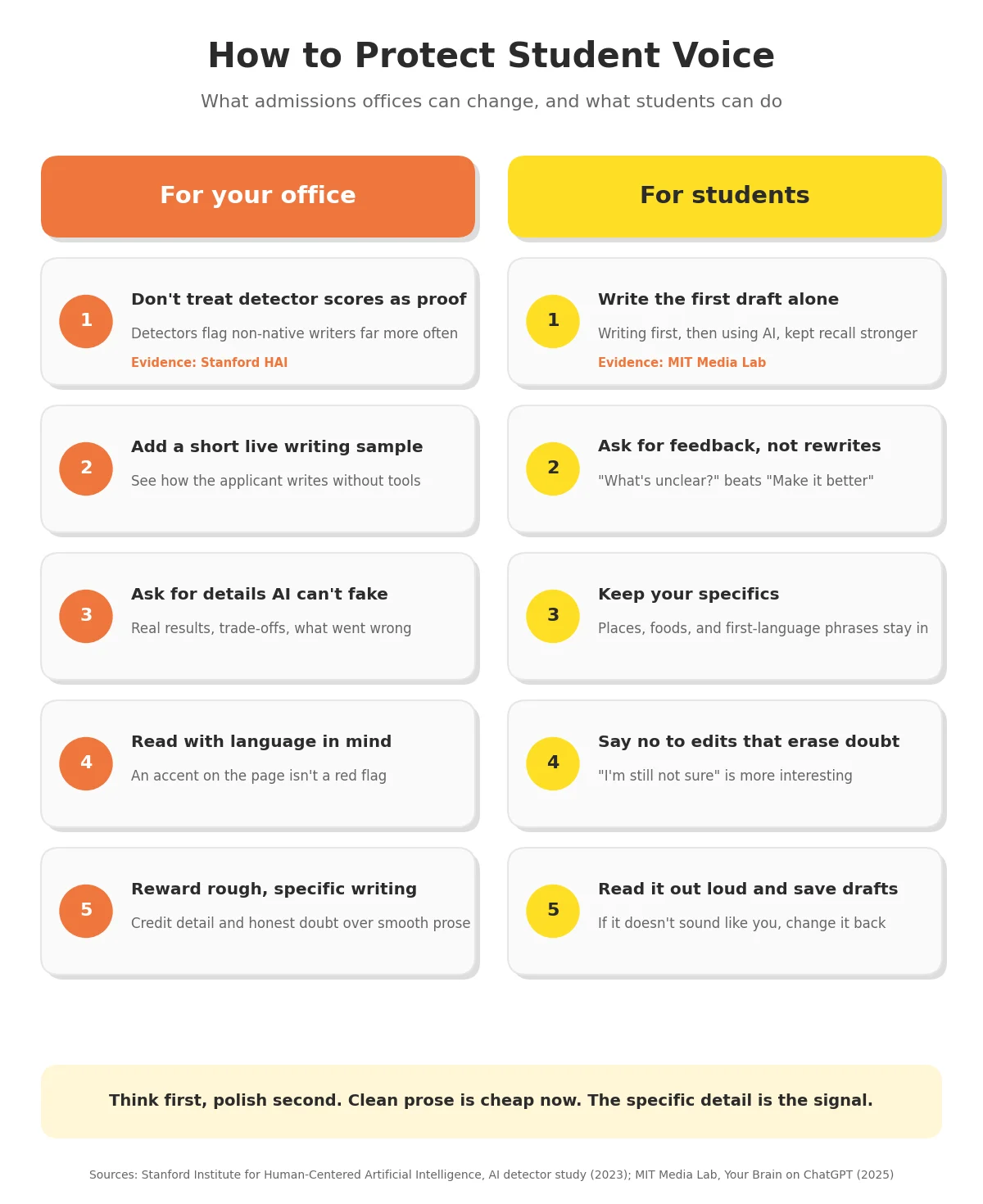
The two items backed by research carry the most weight. Detector scores alone shouldn't decide anything, and writing first before using AI keeps the thinking with the student.
Change How Your Office Reads
Don't treat a detector score as evidence on its own.
Add a short live writing sample or an interview question tied to the essay.
Ask for things AI can't fake well: real results, a specific trade-off, or a moment that went wrong.
Read international applicants' writing with their language background in mind.
Give credit for rough, specific writing over smooth, generic writing.
Tell applicants plainly that an accent on the page won't count against them.
Share This Guidance With Students
Feel free to lift this list for your website, info sessions, or counselor outreach:
Write the first draft alone. Messy is fine. Messy is actually good.
Ask for feedback, not rewrites. Try "What's confusing here?" instead of "Make this better."
Keep your specifics. Names of places, foods, and phrases from your first language stay in.
Say no to edits that erase doubt. "I'm still not sure" is more interesting than a tidy lesson.
Read it out loud. If it doesn't sound like you talking, change it back.
Save your drafts. Version history shows your process if anyone ever asks.
If a student from Brazil, for example, writes about learning English through soccer commentary, the slang and the jokes are the essay. A chatbot will try to clean them up. Your guidance can give her permission to leave them in.
Reward the Rough Edges
Clean prose is cheap now. The odd detail, the honest doubt, and the phrase from home are what tell you who an applicant is.
Build your policies and reading habits to protect those, and you'll see every applicant more clearly.
 The Real Economics Behind Entry-Level Gigs
 Can 3-Year Degrees Solve the Teacher Shortage?
 Does College Public Speaking Really Matter in Today’s Job Market?
 Strategies for Communicating Tuition and Outcomes to Prospective Students
 How Politics Is Shaping College Enrollment