Skills-based hiring isn't a talking point anymore. It's how a lot of companies actually fill jobs in 2026. If you're graduating soon (or you already did), this changes how you should be spending your time right now, not just how you write your resume.

Here's the data first, then the game plan.
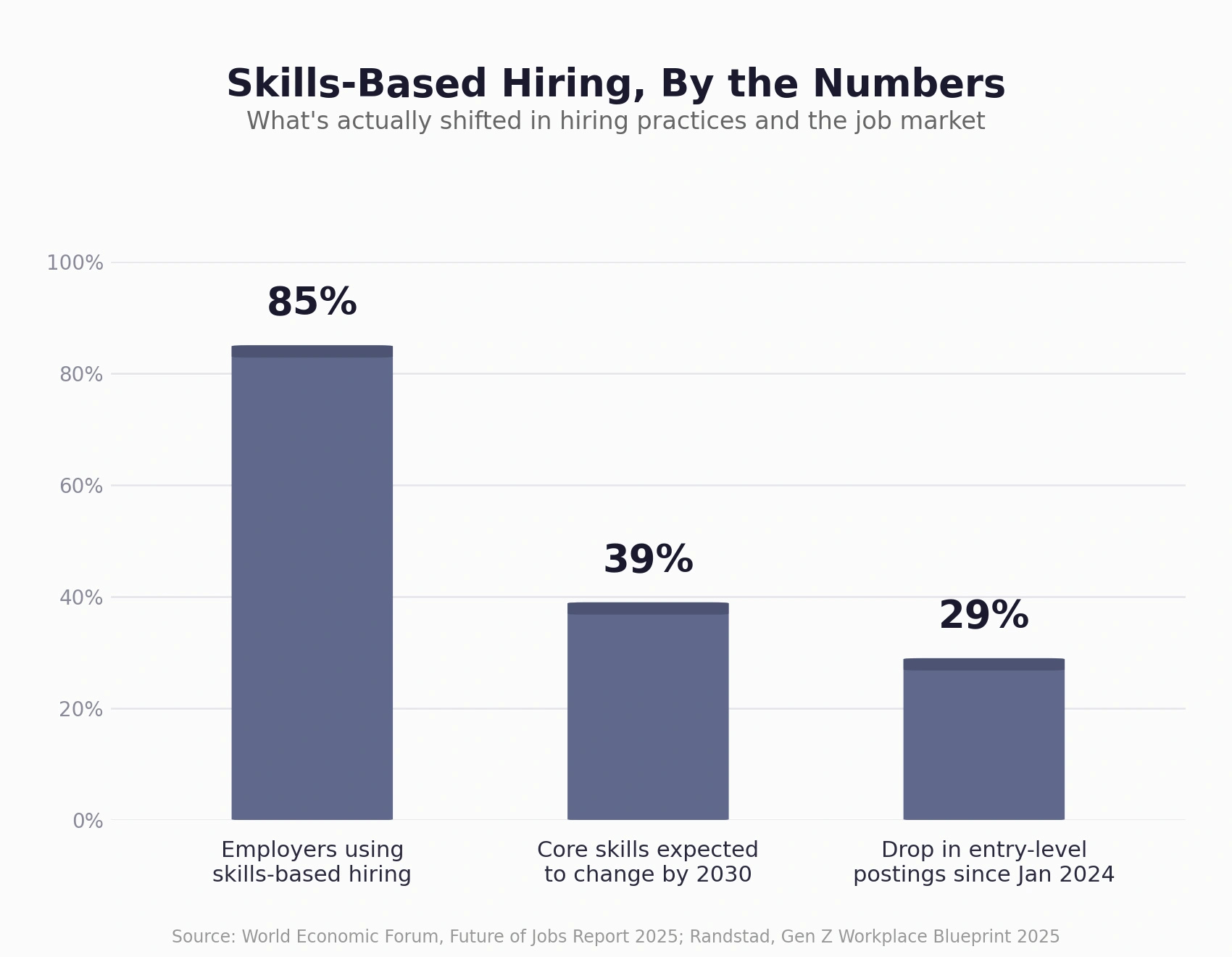
Metric | Figure |
|---|---|
Employers who say they use skills-based hiring | 85% |
How much better skills predict performance than a degree does | 5x |
New hires who actually benefited when firms dropped degree rules | 1 in 700 |
Core job skills expected to change by 2030 | 39% |
Drop in entry-level postings since January 2024 | 29 points |
Your Degree Isn't the Golden Ticket Anymore
For years, a bachelor's degree did one job for recruiters: it thinned the pile. It never actually proved you could do the work.
Company curricula move fast. Degree programs don't. By the time a course gets built, the tools it teaches are often already outdated, especially in tech, finance, and anything data-heavy.
So employers started testing for the real thing instead of trusting a transcript to speak for you.
Here's the twist, though. Research from Harvard and Burning Glass found that fewer than 1 in 700 hires actually changed when companies dropped their degree requirements. Most firms rewrote the job ad and kept hiring the exact same way.
That's not a reason to ignore skills-based hiring. It's a reason to be smarter about where you apply it. Some companies mean it. Others just changed the wording. You want to spot the difference.
The Skills Employers Actually Chase
You Need to Speak Tech, Not Just Study It
The WEF's 2025 report surveyed over 1,000 major employers. AI and big data topped the list of fastest-growing skills, with networks, cybersecurity, and general tech literacy close behind.
These aren't specialist skills anymore. They're the baseline. Employers want proof you've used the tools, not proof you passed a class about them.
This is part of why "STAR" candidates are getting more attention. STAR stands for Skilled Through Alternative Routes, and it covers roughly 70 million U.S. workers who built their skills through bootcamps, certifications, the military, or plain old hands-on work instead of a four-year degree. Several major employers have already dropped degree requirements for a big chunk of their roles, and the trend keeps spreading past tech into finance, aviation, and retail.
Show Them You Can Actually Think
Critical thinking has topped the WEF's list since it started publishing these reports back in 2016. What's changed is how employers check for it.
Interviews used to be a chat about your past. Now they're often a live test: a case study, a scenario, a "walk me through your logic" moment. A good GPA won't get you through that. Clear reasoning will.
If you haven't practiced thinking on your feet under pressure, start now. Work through real case studies. Contribute to an open-source project. Take on freelance work that forces you to solve messy problems with real constraints.
Prove You Never Stop Learning
Half the global workforce has now finished some kind of employer-led training, up from 41% just two years ago, according to the WEF. That's not only a company habit. It's a signal about what gets you hired.
Your degree is a starting line, not a finish line. The WEF expects 39% of core job skills to shift by 2030, which means you'll need skills in five years that don't exist in your syllabus today. Certifications, side projects, and short courses all show you're already building toward that.
Talk Like a Human, Not a Bullet Point
Automation handles the routine stuff now. It can't read a room, manage a tense conversation, or explain a complicated idea in plain terms. Those skills are actively screened for, not treated as a nice extra.
So don't just list "communication skills" and move on. Bring receipts. Show your writing. Prove you can take something complex and make it simple. Walking an interviewer through how you turned a messy project into something a non-technical manager could actually use will land harder than any list of tools on your resume.
Play Well With Others
Remote and hybrid work made teamwork easier to see and easier to test. Employers want evidence you can work across teams, time zones, and tools, not a line on your resume claiming you're a "team player."
Group projects with clear individual roles, open-source contributions, and cross-functional internships all count as evidence. Frame your team experience around outcomes: what got shipped, and what you specifically did to ship it.
Hiring Looks Nothing Like It Used To
Skills tests, portfolio reviews, and project-based interview rounds are now standard at a lot of employers, especially in tech and finance.
Companies running structured pre-employment assessments cut their time-to-hire by roughly 20 to 30%, based on hiring speed data. That's a real incentive for more employers to adopt this approach.
In practice: you might face a coding test, a writing sample, or a case study before you ever talk to a human. Your GPA isn't what gets you through that stage. Your prep is.
Recruiters also search resumes by keyword through applicant tracking systems. A resume built around skills and results surfaces more often than one built around a list of schools and dates.
How to Actually Land the Job
Build a portfolio before you apply. Survey data shows most hiring managers say self-taught skills and real project work can outweigh formal credentials. GitHub repos, case studies, and finished projects give employers something to look at instead of take your word for.
Get certifications employers recognize. Google, AWS, CompTIA, and Microsoft credentials show up in job postings constantly now. A solid certification can patch a gap in your formal education or freshen up a degree that predates current tech.
Rewrite your resume around outcomes. "Built a data pipeline that cut report time by 40%" beats "studied data engineering" every time. Put numbers on what you did.
Practice for assessments. Many employers test you before they even interview you. Use coding platforms, run through case studies in your target field, and don't show up cold.
Back up your soft skills with stories. Have two or three specific examples ready for communication, teamwork, and adaptability. A skill on a list means nothing without a story behind it.
Keep learning out loud. Finish a course. Earn a badge. Ship a project. This tells employers you're building skills before you need a job, not scrambling once you do.
One thing worth knowing: this shift is strongest in tech, finance, business services, retail, and aviation. In fields like medicine, law, engineering, and accounting, formal credentials still matter a lot. Know which bucket your target field falls into before you bet everything on a skills-first pitch.
The Catch Nobody Mentions
Skills-based hiring is real, but it isn't even. The gap between what companies announce and what they actually do in the hiring room is bigger than most job seekers realize.
Degree bias is still baked into a lot of company culture, especially at bigger, older firms. A hiring manager might screen by pedigree out of habit, no matter what the official policy says.
For example:
If a student applies to a large financial firm that publicly dropped its degree requirement, for example, she might pass the skills test and still get cut in the final round for "fit." Meanwhile, a smaller fintech startup in the same city could look at the exact same portfolio, skip the formal test, and make an offer within two weeks. Same skills, two completely different outcomes, depending on who's actually reading the application.
Skills still matter, and the trend is heading in your favor over time. Just don't assume a strong portfolio alone beats every kind of institutional bias. Look at how a company actually writes its job postings. Do they lead with skills and outcomes, or with a degree requirement? That tells you more than any press release will.
Smaller companies and fast-growing startups tend to judge on skills more directly, since there's less bureaucracy between a job post and a decision. For someone starting out, that's often the easier place to build a track record.
Start Building Now, Not Later
If you're still studying, use the time. Take internships with real tools and real stakes. Build something outside of class. Get a certification or two before graduation.
If you've already graduated and the market feels harder than it should, that's not in your head. Entry-level postings have dropped 29 percentage points since January 2024. That's a structural shift, not a slow month. Waiting it out won't fix it. Building skills will.
You now have something older graduates didn't: the ability to credential yourself outside a classroom and have employers take it seriously. For international students weighing how U.S. employers will read their academic record, a service like Scholaro's GPA evaluation can help translate the degree side of the story. But the skills you show up with will carry most of the weight in 2026.
 Does College Public Speaking Really Matter in Today’s Job Market?
 Strategies for Communicating Tuition and Outcomes to Prospective Students
 How Politics Is Shaping College Enrollment
 How Top Performers Land US Job Offers
 The College Majors Foreign Students Regret Choosing