
Here's something that might catch you off guard. Students trust their own campus leaders a lot more than they trust politicians. That's not a hunch, it's what a new nationwide survey found. If you sit in a leadership seat at a college or university, this is worth your attention.
What students were asked | Campus leadership | State or federal officials |
|---|---|---|
Approve of policy decisions | Nearly 8 in 10 students | 43 to 56 percent, depending on level |
Trust the institution to act in their best interest | 55 percent of students | No matching student-level measure exists. For context, only 42 percent of the general public trusts higher ed overall. |
Source: Gallup's 2026 survey, based on responses from 3,801 currently enrolled students.
Campus Decisions Feel Closer to Home
Students approve of choices made by their own school way more than choices made in Washington or their state capitol. We're talking a gap of 23 to 34 percentage points, according to the same Gallup survey.
Makes sense when you think about it. A campus policy shows up in a student's life the next day. A federal policy feels far away and out of anyone's hands.
If a student sees a new tuition payment plan roll out, for example, they can point to a specific office and a specific decision. That kind of direct line builds trust in a way that national politics just can't match.
The Prestige Paradox: Bigger Names, Bigger Distrust
Here's a twist. Students at highly ranked schools trust their leaders less than students everywhere else. Only 45 percent of students at top 100 national universities think leadership acts in their best interest most of the time, compared to 55 percent overall, per Higher Ed Dive's coverage of the same data.
A bigger name usually means a bigger, more distant administration. Students at those schools rarely get face time with the people making the calls, and that distance shows up in the numbers.
If you lead at a large or highly ranked institution, this gap is worth watching closely. Prestige doesn't buy you trust automatically. It might actually work against you.
Political Lines Don't Split How You'd Expect
In the general public, trust in higher ed splits hard along party lines. Among enrolled students, it flips. Republican students are the group most likely to trust their school to act in their favor, according to reporting from a Fox News summary of the Gallup poll.
Approval of campus policies breaks down at 76 percent among Democrat students, 79 percent among independents, and 86 percent among Republicans. Once you're actually enrolled and living the experience, the partisan gap most adults carry around just doesn't hold up the same way.
Mentors Quietly Build the Trust Numbers Don't Show
Trust in leadership doesn't happen in a vacuum. It gets built one relationship at a time, and mentors play a bigger part than most leadership teams give credit for.
Research drawing on the Gallup-Purdue Index found that first-generation students and students at bigger schools have a harder time finding a mentor in the first place, and they rate faculty and staff support lower as a result, according to mentoring research findings.
If a first-generation student never connects with an advisor or professor who checks in on them, for example, they're far less likely to feel like the institution has their back. Mentorship access is one of the few trust levers a leadership team can actually pull directly.
A simple fix: build mentoring touchpoints into first-year orientation or a general education course, rather than leaving it up to students to seek out on their own. Optional outreach only reaches the students who already feel comfortable asking for help.
Leadership Isn't the Most Trusted Group on Campus
Before you get too comfortable with these numbers, here's a gut check. Students trust their professors and advisors more than they trust campus executives. A Student Voice survey found that 28 percent of students report "not much trust" in their president and other senior leaders, a rate notably higher than their distrust in professors.
Students at private nonprofit schools were the least trusting of their president, at 48 percent reporting low trust, compared to 30 percent at public four-year schools and 18 percent at two-year schools.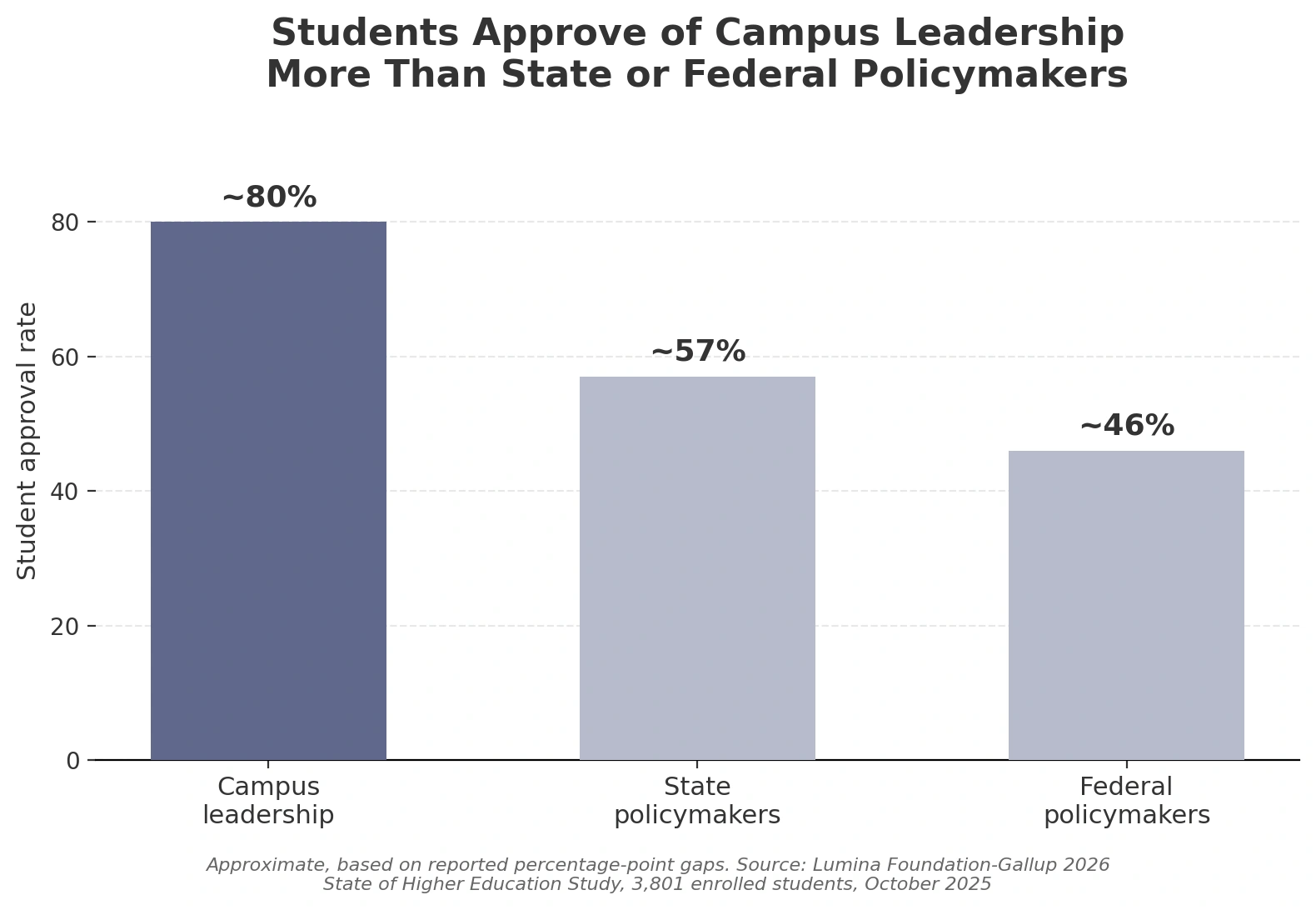
So the win here is real but limited. Students trust you more than they trust a senator. They still trust their own professors more than they trust you. It lines up with what platforms like Scholaro see when they work with advising teams: students rate the academic side of their experience higher than the administrative side, even at schools with strong overall satisfaction.
What Campus Leaders Should Do Now
Students trust you more than they trust a politician. That trust drops fast at bigger schools and for students who never find a mentor. Protect it before it slips.
Moves Campus Leadership Should Make
Keep decisions visible. Students trust what they can see, so keep policy changes transparent and easy to trace back to a real person or office. If you lead a large or top-ranked school, close the distance with small, regular touchpoints like town halls or open office hours. And build mentorship into the structure itself, embedded in orientation or intro courses instead of left optional, especially for first-generation students.
 How Universities Use Zero-Waste Swap Programs to Cut Student Costs
 How Industry Partnerships Shape Modern Curricula
 How Post-COVID Aid Programs Help Universities Rebuild Admissions
 Beyond the Acceptance Rate and How Colleges Decide Who Gets In
 How Leveraging Job Placement Strategies Can Reenroll Returning Students