

Most student achievement strategies fail not because the ideas are wrong, but because the systems behind them are missing. University leaders invest in programs, platforms, and frameworks with genuine intent. The results, more often than not, disappoint. Understanding why requires an honest look at what actually drives change in academic institutions and what consistently gets in the way.
Common intervention | Typical approach | Why it falls short |
|---|---|---|
Tutoring programs | Supplemental, opt-in | Addresses symptoms, not root instruction |
Analytics platforms | Data dashboards | Underused without trained staff |
DEI initiatives | Standalone programs | Not embedded in academic systems |
Leadership training | One-off workshops | No follow-through or accountability |
Strategic plans | Document-led reform | Implementation left to chance |
Start With the Adults, Not the Students
Before any student-facing initiative can produce results, the adults in the system need to be aligned. Faculty, advisors, department heads, and senior leaders need shared goals, shared language, and shared accountability. When that alignment is absent, even well-funded programs produce inconsistent results across departments.
This is not a new insight. As research on systems alignment in education confirms, sustainable change requires coherence between training, departmental culture, and institutional policy. Without it, the system is perfectly calibrated to produce the results it already gets.
The implication for university leadership is uncomfortable: if your student achievement strategy depends on persuading students to engage more, but faculty are not aligned on how to teach, advise, or assess them consistently, you are working in the wrong place.
Belonging Is a Structural Issue
Students who do not feel they belong are less likely to persist, regardless of what support exists around them. Belonging is not a soft concern. It is a structural one. Institutions that treat it as a diversity initiative rather than a core component of their academic systems misunderstand what drives retention.
The environment instructors create directly affects whether students experience themselves as capable participants in academic life. Research on equity frameworks in higher education found that when instructors held a growth mindset about student ability, racial disparities in course performance narrowed. The classroom itself is the intervention.
That means belonging cannot be outsourced to a student affairs team or addressed through a welcome week program alone. It has to be embedded in how faculty teach, how advisors communicate, and how departments respond when students struggle.
Build Systems That Outlast Leaders
One of the most persistent failure modes in higher education reform is leader dependency. Programs gain traction under a committed provost or dean, then stall or collapse when that person leaves. Lasting change requires systems, not champions.
Michael Fullan, in his work on educational change, argues that effective leaders must be coherence-makers: tying together moral purpose, relationship-building, and knowledge-sharing so the organization functions without depending on any single individual. If your student achievement strategy lives inside one person's calendar, it is not a strategy. It is a personal project with institutional funding.
The practical response is to embed reform into governance structures, job descriptions, hiring criteria, and performance reviews. Change that is not institutionalized will not survive the next leadership transition.
Invest in People Before Platforms
Technology platforms, analytics dashboards, and intervention software attract institutional investment because they feel concrete and scalable. They are also frequently underused, because the people operating them lack the training, time, or motivation to apply them well.
A 2023 RAND study found that educators most often identified professional development, teacher evaluation, and summative assessment as either missing from their systems or failing to provide useful guidance. That gap does not close by purchasing a new platform. It closes by treating staff capacity as a strategic priority, not an afterthought.
Develop Leaders So Gains Stick
Distributed leadership matters. When only senior administrators understand the rationale behind a reform, implementation breaks down at the department level. Building leadership capacity across the institution, down to program coordinators and department heads, is what allows gains to persist through transitions.
Research applying Kotter's change model in a university engineering department found that treating early steps as revisable, and strategies as improvable rather than fixed, was what built faculty buy-in and drove results. Most institutions do the opposite: announce a plan, assign ownership to one office, and measure outputs instead of behavior change.
Why Strategies Fail: The Common Fault Lines
Lack of alignment and focus. Institutions pursue too many initiatives at once. Fragmentation dilutes effort and prevents any single strategy from gaining traction. Research on instructional coherence shows that reform efforts strengthening alignment across curriculum, instruction, and assessment consistently outperform those adopting wide varieties of uncoordinated programs.
Implementation gaps. A strategy that exists in a policy document but does not change what happens in a classroom or advising session has not been implemented. It has been approved on paper. The distance between policy and practice is where most reform energy disappears.
Failure to address root causes. Tutoring programs are a common institutional response to poor outcomes. Research involving nearly 7,000 students found tutoring produced only a small increase in reading scores and no measurable gain in math over two years. The root problem, weak core instruction, stays untouched.
Fragmented approaches. When academic affairs, student services, and enrollment management operate in silos, students experience inconsistent support. The gaps between departments become the gaps in outcomes.
Failure in monitoring. Institutions frequently launch initiatives without feedback loops to identify what is working. Without structured monitoring, problems compound undetected and resources keep flowing toward efforts that have already stopped working.
The deficit model trap. Framing performance challenges as deficiencies within individual students leads institutions to design interventions that treat symptoms. Moving from deficit-based framing to opportunity-gap thinking changes which questions get asked, which data gets collected, and which interventions get funded.
Wasted effort on low-impact methods. John Hattie's Visible Learning research, synthesizing over 800 meta-analyses, puts feedback at an effect size of 0.70 and collective teacher efficacy at 1.57. Generic tutoring and mentoring programs sit well below the hinge point of 0.40. Institutions regularly invest in the latter while underfunding the former.
What the Sector Gets Wrong About System Change
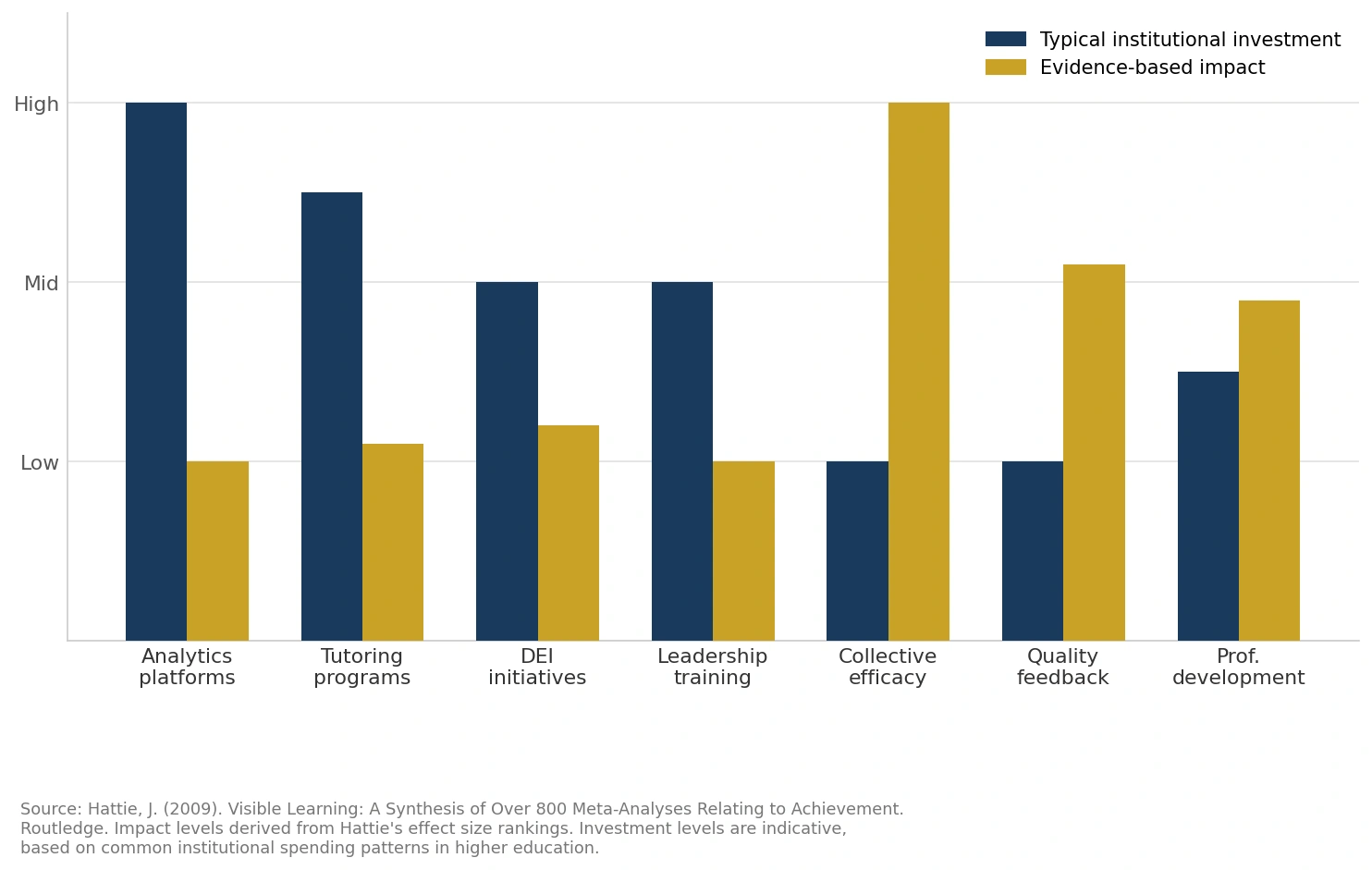
Higher education consistently underestimates the cultural dimension of reform. Policy changes and program launches do not shift behavior on their own. Leaders tend to treat change as a project with a start and end date, rather than an ongoing process requiring sustained attention, adaptation, and accountability.
The sector also overestimates what technology and structural reorganization can do, and underestimates what it takes to shift the beliefs and daily practices of faculty and staff. Announcing a new student success framework is not the same as changing what happens in a Tuesday afternoon advising appointment.
Real system change requires leaders who are willing to name what is not working, build coalitions around a clear direction, and stay focused long enough for new practices to take root. That work is slower, less visible, and less likely to generate a conference presentation. It is also the only kind that lasts.
From Recommendations to Real Change
Good advice that does not change behavior is not good advice. The gap between a consultant's report and actual institutional practice is where most reform energy disappears.
Closing that gap requires embedding recommendations into governance structures, assigning specific staff accountability for implementation, and building in structured review cycles that go beyond annual reporting. Kotter's model is direct on this point: empowering staff means giving them the knowledge, authority, and resources to act, and then removing the structural barriers that prevent them from doing so.
If recommendations are not tracked, revisited, and connected to performance expectations, they become shelf documents. Most do.
Maintaining Focus When Everything Keeps Changing
Leadership turnover, budget cycles, accreditation demands, and shifting policy priorities all compete for institutional attention. Maintaining focus on student achievement strategies amid that noise requires explicit prioritization structures, not just good intentions.
Fullan identifies this directly: leaders not attuned to coherence make the mistake of taking on too many projects and chasing too many external innovations. The result is initiative overload, where staff become skilled at absorbing new directives without meaningfully changing practice.
Protecting reform from overload means saying no to things that compete with the core strategy, even when those things look good on paper. It also means making the strategy visible enough that it cannot be quietly deprioritized when something urgent comes along.
Frameworks Worth Your Time
For university leaders who want to build on evidence rather than intuition, these are the most useful starting points:
Michael Fullan - The New Meaning of Educational Change: whole-system reform, coherence, and leadership capacity
John Hattie - Visible Learning: effect-size evidence on what actually moves student outcomes
John Kotter - Leading Change: organizational change in eight steps, widely applied in higher education
Vincent Tinto - institutional departure theory: the structural drivers of student retention
The National Student Clearinghouse Research Center - persistence and completion data: enrollment, persistence, and completion trends
The research is consistent across all of these sources. Student achievement strategies work when they are built on aligned systems, sustained by distributed leadership, and protected from the institutional tendency to move on before change has taken hold.
 How Universities Use Zero-Waste Swap Programs to Cut Student Costs
 How Industry Partnerships Shape Modern Curricula
 How Post-COVID Aid Programs Help Universities Rebuild Admissions
 Beyond the Acceptance Rate and How Colleges Decide Who Gets In
 How Leveraging Job Placement Strategies Can Reenroll Returning Students