

More than half of U.S. universities still lack formal AI implementation, yet 57% of college students already use AI in their coursework at least weekly. That gap between institutional readiness and student behavior is the challenge facing university leadership today. This strategic framework covers six areas to help you assess and advance LLM adoption: strategy development, implementation models, AI literacy education, policy creation, student-centered approaches, and talent acquisition.
1. Build a Coordinated AI and LLM Strategy
Most institutions have responded to generative AI with scattered initiatives. Individual departments buy tools, faculty create their own policies, and IT fields requests without clear priorities. This produces inconsistent policies, duplicated costs, and compliance risks.
A coordinated strategy needs four elements:
Vision alignment. Connect LLM adoption to your institutional mission. AI strategy should serve institutional strategy, not run alongside it.
Governance structure. Establish a cross-functional AI steering committee. The APRU recommends including academic affairs, IT, legal and compliance, student affairs, and faculty governance.
Phased roadmap. Start with low-risk, high-impact pilots. Administrative automation and research assistance carry less risk than assessment and grading applications.
Budget realism. Enterprise AI platforms cost $20 to $30 per user monthly. Multiply that across your faculty, staff, and student population, then add implementation and training. Once you factor all of that in, the total cost of ownership usually comes in higher than institutions expect.
2. Know Your Implementation Options
Universities are deploying LLMs across four primary areas:
Research support. Literature reviews, data analysis, and interdisciplinary collaboration. An analysis in The Conversation found strong potential in biological sciences, engineering, and social sciences. Low risk, high value.
Administrative operations. Enrollment management, student services chatbots, HR, and financial aid inquiries. These applications free staff for higher-value work and often deliver measurable ROI within months.
Teaching and learning. Course design, personalized feedback, and AI tutoring agents. Institutions piloting Microsoft Copilot for student use have reported performance gains of 10% and task completion time reductions of up to 40%.
Cybersecurity. AI-powered threat detection addresses staffing shortages while giving students hands-on experience.
Major LLM Platforms
Platform | Provider | More info |
|---|---|---|
ChatGPT | OpenAI | |
Claude | Anthropic | |
Gemini | ||
Copilot | Microsoft | |
Llama (open-source) | Meta |
Evaluate each platform on data privacy, system integration, enterprise support, and cost. A multi-vendor approach avoids lock-in. Make sure contracts preserve flexibility to switch providers.
3. Invest in AI Literacy Education
The Cengage AI Education report found 65% of higher ed students believe they know more about AI than their instructors. That perception, accurate or not, creates friction in the classroom. Faculty development has to become the foundation of your AI education strategy, not an optional workshop.
You have three curriculum integration models:
AI as subject. Dedicated courses in AI, machine learning, and data science. These serve students in technical fields but reach a limited population.
AI as tool. Integration across disciplines. Writing courses cover AI-assisted revision; research methods courses cover AI literature review. Broader reach, but requires faculty buy-in across departments.
AI as literacy requirement. Baseline competency for all graduates, treated like writing or quantitative reasoning. Few institutions have implemented this yet, but workforce expectations are pushing in this direction.
Graduate programs also need explicit guidance. Some institutions have collaborated with peers to develop guidelines for graduate research covering literature synthesis, data analysis, writing, and co-authorship questions. Don't leave students guessing.
4. Establish AI Policies That Work
Most top-ranked universities have landed on a tiered approach where policies vary by course, assignment type, or department. A blanket policy either restricts legitimate uses or fails to prevent misuse. A creative writing seminar has different concerns than a data science course.
Your policy should address six areas:
Scope. Define who is covered. Many early policies focused only on students and left faculty use unaddressed.
Permitted uses. Research support, administrative tasks, and brainstorming may be broadly permitted. Assessment and grading may need restrictions.
Prohibited uses. Specify what constitutes an academic integrity violation. The Duke Center for Teaching treats unauthorized AI use as cheating under the Duke Community Standard, with instructors defining permitted use per course.
Disclosure requirements. When and how must AI use be acknowledged.
Data handling. Student data, research data, and proprietary institutional information may require different treatment.
Enforcement. Align consequences with existing academic integrity processes.
If you operate study abroad programs, have EU-based online students, or partner with European institutions, the EU AI Act's transparency requirements apply to you.
Regional accreditors are weighing in too. In October 2025, the C-RAC accreditor statement confirmed that using AI in learning evaluation does not conflict with accreditation standards. Build annual policy reviews into your process from the start.
5. Center Your Students in AI Strategy
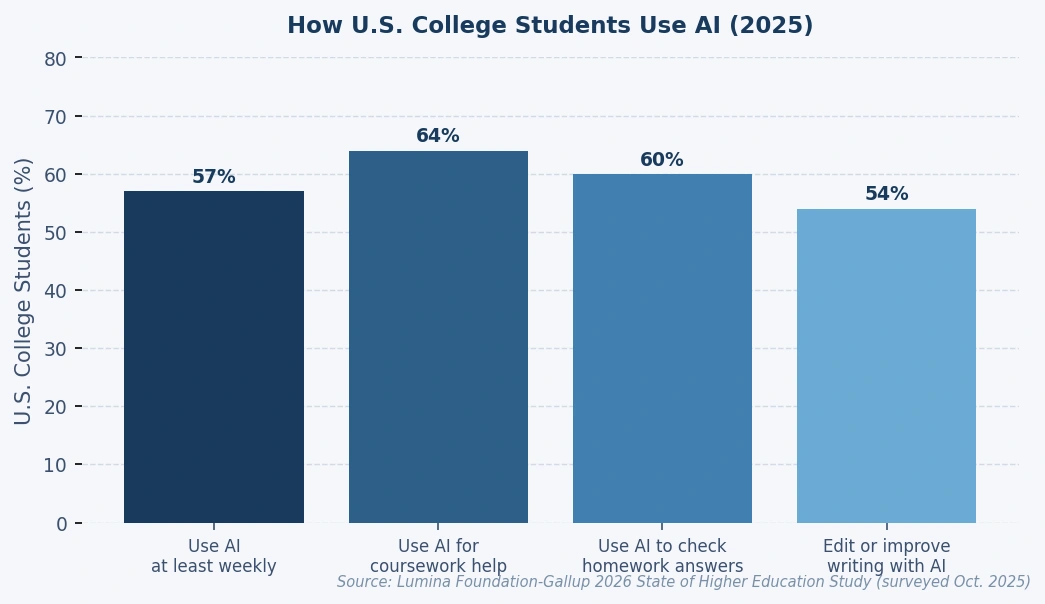
U.S. college students are already using these tools at scale. The Lumina Foundation-Gallup study found 57% of U.S. college students use AI in their coursework at least weekly, and about one in five use it daily. More than half who avoid it say they consider it unethical or cheating. They want to learn responsible AI use, not just be told what is banned.
Equity matters here. Premium AI tools create advantage gaps. Students who can afford $20 monthly subscriptions access capabilities that free tiers don't offer. Institutional licensing levels the playing field.
AI can also strengthen student support infrastructure. Early warning systems identify at-risk students by analyzing engagement patterns. Personalized learning pathways adapt to individual progress. Chatbots extend help beyond office hours.
Picture this: a first-year student misses several classes and stops submitting assignments. An AI-powered early warning system flags the drop in engagement within days, prompting an advisor to reach out before the student falls too far behind.
Keep one thing clear: AI should supplement human connection, not replace it. Over-reliance may weaken critical thinking, and students still need human mentorship.
6. Recruit and Retain AI Expertise
PhD-level AI talent is scarce. AI job postings jumped 50% while the annual supply of new AI PhDs remains in the hundreds. Tech companies can double or triple academic salaries. You need a realistic strategy.
Four hiring models to consider:
MODEL 1
Chief AI Officer
Executive-level coordination signals institutional commitment and creates accountability.
MODEL 2
Distributed faculty lines
Dedicated AI faculty across departments, not just computer science. Business, health sciences, and humanities all need faculty who can connect AI to their disciplines.
MODEL 3
Technical staff
Data engineers, AI trainers, and instructional designers with AI fluency. These roles often go unfilled until projects stall.
MODEL 4
Hybrid models
Fractional or consulting arrangements address specialized needs without full-time commitments.
On retention: autonomy, cross-functional collaboration, and publication opportunities matter as much as salary to many researchers. Build internal pipelines by upskilling existing staff rather than relying entirely on external hires.
Your Next Steps
LLM adoption is a strategic imperative, not a technology project. It touches teaching, research, operations, student experience, and institutional reputation.
Bring these four questions to your next leadership meeting:
☐ Do we have a cross-functional committee managing AI, or are departments working in silos?
☐ Have we given faculty the training and policy templates they need to handle AI in the classroom?
☐ Are we widening an equity gap by leaving students to rely on free, lower-quality AI tools?
☐ Do our data security protocols protect student and faculty work from being fed into public models?
Where you answer "no" or "I don't know," you have found your starting points. Speed matters, but so does intentionality. Institutions that rush in without governance structures create problems they will spend years fixing. Conduct an institutional AI readiness assessment this quarter. Assign ownership. Set timelines. The institutions that act now will hold real advantages in enrollment, research funding, and operational performance for years ahead.
 How Politics Is Shaping College Enrollment
 How Top Performers Land US Job Offers
 The College Majors Foreign Students Regret Choosing
 The Tightest Job Market in Years for College Grads
 How Universities Are Adapting Health Programs to a Moderating Job Market