
If you run recruitment or academic strategy at a university, you already know international students weigh a lot before picking a school. Rankings matter. Cost matters. But one factor decides more applications than most leadership teams give credit for: what happens to a student after graduation, work-wise. Post-study work visas aren't a footnote. They're often the deciding line item.
Here's the thing. Two schools can offer near identical programs, and a student will pick the one with better post-graduation work rights every time. If your institution isn't factoring that into recruitment messaging, you're leaving enrollment on the table.
Quick Comparison: Who Offers What
Before we go section by section, here's how the U.S. stacks up against the destinations students compare it to most. Raw visa length only tells half the story now. Field restrictions and language rules matter just as much.
Country | Post-study visa | Max duration | Eligibility hurdles | Path to residency |
|---|---|---|---|---|
United States | OPT / STEM OPT | Up to 36 months | Work must tie to major. STEM extension needs an E-Verify employer. | Indirect, via H-1B |
Canada | PGWP | Up to 3 years | Degree holders need a language score of CLB 7. Non-degree programs also face field of study restrictions. | Direct, via Express Entry |
Australia | Subclass 485 | 2 years Bachelor's, 2 to 3 years Master's, 4 years PhD | Age cap of 35 (exceptions for research degrees). English test required within 12 months of applying. Regional study adds 1 to 2 years. | Indirect, points based |
United Kingdom | Graduate Route | 2 to 3 years now, dropping to 18 months for non-PhD graduates from January 2027 | No language or field requirement beyond course completion. | Indirect, via Skilled Worker |
Why Work Rights Shape the Decision
Students don't pick a school just for the degree. They're weighing four or five years of their life, including what comes after the diploma. A degree with no work runway attached is a much harder sell, no matter how strong the program is.
If a student, for example, gets into two comparable graduate programs and one path to a job after graduation is clearer than the other, that's often what decides it, not the coursework. Post-study work rights don't just affect where a student ends up. They affect whether that student applies to your program in the first place.
An IDP Education survey of 8,000 students, cited in a NAFSA issue brief, put a real number on that hesitation. 66 percent of respondents said they'd pick a different destination if post-study work options were removed. That's not a small preference. That's a majority of your applicant pool telling you exactly what they need to hear before they apply.
The Career Case: Real Work, Real Networks
Work authorization after graduation isn't just about earning a paycheck. It's the difference between leaving with a diploma and leaving with actual U.S. work history, references, and a professional network in the field a student studied for.
That's the pitch international offices should be making harder. A program that connects directly to a work authorization pathway gives students something concrete to build toward, not just a transcript.
The Risk Side: What's Changing Right Now
Here's where leadership teams need to pay close attention. The Congressional Research Service notes that over 1.5 million F-1 and M-1 students and recent graduates were in the U.S. in 2024, with about a quarter authorized to work through OPT. That's a program a lot of policymakers are actively debating right now, which means the rules your students rely on could shift again with little warning.
It just got tighter. The Department of Homeland Security finalized a rule in July 2026 that removes "duration of status" for F-1 students and shortens the post-work grace period from 60 days to 30. That's the window a graduate has to leave the country, transfer programs, or change status once their work authorization ends. Thirty days is a tight runway if a job falls through or a visa case gets delayed.
For your recruitment story, this matters. Every added layer of uncertainty is one more reason a hesitant applicant picks a different program altogether. Students talk to each other. A shrinking grace period becomes forum chatter fast, and forum chatter shapes next year's applicant pool.
The Financial ROI: Connecting Visa Policy to University Revenue
If the career argument doesn't land with your board, the money will. According to NAFSA, international students contributed $42.9 billion to the U.S. economy and supported over 355,000 jobs in the 2024-25 academic year. That's a 2 percent drop from the year before, the first decline since the pandemic.
It gets sharper. The same report projects a further $1.1 billion loss and nearly 23,000 fewer jobs for fall 2025, tied to a 17 percent drop in new international enrollment. That's not a rounding error. That's a direct line from tighter post-study work policy to fewer applications to lower revenue on your own campus.
If a student, for example, is choosing between your program and a nearly identical one, the school that can clearly explain the work pathway after graduation is the one that wins the application. Multiply that by a few thousand students and you're looking at real tuition dollars.
What This Means for Your Institution
You can't rewrite federal immigration policy from your office. But you can control how clearly your institution explains the pathway that does exist, and how fast you move once a student is ready to enroll.
Put post-graduation work options front and center in recruitment materials, not buried in an FAQ page.
Bridge the gap between International Student Services and admissions or marketing. Visa advisors often know about a policy shift weeks before marketing updates its messaging to match.
Partner career services with international offices to highlight STEM OPT employer networks, internship placement rates, and H-1B sponsorship track records directly on program pages.
Build advising capacity now around the new grace period rules, since students will need faster decisions once their work authorization ends.
Address the 30-day grace period and other regulatory changes head-on in webinars and FAQs. Silence reads as unpreparedness.
Keep messaging honest about the H-1B lottery. Overpromising a guaranteed outcome damages trust fast when a student doesn't get picked.
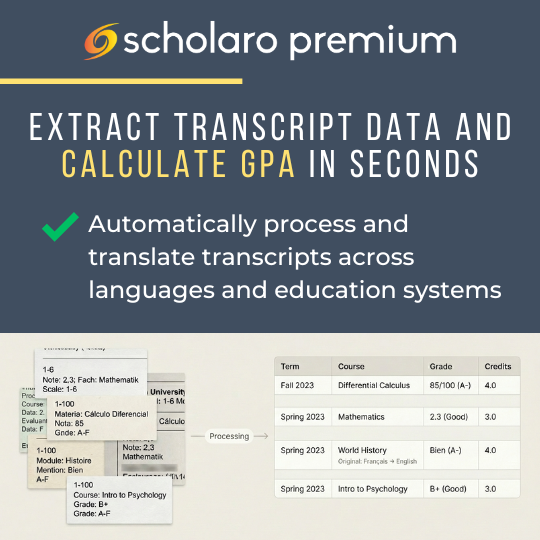
Speed matters just as much as messaging. When students face tight visa windows and complex eligibility requirements, a slow admissions decision can cost you the applicant entirely. Part of that speed comes down to how fast a school can process foreign transcripts and coursework. Scholaro is one of the tools institutions use for that step, since a quicker credential evaluation means one less delay between acceptance and a student's visa timeline.
Policy Friction Is a Recruitment Edge
Post-study work rights are a recruitment tool, a risk factor, and a revenue line all at once. Schools that pay attention now will have a real edge over the ones still treating this as an afterthought.
 How Universities Use Zero-Waste Swap Programs to Cut Student Costs
 How Industry Partnerships Shape Modern Curricula
 How Post-COVID Aid Programs Help Universities Rebuild Admissions
 Beyond the Acceptance Rate and How Colleges Decide Who Gets In
 How Leveraging Job Placement Strategies Can Reenroll Returning Students