Recruiters see OPT and CPT on plenty of resumes, but most don't fully get what these terms mean for hiring you. That gap is on you to close. Explain your work authorization clearly and you knock out the hesitation before it even starts.
Here's what to say, when to say it, and how to answer the questions recruiters actually ask.
Feature | CPT | OPT |
|---|---|---|
When you use it | While still enrolled | Mostly after graduation |
Job offer needed first | Yes | No |
Duration | Set by your DSO, tied to your program | 12 months, plus 24 more for STEM degrees |
Who approves it | Your school's DSO | USCIS |
Cost to the employer | None | None |
One clarification on that OPT row: you don't need a job offer to apply, but once your OPT start date hits, you get 90 days to find work before your authorization is at risk.
What Recruiters Want to Hear First
Most hiring hesitation about international candidates comes down to three worries. Answer them upfront and save everyone the back and forth.
No immediate sponsorship needed. OPT and CPT come built into your F-1 status. The employer isn't filing anything or paying a fee for you to work.
No extra cost. There's no employer fee for CPT or standard OPT. Even the STEM extension just needs the employer enrolled in E-Verify, which most established companies already are.
A real timeline. You can apply for OPT starting 90 days before your program ends and up to 60 days after. Give the recruiter your actual dates instead of a vague range.
If a student, for example, misses out on a callback because a recruiter assumes OPT means a lengthy visa process, a single follow-up email with the actual dates and rules can turn that around, sometimes fast enough to land the offer within a week.
Get CPT Straight in Your Own Head First
You can't explain CPT well if it's fuzzy to you. Curricular Practical Training is temporary, off-campus work tied to your major. Your school's Designated School Official has to sign off on it, and it goes on your I-20 before you start working, not after.
CPT comes in two flavors:
Part-time: 20 hours a week or less, while you're enrolled.
Full-time: more than 20 hours a week, usually during a break or a dedicated internship term.
One rule matters more than the rest. Rack up 12 months or more of full-time CPT and you lose your OPT eligibility for that degree, period. Part-time CPT never counts toward that limit, no matter how long you use it. Most students never get close to a full year of full-time CPT, so this rarely bites anyone, but it's smart to know before you say yes to a full-time internship offer.
If a student, for example, takes one full-time summer internship through CPT and worries it will wreck their OPT eligibility, they can relax. One internship is nowhere near the 12-month threshold. The real risk only shows up after repeated, long stretches of full-time CPT that stack up to a full year or more.
Quick side note while we're on terms: pre-completion OPT is the version you can use while still enrolled, usually part-time during the school year or full-time over breaks. Post-completion OPT, the one this article mostly covers, kicks in after you finish your degree.
What OPT Actually Gets You
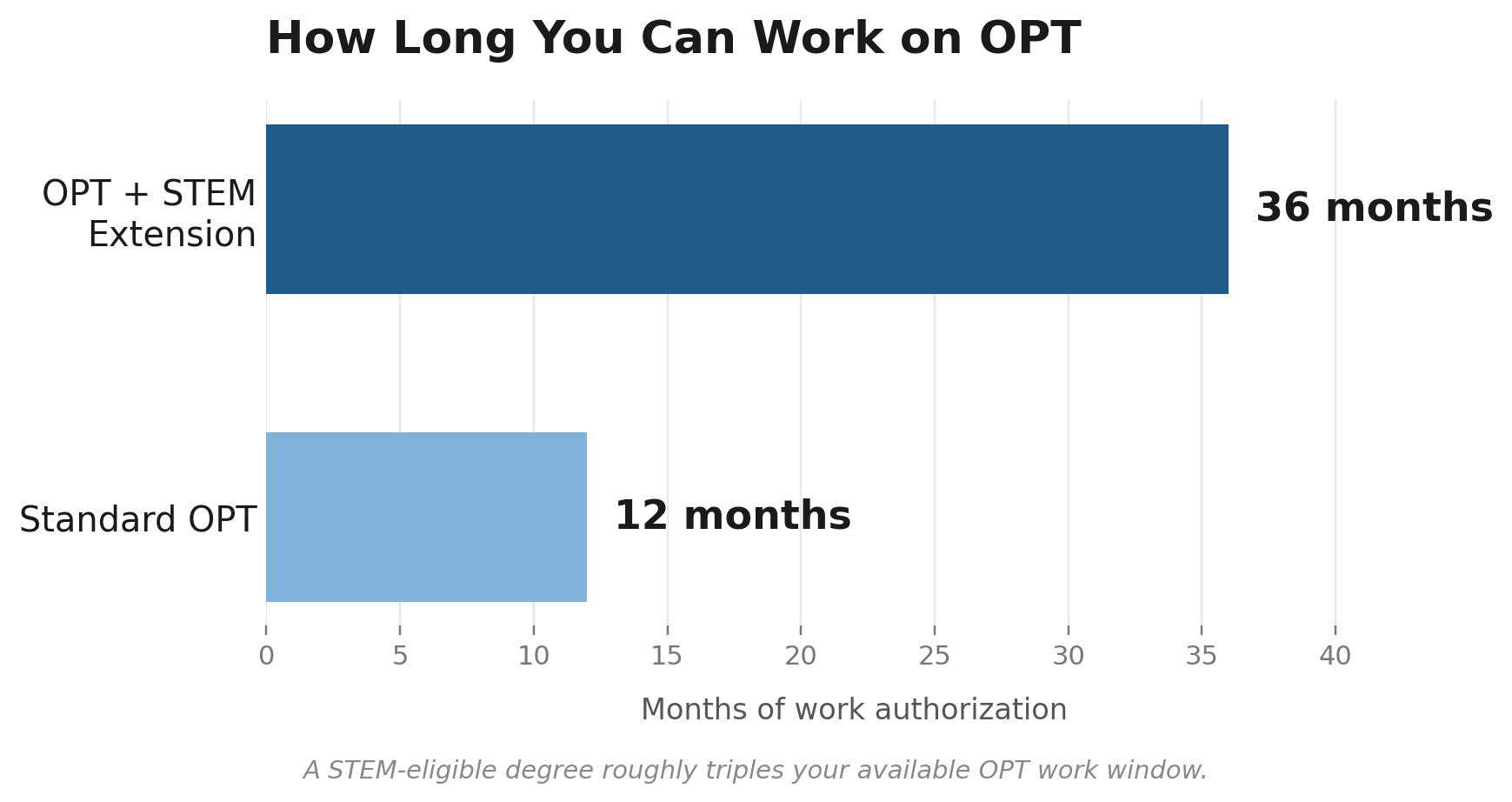
Standard post-completion OPT gives you 12 months of work authorization tied to your major, once you finish your degree. If your degree falls on the DHS STEM list, you can apply for a 24-month extension on top of that, bringing your total to 36 months.
You'll submit Form I-983, a short training plan, to your school to get an updated I-20. Then you file Form I-765 with USCIS for your actual STEM EAD. USCIS plays a real role here too, alongside your school. Since the filing window opens 90 days before your current OPT expires, getting your I-983 done early keeps the whole timeline smooth.
Processing time varies. Standard OPT usually clears in a few months. The STEM extension can take longer given current USCIS case volume, so file as early in your window as you can.
Talking About H-1B Without Overpromising
Recruiters often want to know what happens once your OPT runs out. Be upfront: the H-1B lottery isn't guaranteed, and you're not asking them to commit to anything today.
One detail worth knowing: if you get picked in the H-1B lottery and your employer files the actual petition asking for a change of status before your OPT or grace period runs out, your F-1 or STEM OPT status automatically extends through the end of September. That bridges you to the October 1 H-1B start date with no gap in work authorization. This is the cap-gap extension, and it only kicks in once that petition is filed and received on time.
Frame OPT and the STEM extension as your working runway, not a placeholder. You've got up to 36 months to prove yourself before H-1B even enters the picture.
A Timeline Change Worth Knowing
DHS published a final rule on July 17, 2026, that ends "duration of status" for F-1 students. It takes effect September 15, 2026. The part that matters most here: the grace period after your OPT ends is shrinking from 60 days to 30 days. That's the window you have to leave the country, transfer to a new program, or change your status once your work authorization runs out.
There are transition provisions for students already in the U.S. before the effective date, so this isn't a clean cut for everyone on the same day. Still, if your OPT or STEM OPT is ending anywhere near or after September 15, 2026, plan your next step earlier than you normally would. Thirty days moves fast.
Traveling While on OPT or CPT
If your job search or new job involves international travel, keep a few things current. Get your travel signature updated by your DSO before you leave, and carry your EAD card, a copy of your job offer or employment letter, and a valid passport. Answer any questions at the border directly and briefly. Officers see thousands of F-1 cases, and short, consistent answers land better than long ones.
A Script You Can Actually Use
You don't need to recite immigration law. Use this when a recruiter asks about your work status:
"I am currently fully authorized to work in the U.S. under post-completion OPT through [Date], with no sponsorship or legal fees required from [Company Name]. Because my degree is in a STEM field, I am also eligible for a 24-month extension, giving me a total of 3 years of seamless work authorization. I'd be happy to share my I-20 or EAD details whenever helpful."
Swap in your real dates and company name, and you've covered the four things a recruiter actually needs: your status, the cost (none), your STEM eligibility if it applies, and an easy way to verify it.
If you also want to see how your foreign coursework reads to a U.S. employer, a tool like Scholaro's GPA tool can help with that piece too.
Keep It Simple
Recruiters just want clear dates and no surprises. Give them that, and the conversation moves fast.
This article is for general information only and isn't legal advice. Immigration rules change often, including the update noted above, so confirm your specific situation with your school's international student office or an immigration attorney before making decisions about your status.
 5 ways colleges can make career prep 'unavoidable' for students
 The Real Economics Behind Entry-Level Gigs
 Can 3-Year Degrees Solve the Teacher Shortage?
 Does College Public Speaking Really Matter in Today’s Job Market?
 Strategies for Communicating Tuition and Outcomes to Prospective Students