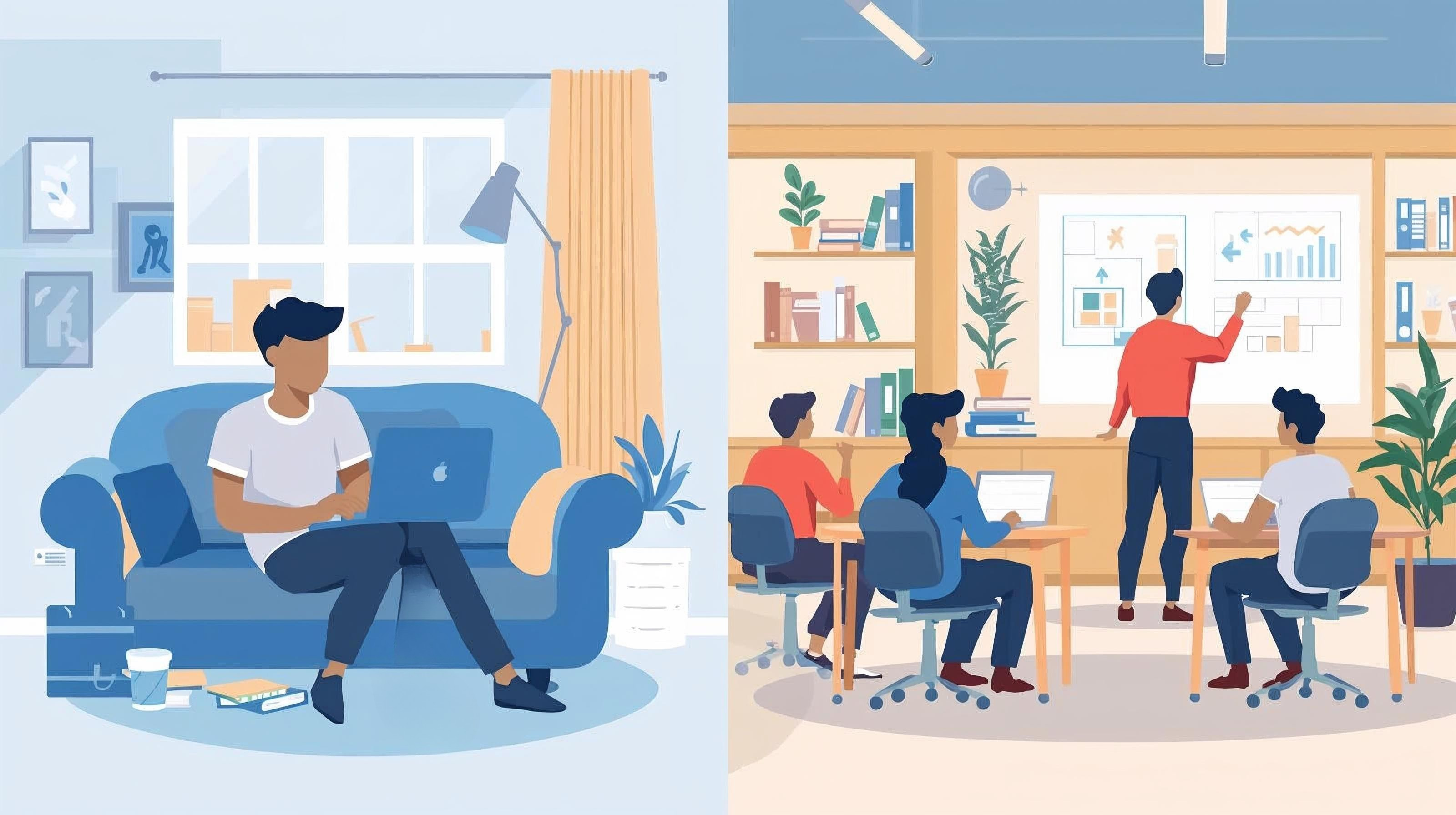
The way Americans earn degrees has changed. What was once a clear choice between commuting to campus or not attending at all has become a spectrum of options. Online study vs. classroom experience is no longer a fringe debate. It sits at the center of how students, graduates, and employers think about education's value.
Over 40 million US students have taken at least one online course. Many completed entire degrees remotely. Others sat in lecture halls five days a week. Some did both. Now, as graduates enter the workforce and reflect on their education, a reasonable question emerges: which format actually made a difference?
The answer is not simple. Both formats have clear strengths. Both have weaknesses. The impact of either depends on your learning style, career goals, financial situation, and the field you want to enter. This article breaks down what each format does well, what research says about outcomes, and what matters most for long-term success.
What Each Format Does Well
Online Learning Strengths
Online education works for people whose lives do not fit a traditional schedule. Working professionals, parents, military personnel, and anyone living far from a university campus can earn degrees without relocating or quitting their jobs.
Flexibility is the headline benefit. You can watch lectures at midnight or 6 a.m. You can rewind and rewatch content you did not understand the first time. You can complete coursework during lunch breaks or between shifts. For anyone juggling responsibilities, this flexibility is not a luxury. It is a requirement.
Cost savings add up quickly. No commuting means no gas, parking fees, or vehicle wear. No campus housing means no room and board expenses. Digital textbooks often cost less than physical ones. These savings matter, especially for students financing their own education.
Online learning also builds skills employers value. Completing a degree remotely requires self-discipline, time management, and the ability to work independently. You cannot coast through an online program. You must manage your own schedule, meet deadlines without daily reminders, and stay motivated without a professor standing in front of you.
Classroom Learning Strengths
Traditional classroom education offers something online formats struggle to replicate: immediacy. When you sit in a room with an instructor, you get real-time feedback. You can ask a question and receive an answer in seconds. You can read facial expressions, pick up on tone, and adjust your understanding on the fly.
Structure helps many students succeed. Showing up to class at a set time creates accountability. The physical environment signals to your brain that learning is happening now, not whenever you get around to it. For students who struggle with procrastination, this structure can make the difference between finishing a degree and dropping out.
Social connections form more naturally in person. Study groups happen after class. Friendships develop over coffee. Professional networks begin with the person sitting next to you. These relationships often outlast the degree itself and become sources of job referrals, mentorship, and collaboration years later.
Hands-on learning remains a classroom advantage. Lab sciences, clinical training, studio arts, and skilled trades require physical presence. You cannot learn to draw blood through a screen. You cannot practice welding via Zoom. For fields that demand tactile skills, classroom experience is not optional.
How Technology Shapes Both Environments
Technology no longer belongs exclusively to online education. It has transformed physical classrooms just as thoroughly. Smartboards replaced chalkboards. Learning management systems organize assignments for in-person and remote students alike. Polling software lets instructors gauge understanding in real time.
In online settings, technology enables adaptive learning platforms that adjust difficulty based on student performance. Recorded lectures allow unlimited review. Discussion boards create asynchronous conversations that introverted students often prefer over speaking up in class. Collaborative tools let groups work together across time zones.
The most effective programs now use technology to create immersive experiences regardless of format. Virtual reality takes geology students inside rock formations. Simulations let nursing students practice patient assessments. AI tutoring systems provide personalized feedback at scale.
Hybrid models combine the advantages of both settings. Students might attend lectures online but come to campus for labs, exams, or group projects. This approach recognizes that some content works better digitally while other learning requires physical presence.
One point matters more than format: instructional design and teacher involvement determine outcomes more than whether a course happens online or in person. A poorly designed classroom course will fail students just as thoroughly as a poorly designed online one. Technology is a tool. How instructors use it makes the difference.
What Research Says About Academic Outcomes
Studies on online vs. classroom learning produce mixed results. A US Department of Education meta-analysis found that online students performed slightly better on average than their in-person counterparts. The analysis covered research from 1996 to 2008 and found that students in blended or fully online environments ranked in the 59th percentile on tested performance, compared to the 50th percentile for traditional classroom students.
However, other research tells a different story. A 2024 study published in Humanities and Social Sciences Communications found that in-person students achieved higher outcomes in certain subjects, particularly in freshman-level courses where students had not yet developed strong study habits.
Student preference data adds another layer. In a 2024 survey, 54% of students preferred classroom learning because it helped them focus and stay motivated. Many students who tried online learning for the first time found it isolating and struggled to maintain engagement.
Why do results vary so much? Several factors explain the inconsistency.
Subject matter plays a significant role. Theory-based courses in business, humanities, and social sciences often translate well to online formats. Courses requiring lab work, clinical practice, or physical skill development lose something in digital translation.
Student characteristics matter enormously. Self-motivated learners with strong time management skills tend to thrive online. Students who need external structure and accountability often struggle without the rhythm of in-person attendance.
Program quality varies widely. A well-designed online course with interactive elements, regular instructor feedback, and opportunities for peer collaboration can match or exceed a traditional course. A poorly designed online course consisting of recorded lectures and multiple-choice quizzes will fail to engage students regardless of their learning style.
The Primary Drawback of Online Learning
Ask graduates what they missed most about learning online, and one answer dominates: human connection. The lack of face-to-face interaction creates problems that compound over time.
Immediate feedback disappears in asynchronous environments. In a classroom, you can raise your hand and get an answer in seconds. Online, you might wait hours or days for a response. That delay can stall understanding and allow confusion to harden into misunderstanding.
Social isolation affects mental health. School is not just about content. For many students, it is their primary source of social contact. When that contact moves entirely online, stress and anxiety often increase. Students report feeling disconnected not just from peers but from the institution itself.
Motivation suffers without structure. The flexibility that makes online learning attractive also makes procrastination easy. Without set class times, deadlines can feel abstract. Without peers working alongside you, the pressure to keep up diminishes. Many students fall behind and never catch up.
Practical learning takes a hit. You can read about laboratory techniques. You can watch videos of surgical procedures. But reading and watching are not the same as doing. Fields requiring hands-on competency suffer when training moves entirely online.
Academic integrity concerns persist. Remote assessments are harder to proctor. Students can more easily access unauthorized materials during exams. While proctoring software has improved, it cannot fully replicate the controlled environment of an in-person testing center.
These drawbacks do not make online learning invalid. They do mean that online programs must work harder to compensate for what the format naturally lacks.
What Influences Learning Outcomes Most?
Format matters less than you might think. Research consistently shows that student success depends on multiple interacting factors, not a single variable like delivery method.
The 5 C's of Learning
Education researchers have identified five skills that define success in 21st-century learning: critical thinking, creativity, communication, collaboration, and citizenship. These competencies matter more than memorizing content.
Critical thinking involves analyzing information, evaluating evidence, and forming reasoned conclusions. Both formats can develop this skill when courses require students to engage with complex problems rather than simply absorb facts.
Creativity means generating new ideas and approaching challenges from fresh angles. Online environments can foster creativity through multimedia projects, digital portfolios, and design challenges. Classrooms offer spontaneous brainstorming and collaborative ideation.
Communication skills develop through practice. Online students practice written communication extensively through discussion posts, emails, and collaborative documents. Classroom students get more practice with verbal communication and reading nonverbal cues.
Collaboration requires working with others toward shared goals. Online platforms enable collaboration through group projects, shared workspaces, and video meetings. Classrooms allow for more fluid, informal collaboration that happens naturally when people share physical space.
Citizenship involves understanding your responsibilities within communities. Both formats can address civic engagement, ethical reasoning, and global awareness when instructors intentionally incorporate these themes.
Neither format has a monopoly on building these competencies. What matters is whether the program intentionally develops them.
Three Factors That Drive Student Success
Beyond the 5 C's, three factors consistently predict whether students succeed.
Engagement and motivation sit at the top. Students who connect with their material, feel curious about the subject, and see relevance to their goals perform better in any format. Disengaged students struggle whether they sit in a lecture hall or watch from their couch.
Quality instruction matters more than delivery method. Effective teaching and engaging communication drive outcomes. A skilled instructor can make an online course compelling. A disengaged instructor can make an in-person course ineffective. The human element of teaching transcends format.
Support systems catch students before they fall. Access to tutoring, academic advising, mental health resources, and peer support networks helps students navigate challenges. Programs that invest in support infrastructure see higher completion rates regardless of delivery format.
Self-discipline amplifies everything else. Students who manage their time well, meet deadlines consistently, and take responsibility for their learning succeed in both formats. Students who lack these skills struggle everywhere but face steeper consequences online where no one is watching.
A sense of belonging keeps students enrolled. Feeling connected to an institution, a peer group, or even a single instructor provides motivation to persist through difficult stretches. Building belonging is harder online but not impossible.
How Employers View Each Credential
Employer perception of online degrees has shifted over the past decade. A decade ago, many hiring managers viewed online credentials with skepticism. Today, 87.4% of employers surveyed in a 2024 NACE study reported hiring graduates with online degrees. Additionally, 100% of those employers paid online graduates the same starting salary as in-person graduates.
This parity reflects growing acceptance. Most employers now understand that accredited online programs require the same coursework, meet the same standards, and produce graduates with the same knowledge as traditional programs. The degree itself often does not even specify how coursework was completed.
However, perception varies by region and industry. Two-thirds of global employers still believe in-person programs build stronger leadership and communication skills. US employers are more skeptical than those in Asia about online credentials, though this gap is narrowing.
Field of study influences perception significantly. In business, technology, and education, online degrees face less stigma. Employers in these fields often care more about skills and experience than where you sat while learning. In healthcare, engineering, and law, employers often prefer traditional credentials because these fields require extensive hands-on training that online formats cannot fully replicate.
Accreditation and institutional reputation matter more than format. An online degree from a well-known, regionally accredited university carries more weight than an in-person degree from an unaccredited institution. Employers who care about credentials care about quality signals, not delivery mechanisms.
The skills online learning develops can work in graduates' favor. Completing a degree while working full-time demonstrates time management, self-motivation, and the ability to balance competing demands. These are skills many employers seek in candidates.
Making the Right Choice for Your Situation

No format is objectively better. The right choice depends on your circumstances, goals, and learning preferences.
Online learning fits well if you:
Work full-time and cannot attend daytime classes
Have caregiving responsibilities that limit your schedule
Live far from a campus offering your desired program
Learn well independently and manage your own time effectively
Are pursuing a field where online credentials face no stigma
Classroom learning fits well if you:
Need structure and external accountability to stay on track
Learn through discussion, debate, and spontaneous interaction
Value the social aspects of education and want to build a peer network
Are pursuing a field requiring lab work, clinical training, or hands-on practice
Struggle with motivation when working alone
Hybrid options work for students who want both flexibility and some in-person contact. Many programs now offer courses that blend online content delivery with periodic campus sessions for exams, labs, or networking events.
Before choosing, ask yourself honest questions. How do you actually learn, not how you wish you learned? What does your target career field expect? What resources do you need to succeed, and which format provides them?
Talk to graduates of programs you are considering. Their experience will tell you more than marketing materials. Ask what they wish they had known before enrolling.
Conclusion
The debate over online vs. classroom learning often misses the point. Neither format is universally superior. Both can deliver solid education when designed well and delivered by committed instructors. Both can fail students when executed poorly.
What matters is fit. The right format matches your life circumstances, learning style, and career goals. It provides the support you need and develops the skills employers value. It challenges you without overwhelming you.
Technology continues to narrow the gap between formats. Tools that once belonged only to physical classrooms now enhance online learning. Methods developed for remote education now improve in-person instruction. The distinction between online and classroom learning grows less defined each year.
Employer acceptance of online credentials has increased substantially. Most hiring managers no longer penalize candidates for earning degrees remotely. Accreditation, institutional reputation, and demonstrated skills matter far more than delivery format.
If you are a graduate reflecting on your education, do not evaluate it solely by format. Consider whether it prepared you for your career, built skills you use daily, and connected you with people who matter to your professional life. Those outcomes determine whether your education had impact, regardless of where the learning happened.
If you are choosing between formats now, focus less on the delivery mechanism and more on program quality, accreditation, and your own commitment to learning. The education that serves you well is the one you will complete, apply, and build upon for the rest of your career.
 Understanding the Decline of International Enrollment in American Universities
 Why AI Writing Polish Can Flatten Student Expression
 Connecting International Talent to Inclusive Careers
 How to Find Legitimate College Scholarships
 Strategic Choice in Times of Uncertainty: Insights for Campus Leaders