
AI tools are reshaping science education. Over half of college students now use AI monthly for coursework, with that number climbing to 92% globally. For science majors tackling complex lab work, data analysis, and technical writing, AI offers powerful support. But success requires understanding both the capabilities and limitations of these tools.
How Students Use AI in Science Courses
Students apply AI tools across different stages of their coursework. The following table shows common applications and their appropriate use cases.
Task Category | AI Tool Examples | Appropriate Use | Common Pitfall |
|---|---|---|---|
Literature Research | Consensus, ScholarAI | Finding relevant studies, summarizing findings | Accepting fabricated citations |
Data Analysis | Julius AI, ChatGPT | Generating code, identifying patterns | Using results without understanding statistics |
Writing Assistance | Grammarly, Claude | Improving clarity, fixing grammar | Submitting AI-generated content as own work |
Concept Learning | ChatGPT, Claude | Explaining difficult topics, creating practice problems | Over-reliance preventing skill development |
Building Research Foundations with AI
Before starting any experiment or research project, you need background knowledge. AI research assistants help you locate relevant literature and understand complex concepts quickly. Tools like Consensus, ScholarAI, and similar platforms search databases to find peer-reviewed articles, then summarize key findings in plain language.
You can ask these tools to explain the current state of research on a specific topic, identify gaps in existing studies, or suggest experimental approaches. This preliminary research phase becomes faster and more thorough with AI assistance.
Science courses throw difficult concepts at you rapidly. ChatGPT and similar tools break down complex theories, chemical reactions, or biological processes into digestible explanations. You can request explanations at different comprehension levels, ask follow-up questions, and generate practice problems.
AI excels at creating analogies and visual descriptions that make abstract concepts concrete. If you're struggling with enzyme kinetics or quantum mechanics, AI can provide multiple explanations until one clicks.
Strong hypotheses come from understanding existing research patterns. AI analyzes previous studies to help you identify testable questions and predict potential outcomes. Virtual simulations let you test variables before entering the lab, saving time and resources.
You can describe your research interest to AI and receive suggestions for experimental design, control variables, and measurement methods. This planning phase helps you approach lab work with clearer direction.
Avoiding Common Mistakes
AI confidently generates plausible but incorrect information. It might cite non-existent studies, provide wrong chemical formulas, or misstate scientific principles. Always verify outputs thoroughly against peer-reviewed sources.
Never copy AI-generated content directly into lab reports without fact-checking. Cross-reference claims with your textbook, scientific databases, or instructor materials. AI is a starting point, not a final authority.
The biggest risk is letting AI do your thinking. Using it as a crutch prevents you from developing research and analysis skills that define scientific competence. Students need to balance AI assistance carefully with independent work.
Research shows different outcomes based on how students use AI tools. The following chart illustrates the impact on critical thinking skills.
Students who use AI to brainstorm and clarify concepts show improved learning. Those who use it to complete entire assignments show weaker critical thinking skills. The tool should enhance your abilities, not replace them.
AI-generated citations contain mistakes. Authors get misattributed, publication dates are wrong, and entire references may be fabricated. Verify every citation individually using primary sources or citation databases before including it in your work.
Never trust AI-generated bibliographies without thorough checking. One fabricated citation can undermine your entire paper's credibility.
Using AI Responsibly in Science Courses
AI policies vary widely by instructor and assignment. Some professors welcome AI for brainstorming and editing. Others prohibit it entirely. Most fall somewhere in between, allowing specific uses while restricting others.
Check your syllabus carefully. If AI policies aren't clear, ask your instructor directly before using any tools. Assumptions about what's acceptable often lead to academic integrity violations. Cornell University's Center for Teaching Innovation notes that policies should be communicated in syllabi, assignment instructions, and verbally in class.
Keep detailed logs of prompts and outputs. Track tools used including version numbers, dates, and specific tasks. Save transcripts of your AI conversations.
This documentation serves two purposes. First, it helps you stay honest about your work process. Second, it provides evidence if questions arise about your academic integrity. Many students have been falsely accused of AI misuse. Detailed records protect you.
Your analysis, interpretation, and conclusions must be your own. AI assists learning but shouldn't replace your intellectual effort.
The work you submit should reflect your understanding of course material. AI can help you organize thoughts or improve clarity, but the core ideas, experimental design, and scientific reasoning need to come from you. Harvard's Office of Academic Integrity emphasizes that assignments should demonstrate learning rather than AI capability.
Analyzing Experimental Data
Python and R remain standard for science courses. These programming languages offer powerful statistical packages, but they require coding knowledge. AI bridges this gap.
Julius AI and ChatGPT with code interpreter generate Python or R code based on plain English descriptions of your analysis needs. You describe your dataset and desired statistical tests, and AI writes the code. This approach helps you learn programming while completing assignments.
AI identifies trends in complex datasets that might escape human observation. Machine learning helps analyze large biological datasets, physics simulations, or chemistry results.
Upload your experimental data and ask AI to identify patterns, outliers, or correlations. It can suggest appropriate statistical tests and help interpret results in the context of your hypothesis. However, you must understand the statistics being applied. Blindly accepting AI's analysis without comprehension violates scientific principles.
Proper data visualization communicates your findings effectively. AI generates graphs and charts that meet scientific standards. Describe your data structure and the story you want to tell, and AI suggests appropriate plot types.
Tools help you format figures according to journal or course requirements, adjust axes for clarity, and create publication-ready graphics. You can iterate quickly, trying different visualization approaches to find the most effective presentation.
Creating Lab Reports and Scientific Writing
AI provides report templates for each section. Lab reports follow standard formats: abstract, introduction, methods, results, discussion, and conclusion. AI explains what content belongs in each section and provides examples.
You can input raw notes from your experiment and ask AI to suggest an organizational structure. This scaffolding helps you transform disorganized observations into coherent scientific communication.
Scientific writing must be precise and clear. Tools like Grammarly and Claude check writing for clarity and coherence. They suggest revisions while maintaining technical accuracy.
AI identifies passive voice, wordy phrases, and unclear antecedents. It can rephrase awkward sentences while preserving scientific meaning. This editing support is particularly valuable for non-native English speakers or students new to technical writing.
AI helps format references according to specific citation styles. Whether your course requires APA, MLA, CSE, or journal-specific formats, AI can convert citations appropriately. However, always verify the output. AI makes formatting errors and sometimes misunderstands citation requirements.
Balancing AI Use and Learning
Use AI for brainstorming, clarification, and catching errors. It excels at explaining concepts from multiple angles, generating practice problems, and providing instant feedback on your understanding.
Students who use AI tutors show measurable improvements in course completion times and understanding when tools supplement rather than replace learning.
AI tutors offer support without judgment. You can ask questions freely, explore tangential interests, and learn at your own pace. EDUCAUSE reports that students using [AI tutors completed courses faster](https://er.educause.edu/articles/sponsored/2025/8/4-ways-ai-can-help-students-succeed-in-college) with improved understanding.
Core skills require independent practice. Experimental design, hypothesis development, and critical analysis of results define scientific competency. These skills atrophy if you outsource them to AI.
Struggle productively with difficult concepts before seeking AI help. The cognitive effort of wrestling with problems builds lasting understanding. AI should clarify confusing points, not eliminate the learning challenge entirely.
Learning AI collaboration prepares you for research and industry careers. Professional scientists increasingly use AI for literature review, data analysis, and manuscript preparation. Developing good AI habits now positions you for success.
Documenting AI Use in Your Work
When AI use is permitted, transparency is mandatory. Include specific tool details: tool name, version number, date used, and descriptions of tasks completed.
Your disclosure should specify what AI did and what you did. For example: "I used ChatGPT-4 on October 15, 2025, to generate Python code for linear regression analysis. I modified the code to fit my dataset, verified the statistical calculations manually, and wrote all interpretations of results independently."
A complete disclosure includes prompts you entered and how you used the outputs. "I used Claude Sonnet 4 to improve the clarity of my discussion section. I uploaded my draft and requested suggestions for improving flow while maintaining scientific accuracy. I reviewed all suggestions critically and accepted approximately half of them, rejecting changes that altered my intended meaning."
Princeton University's library guides recommend that disclosure statements include details about AI tools, prompts used, and how outputs were incorporated into final work.
Add disclosures in appendices or acknowledgments sections per instructor guidance. Some professors want disclosures at the beginning of papers, others at the end. Follow course-specific requirements precisely.
Making Science Education More Accessible
AI tutors provide assistance regardless of your schedule. Students working jobs, caring for family, or studying across time zones benefit from always-available help. Visual learners can request diagrams and illustrations. Auditory learners can use text-to-speech features.
Students with dyslexia benefit from AI-powered text-to-speech and proofreading tools. Non-native speakers use translation features. Students with ADHD leverage AI for organization and task breakdown. These accommodations help level the playing field, allowing students to demonstrate scientific knowledge without barriers imposed by disabilities or language limitations.
AI helps students without extensive lab experience or advanced technical skills entering college. Students from under-resourced high schools can use AI to catch up on foundational concepts while keeping pace with current coursework.
Supporting Faculty and Course Design
Instructors use AI for lesson planning, rubric development, and generating examples. This efficiency allows professors to spend more time engaging directly with students. Faculty can create more diverse problem sets, develop better scaffolded assignments, and provide more detailed feedback when AI handles time-consuming administrative tasks.
Well-designed assessments reduce temptation to misuse AI. Assignments requiring personal reflection, unique lab data interpretation, and process documentation resist AI substitution. Education technology providers note that authentic assessment better measures student learning in the AI era.
Authentic assessment focuses on application and critical thinking. Instead of testing rote memorization, these methods evaluate your ability to solve novel problems, design experiments, and defend scientific arguments. Oral exams, lab practicals, and portfolio assessments better measure scientific competency when AI tools are widely available.
Getting Started with AI Tools
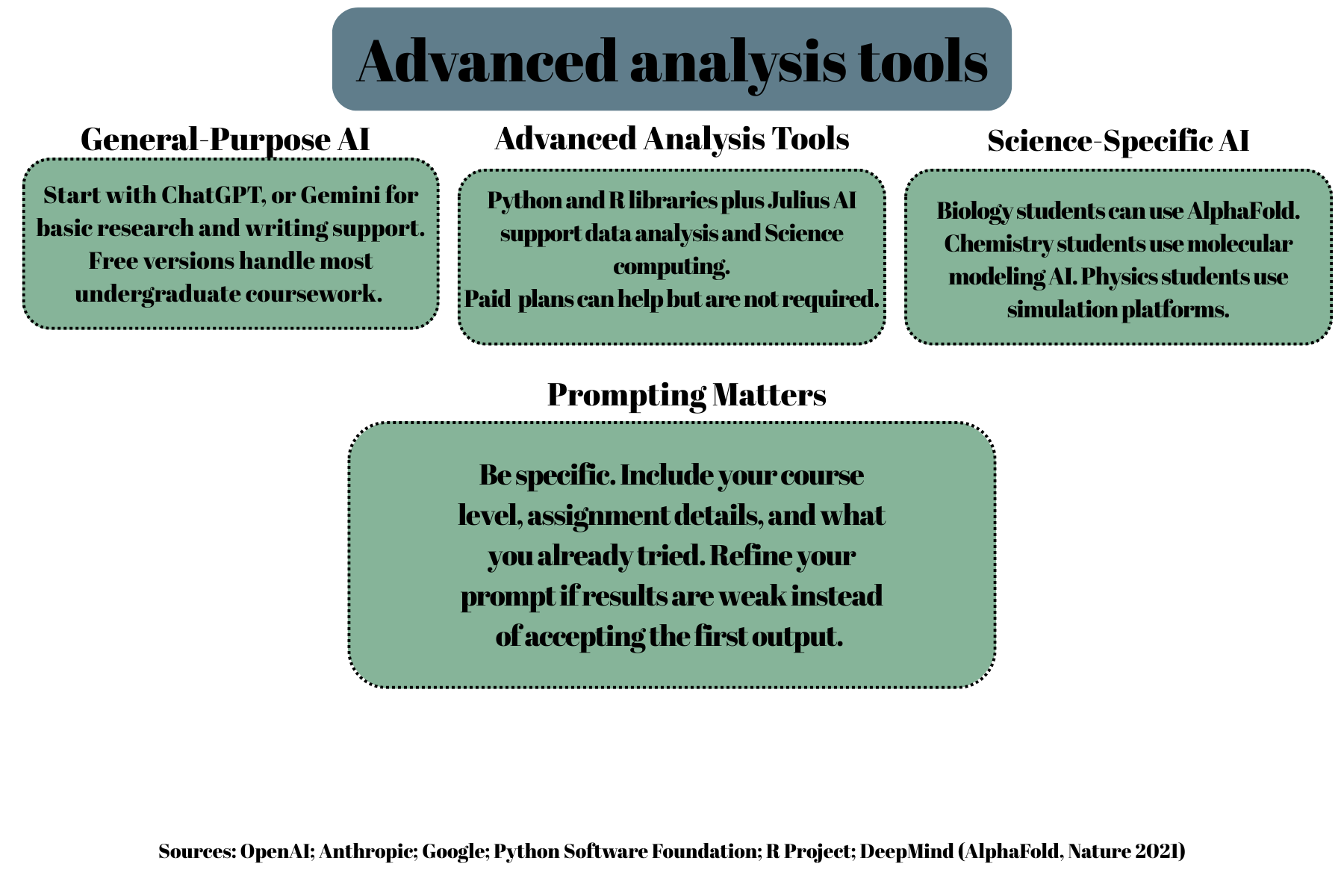
Start with ChatGPT, Claude, or Gemini for basic research and writing assistance. These general-purpose tools handle most undergraduate science needs without specialized training. Free versions offer substantial functionality. Paid subscriptions provide faster responses and access to more powerful models, but aren't necessary for basic coursework.
Python and R libraries plus Julius AI offer advanced analytical capabilities. These tools integrate directly with scientific computing environments. For biology students, AlphaFold predicts protein structures. Chemistry students can access molecular modeling AI. Physics students benefit from simulation platforms.
Effective prompting improves output quality dramatically. Start with clear, specific requests. Provide context about your course level, specific assignment requirements, and what you've already tried. Iterate based on results. If the first output misses the mark, refine your prompt rather than accepting inadequate results.
Real Applications in Science Courses
AlphaFold understands protein structures with remarkable accuracy, accelerating research into diseases and drug development. In your courses, AI analyzes gene expression data, models population dynamics, and interprets phylogenetic trees. You can use AI to explore biological pathways, predict mutation effects, and understand complex ecological interactions. Google DeepMind reports that AlphaFold has helped researchers make breakthroughs in malaria research and antimicrobial resistance.
AI predicts chemical reactions and assists with molecular modeling. Input reagents and AI suggests likely products, reaction mechanisms, and optimal conditions. Tools help interpret spectroscopy results, predict compound properties, and design synthetic routes.
Simulations demonstrate forces and motion under different conditions. Adjust variables like gravity, friction, or electromagnetic field strength and observe results instantly. AI processes particle accelerator data, analyzes experimental error, and helps visualize abstract concepts like quantum superposition or relativistic effects.
Research Evidence on AI Effectiveness
Students using AI tutors completed courses faster with improved understanding when tools supplemented learning without replacing it. The key difference was intentional integration rather than passive reliance. Students who engaged actively with AI outputs, questioning and verifying rather than accepting blindly, showed the strongest outcomes.
Research shows mixed effects on critical thinking. This split reflects different usage patterns. Students using AI for complete answers show declining critical thinking. Those using it for clarification and verification show improvement. The tool itself is neutral. Your approach determines whether AI enhances or degrades your cognitive development.
Proper AI integration supports digital literacy essential for modern scientific careers. Professionals need to collaborate with AI effectively, verify outputs critically, and maintain human judgment in scientific decision-making.
Challenges and Ethical Considerations
Be cautious about uploading sensitive data to AI platforms. Experimental results from ongoing research, proprietary methods, or data with privacy implications shouldn't be shared with commercial AI services. Many AI companies train future models on user inputs. Your lab data could become part of their training sets, potentially compromising research integrity or intellectual property.
Not all students have equal access to premium AI tools. While free alternatives exist, they often have limitations in computational power, response speed, or feature availability. This access gap creates potential inequities. Some students afford advanced AI assistance while others make do with basic tools.
Submitting AI-generated work as your own violates academic integrity policies at every institution. Consequences range from assignment failure to expulsion. Even when AI use is permitted, failing to disclose it constitutes dishonesty. The University of Missouri's Office of Academic Integrity states that using AI without permission constitutes academic dishonesty and unfair advantage.
AI training requires substantial energy consumption and computing resources. Each query to large language models has an environmental cost. Additionally, AI may reshape the scientific workforce, eliminating some jobs while creating others.
Conclusion
AI offers support for college science students from initial research through final reports. Success requires balancing AI assistance with independent skill development, maintaining transparency about tool use, and applying critical judgment to all outputs.
The students thriving with AI are those who view it as a collaborative partner rather than a shortcut. They use AI to understand concepts more deeply, complete analysis more thoroughly, and communicate findings more clearly while ensuring the work remains authentically theirs.
As AI becomes standard in scientific practice, learning to use it effectively and ethically during college prepares you for successful research careers. Start experimenting with these tools now, under instructor guidance, to develop the judgment and skills that will serve you throughout your scientific career.
 Choosing Between Online and Classroom Learning? Here’s What Affects Your Future
 Rethinking Online Learning Strategy: What Today’s Students Demand
 Career Shock vs Culture Shock: What Shapes the First Job Abroad
 Best Platforms for Video-Based Learning on Mobile in 2026
 How Student Expectations Are Forcing U.S. Universities to Rethink Tech Strategy in 2026