
Computer science used to be the safe bet. Now it's the major with the biggest drop in a decade, and colleges are scrambling to figure out what comes next. The answer a growing number of schools are landing on isn't a tweaked CS degree. It's a real AI major, built with other departments, not bolted onto one.
If you're setting curriculum priorities right now, this matters more than it might seem. Here's what the numbers say, and what a good AI major actually needs to look like.
Enrollment Is Shifting Fast, and the Data Proves It
Metric | Change |
|---|---|
US colleges with a dedicated AI major | 4 in 2020 → 79 today |
Undergrad CS enrollment, spring 2026 | Down 8.4% |
New CS majors nationally (2025 cohort) | Down 13% |
Researchers tracking AI degree program growth found the number of schools offering a standalone AI major jumped from four to 79 in six years. That's not a niche experiment anymore. That's a real shift in what students expect a college to offer.
Employers Want AI Fluency Everywhere, Not Just in Tech
Here's the twist nobody predicted a few years ago: employers aren't hunting for an army of AI specialists. They want people in regular jobs, marketing, finance, operations, who know how to use AI tools well.
More than a third of entry-level job postings now ask for some AI skill, nearly triple the share from just six months earlier, according to a national employer survey. And over half of AI-related job postings sit completely outside IT and computer science roles, according to labor market analytics firm Lightcast.
So if your AI program only lives inside the computer science department, you're training for a job market that barely exists anymore. Employers want AI paired with something else: business, health, communications, whatever the student's actual field is.
Take a student who studies public health, for example, and picks up a minor built around AI tools for data analysis. That combination gets more attention from hiring managers right now than a pure coding background does.
Coding Alone No Longer Feels Like a Safe Bet
Computer science enrollment fell across every type of four-year institution this spring, even while total undergrad enrollment kept growing. That's according to the enrollment trends report from the National Student Clearinghouse Research Center.
The number of new CS majors nationally dropped 13% this year, according to the latest Taulbee Survey from the Computing Research Association.
It's not that coding stopped mattering. It's that students got spooked. A department chair at one well-known university put it plainly: students are worried entry-level coding jobs are the first ones AI will replace, and that fear is driving the drop more than anything happening in the classroom.
Here's a relatable version of it. A student, for example, picks CS as a freshman because it seemed like a guaranteed job. Two years later, that same student switches to a data science or applied AI track instead, not because they lost interest in tech, but because they want a degree that reads as future-proof on a resume.
That's not one student's story. It's a pattern showing up in enrollment data everywhere.
Departments Have to Team Up to Build This Right
The AI majors getting real traction right now aren't computer science rebrands. They're built with two or three departments working together.
One private university in the Northeast rolled out close to two dozen new AI majors, each paired with a different field: business, biochemistry, philosophy, chemical engineering. One public research university built its new AI degree jointly with the philosophy and math departments, specifically to cover ethics and reasoning alongside the technical side. Another technical college added an applied AI degree that requires a policy and ethics sequence plus a mandatory internship, not just coding classes.
A few patterns show up across every one of these programs:
AI core courses paired with a required minor or concentration in another field
A mandatory ethics or policy component, not an elective
Hands-on project work tied to real industry problems
Faculty pulled from at least two departments, not just computing
If your institution is only offering an AI minor tacked onto CS, you're behind this curve already.
Students Are Already Switching Majors Over This
This isn't just an academic debate. Students are actively switching majors over it.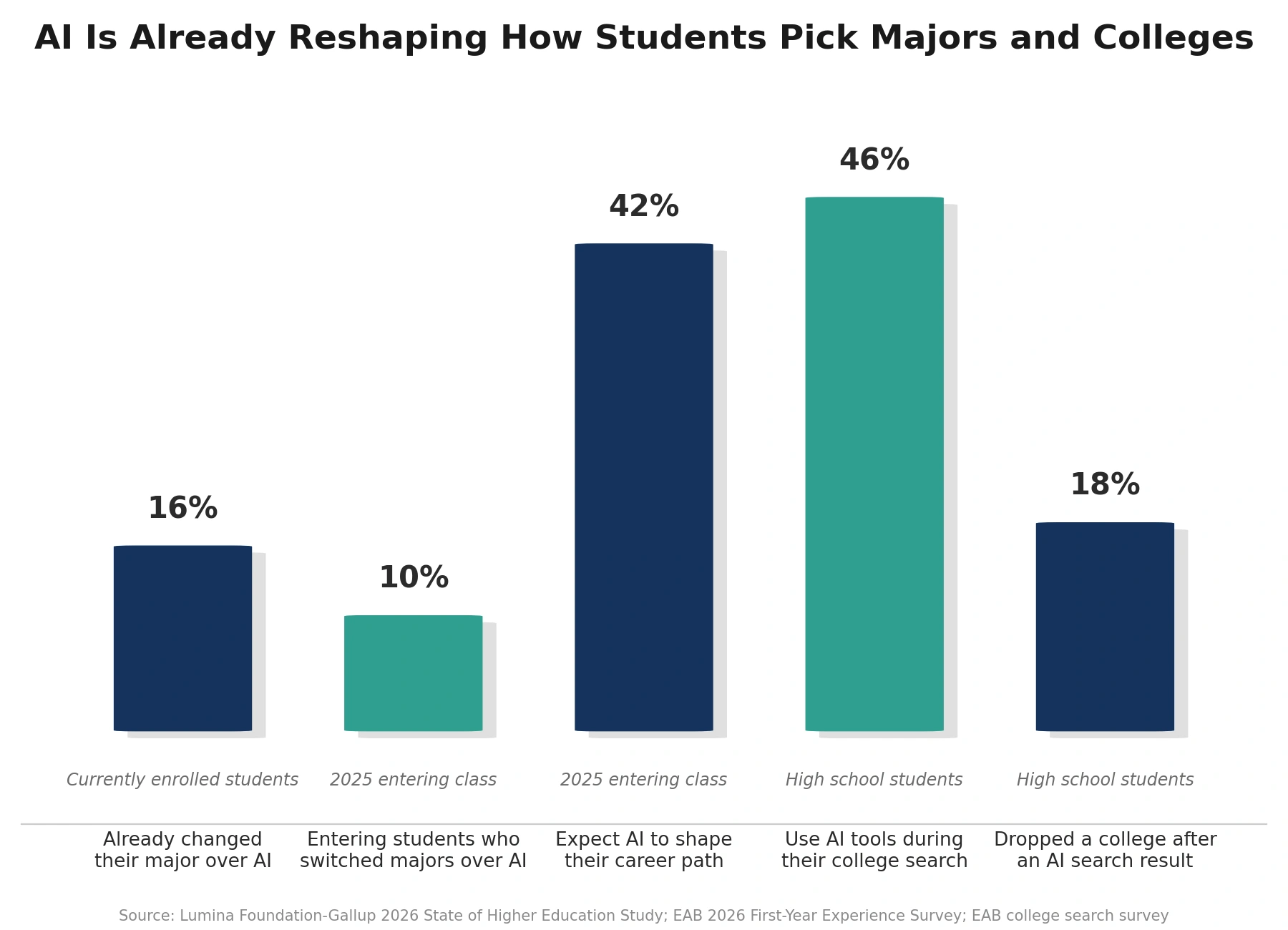
About 16% of currently enrolled students say they've already changed their major because of how AI might affect their field, based on Gallup survey findings from the Lumina Foundation-Gallup 2026 State of Higher Education Study. Among incoming first-year students specifically, about 10% had already switched majors over job security worries tied to AI, and 42% expect it to shape their career path down the road, according to a national EAB survey.
It gets earlier than that too. Nearly half of high schoolers now use AI tools while researching colleges in the first place, and almost one in five have already crossed a school off their list based on what AI search turned up, per a separate college search survey. If your program pages don't clearly explain what your AI major actually covers, you're losing applicants before you ever talk to them.
Build the Major Before Students Choose Somewhere Else
The case here isn't complicated. Employers want AI skills spread across every field, not locked inside computer science. Students already sense that and are shifting majors because of it. Schools building real cross-department AI majors right now are the ones capturing that shift instead of losing enrollment to it.
 The Financial Crisis Shrinking Small Colleges
 The Real Risks Behind Social Media Screening
 Why Expanding Higher Ed Access in SIDS and LDCs Matters for Global Progress
 What the Education Department’s New Rules Mean for Your Career
 How AI Chatbots Shape Student Retention and Academic Navigation