

Networking is one of those things everyone tells you to do in college, but nobody really explains how. The good news: most networking tips for college students are pretty low-effort once you know where to start. According to LinkedIn, 80% of professionals say networking played a role in their career success, which means your connections matter at least as much as your resume. You don't need to be outgoing or already know a bunch of professionals. You just need to be consistent.
Here's a quick breakdown of what we'll cover:
Tip | Best For |
|---|---|
Start early | Freshmen and sophomores |
Get involved on campus | Students who want organic connections |
Get off campus | Anyone stuck in the campus bubble |
Attend university events | Students who want face-to-face exposure |
Use your career center | Everyone (seriously, use it) |
Build a LinkedIn presence | Students targeting specific industries |
Do internships | Juniors and seniors ready to work |
Leverage personal connections | Students who overlook what they already have |
1. Start Early
The biggest mistake students make is waiting until senior year to start networking. By then, you're applying for jobs at the same time as everyone else, and you're building relationships from scratch under pressure.
Start in your first or second year. You don't need a clear career goal yet. You just need to show up, be curious, and have a few conversations. One new professional connection a month adds up fast.
Say you're a freshman who starts showing up to department speaker events just to see what's out there. By junior year, you could have two genuine mentors and a summer internship lined up, not from applying cold, but from conversations you started two years earlier.
Set a simple goal: connect with two new people this month, attend one event this semester, or reach out to one alumnus this week. Goals keep you moving even when you're busy.
2. Get Involved on Campus
On-campus involvement is one of the most underrated networking tools you have. Clubs, student organizations, honor societies, student media, professional associations. These aren't just resume padding. They're where you meet people who share your interests and, eventually, your career path.
On-campus jobs are especially useful. Working in a department, library, or lab puts you in regular contact with faculty and staff who can write references, make introductions, and vouch for you to people they know.
Think about what could happen if you spent two semesters as a research assistant for a professor in your department. You do good work, they get to know you, and when a hiring manager they've worked with for years asks if they know any strong graduating students, your name comes up first.
Join at least one student organization in your field
Look for on-campus jobs in departments relevant to your major
Take leadership roles when they come up
Attend the club fair at the start of each semester
3. Get Off Campus
Staying entirely on campus is a trap. You end up networking with the same pool of people in your program, which limits your reach. The professional world is outside those gates.
Volunteering is one of the easiest ways to break out of the campus bubble. Look for local nonprofits, community events, or industry meetups in your city. You'll meet working professionals in a low-pressure setting, and you'll have something to talk about beyond class assignments.
Imagine you're a communications student who volunteers at a local film festival for a weekend. You spend a few hours helping set up alongside a documentary producer. You're not pitching yourself; you're just being useful. That kind of low-stakes interaction is often where the best professional relationships start.
Check Eventbrite and Meetup for industry events in your city
Search your city's volunteer clearinghouses for relevant opportunities
Look for local chapter events run by professional associations in your field
Many of these are free or discounted for students
4. Attend University Events
Career fairs, alumni panels, speaker series, industry nights. Your university probably runs more of these than you realize. Most students skip them. The ones who show up are immediately more visible.
Don't just walk in and wander around. Do a little homework first. Find out who's speaking or which companies will be there, and prepare one or two specific questions. That prep turns a generic handshake into an actual conversation.
Follow up within 48 hours. A short LinkedIn message or email referencing something specific from the conversation is all you need. Most people appreciate it, and very few students actually do it.
Check your university's events calendar weekly
Sign up for your department's newsletter
Attend alumni events even if you're not a senior yet
Bring business cards or have your LinkedIn QR code ready
5. Use Your College Career Center
The career center is one of the most underused resources on any campus. Inside Higher Ed reports that about a third of students have never interacted with their campus career center at all, even seniors preparing to graduate.
That's a missed opportunity. Career advisors can introduce you directly to recruiters and alumni. They run workshops, maintain job boards, and often know which companies are actively looking for students from your school.
The chart below shows how students currently use career center services, based on survey data from Inside Higher Ed:
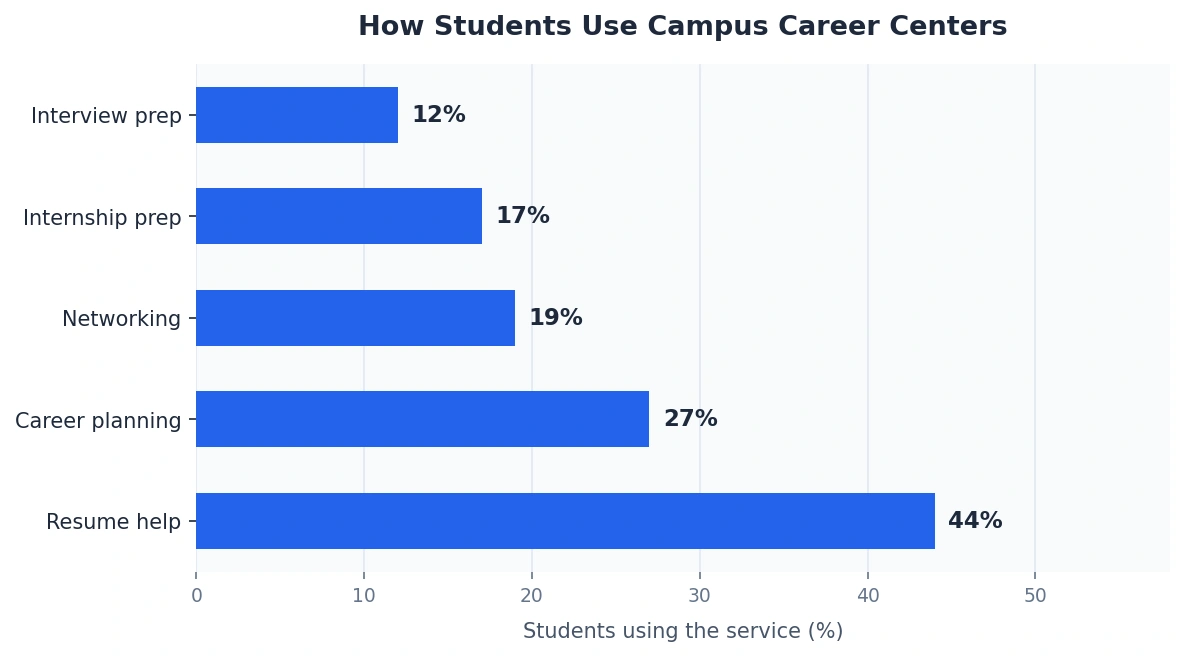
Resume help is the most common service students seek, but networking support sits at just 19%. According to the National Association of Colleges and Employers, as reported by Inside Higher Ed, students who used just one career center service received an average of 1.24 job offers, and that number increased with each additional service used. The more you engage, the better your odds.
6. Build a Real LinkedIn Presence
LinkedIn isn't just for people who already have jobs. It's where professionals look to see if you're serious about your field. A half-finished profile sends a message you probably don't want to send.
Fill out your profile fully: photo, headline, summary, any relevant experience including campus jobs and internships. Then actually use the platform. Connect with classmates, professors, speakers you've met, and alumni from your school.
Use LinkedIn's alumni tool to find graduates working in roles or companies you're interested in. Send a short, specific connection request with something personal that references a shared tie. That converts far better than the default message.
Here's how that could play out: you leave a substantive comment on a post by someone in your target industry. They notice, send you a connection request, and a short conversation follows. Six months later, when you're job searching, you already have a warm contact inside that company because you said something worth reading months ago.
Post occasionally about things you're learning or projects you're working on
Comment on posts in your industry with something substantive, not just a like
Follow companies and thought leaders in your target field
Ask professors or supervisors for LinkedIn recommendations
7. Do Internships and Cross-Department Work
Internships are probably the most effective networking tool on this list, because you build relationships through actual shared work. Co-workers and supervisors see what you can do. That carries a lot more weight than a brief conversation at a career fair.
Don't wait until you feel ready. Apply early, even for positions that feel slightly out of reach. NACE's 2026 internship data shows the average hourly wage for bachelor's-level interns now sits at $23.35. These are real work experiences, not just resume lines.
Cross-department networking is also worth doing on campus. Take an elective outside your major. Ask a professor in a different department if they need research help. Join a project team that mixes disciplines. These connections often lead to referrals in directions you didn't expect.
8. Tap Personal Connections and Ask for Introductions
The network you already have is bigger than you think. Your parents' colleagues, your friends' parents, neighbors, family friends, former teachers. These are warm connections who are generally willing to help a student.
Play the student card. Professionals are much more receptive to students than to strangers asking for jobs. You're not a threat, and most people genuinely like helping someone who's just starting out.
The key is to ask for an informational interview, not a job. Once you're in the conversation, you learn things and leave an impression. The opportunity often follows later.
Make a list of adults in your life with relevant careers
Ask for an introduction rather than a job
Follow up after every conversation with a short thank-you
Be helpful in return: share articles, make introductions, offer what you can
Keep expanding the list over time
The Informational Interview Email Template
Not sure what to actually say? Here's a three-sentence email that works:
Subject: Quick question from a [your major] student
Hi [Name], I'm a [year] studying [field] and came across your work at [company/through mutual connection]. I'd love to ask you a few questions about your career path. Would you have 20 minutes for a call in the next few weeks? I'm not looking for a job, just some honest perspective from someone doing work I find interesting.
Short. Specific. No pressure on them. That combination gets replies.
How to Keep the Relationship Going
Most students make the connection and then disappear. That's where most college networking falls apart, and it's entirely avoidable.
You don't need to stay in constant contact. You just need to check in occasionally with something useful:
Send a quick update 3 to 6 months after your first conversation: "Wanted to let you know I took your advice and landed an internship. Thank you."
Share a relevant article in their field with a one-line note
Congratulate them when they get a promotion or new role (LinkedIn makes this easy)
Ask a follow-up question that shows you acted on what they told you
Common Networking Mistakes to Avoid
A lot of students sabotage their networking before it even starts. Here are the most common mistakes and what to do instead:
The Mistake | Why It Backfires | Do This Instead |
|---|---|---|
Asking for a job in the first message | Puts pressure on someone who doesn't know you | Ask for a conversation, not a favor |
Sending a generic connection request | Gets ignored or declined | Add one specific sentence about why you're reaching out |
Ghosting a mentor after one meeting | Burns the relationship and your reputation | Send a follow-up within 48 hours, then check in every few months |
Only networking when you need something | People notice and it feels transactional | Stay in contact consistently, not just at crunch time |
Treating every event like a job fair | Makes conversations feel forced and forgettable | Be curious about people, not just about what they can do for you |
Start Small, Stay Consistent
You don't need to do all of this at once. Pick two or three things, build the habit, and expand from there. The students who build the best networks aren't the most outgoing. They're just the most consistent.
 The Real Economics Behind Entry-Level Gigs
 Can 3-Year Degrees Solve the Teacher Shortage?
 Does College Public Speaking Really Matter in Today’s Job Market?
 Strategies for Communicating Tuition and Outcomes to Prospective Students
 How Politics Is Shaping College Enrollment