If you work in higher ed leadership, you already know this problem. Millions of adults started college, stopped, and never came back. Job placement strategies are one of the few things that actually gets them to reconsider. Not another email about "finishing your degree." A real answer to the question they're actually asking: will this get me a better job.

Here's how to build that answer into your re-enrollment strategy, and why it works.
Career Payoff Is What Brings Students Back
Adults who stopped out aren't sitting around waiting for a nudge about credit hours. They're weighing time, money, and whether it's worth it.
If a student left school years ago to take a factory job, for example, a vague "come back and finish" message won't move them. A clear number, like a real wage jump tied to a specific credential, might.
Employers are backing this up. A 2025 Coursera micro-credentials report found most employers are willing to pay more for candidates with verified skills, and most have already hired someone with a micro-credential in the past year. That's the kind of proof point that gets a stopped-out student to open your email instead of deleting it.
Here's a quick look at who you're actually trying to reach:
Trait | Share of stopped-out students |
|---|---|
Working full or part time | 64% |
Parents | 24% |
Dealing with housing or food insecurity | 60% |
Living with a disability | 19% |
Veterans or active duty | 6% |
First-generation students | 35% |
Source: CHEPP research brief
This isn't a group with free time and no obligations. Every outreach effort has to respect that and make the payoff obvious fast.
Turn Career Support Into Your Selling Point
You don't need a huge budget to make career support the center of your re-enrollment pitch. You need a few tactics done well.
Build real employer partnerships. Co-op agreements, guaranteed interviews, and direct hiring pipelines give returning students something concrete, not just a promise.
Market your micro-credentials directly. Employers surveyed in the Coursera report said they'd offer meaningfully higher starting pay for candidates with a stackable credential, and said it cuts new-hire training time too.
Lead outreach with career data, not generic messaging. Put placement rates and salary ranges in the first line of your recruitment email, not buried on page three of a brochure.
Pair every advisor with labor market data. A student thinking about healthcare admin needs different numbers than one eyeing IT. Advising should reflect that.
If a student left an accounting program halfway through, for example, hearing that a short credential could get them promoted within their current job, without starting over, is a much easier yes than "come back and retake your gen eds."
Give Credit for What Students Already Know
One of the biggest levers you have isn't new money. It's recognizing learning students already have.
Credit for prior learning, or CPL, lets students turn work experience, military training, or industry certifications into college credit. That shortens the path back to a degree and directly answers the "is this worth my time" question.
This isn't guesswork. Programs that connect credit recognition to career relevance see real completion gains. Indiana's credit for prior learning initiative found students who got CPL were more than twice as likely to graduate, with a 17% jump in completion rates and 17.6 more credits earned on average, according to the state's Commission for Higher Education. That held up regardless of race, ethnicity, or income level.
The scale of the opportunity here is bigger than most leadership teams realize. The National Student Clearinghouse Research Center, in its latest enrollment update, puts the number of adults with some college and no credential at 41.9 million nationally, about 18% of the working-age population. Streamlining how these students access aid and credit recognition is one of the most direct ways to bring that number down.
The hard part is usually logistics, not willingness. If a student spent years earning certifications on the job, for example, the last thing they want is to sit in a registrar's office for weeks waiting to find out what actually transfers. This is where a tool like Scholaro's credential evaluation platform helps. It clears the transcript bottleneck fast, so returning students get a real answer about their credit instead of a long wait.
That's the case you want to make to your board. This isn't charity. It's a completion strategy with a track record.
How States Are Getting Adults Back to Class
You don't have to build this from zero. Some states have already done the hard part.
New Jersey estimates more than 840,000 residents have some college credit but never finished a credential. The state's Office of the Secretary of Higher Education partnered with a re-enrollment support provider to reach out directly to these students. So far, over 11,800 have re-enrolled, and more than 1,100 have graduated.
The playbook is simple: find the students, reach out with a clear message, and give them support once they're back. No mystery ingredient. Just consistent follow-through.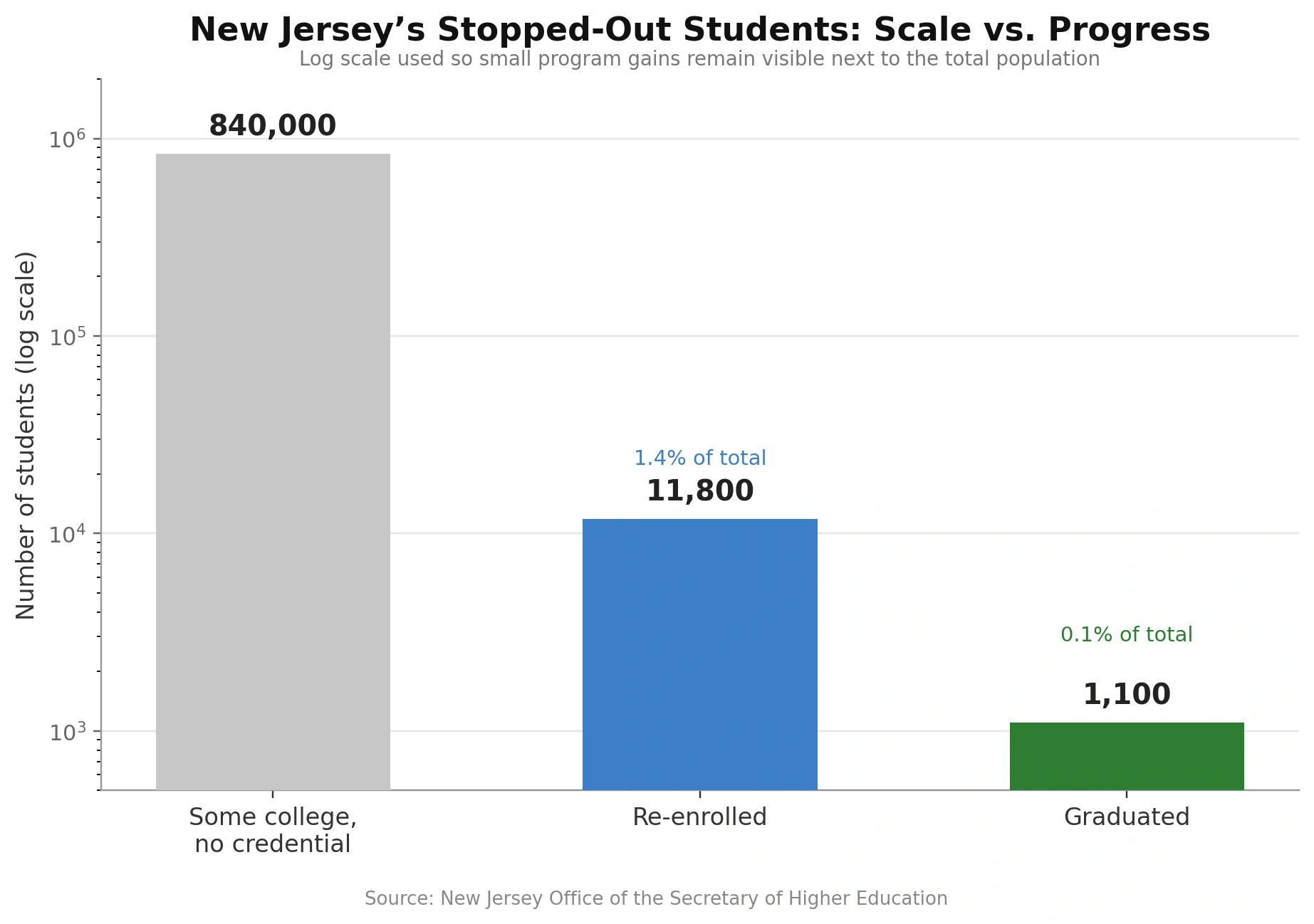
Where to Go From Here
A few next steps if you're building this out on your campus:
Read our first steps guide to see how to structure early outreach.
Check our adult learner application guide for students re-entering school.
Read our statewide re-enrollment blueprint to see the New Jersey model in full.
Lead With the Job, Not the Degree
Adults don't come back to school for a diploma. They come back for a better job. Lead with that, back it up with real data, and give them a shorter path using the credit they've already earned. That's what actually moves the needle.
 How Universities Can Guide Top Students Beyond Corporate Career Tracks
 How Global Education Hubs Are Redefining University Expansion Strategy
 Why Colleges Need Brand New AI Majors
 The Financial Crisis Shrinking Small Colleges
 The Real Risks Behind Social Media Screening