

Is a PhD worth it? If you're a prospective student, currently in a program, or a recent grad trying to figure out your next move, this is the question keeping you up at night. Six or more years of your life is a big bet, and it only pays off if it lines up with your career goals, your salary expectations, and the return you actually get on that time. Let's break down what the numbers actually say, where PhD grads end up, and what nobody tells you before you sign up.
The Quick Numbers
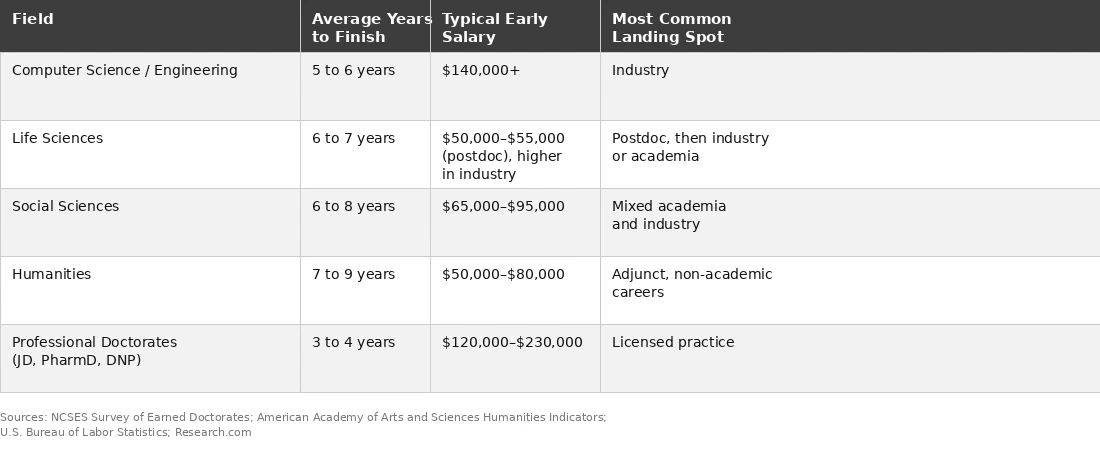
Before we get into the weeds, here's a snapshot of how different PhD paths tend to shake out.
Field | Average Years to Finish | Typical Early Salary | Most Common Landing Spot |
|---|---|---|---|
Computer Science / Engineering | 5 to 6 years | $140,000+ | Industry |
Life Sciences | 6 to 7 years | $50,000 to $55,000 in a postdoc, higher once in industry | Postdoc, then industry or academia |
Social Sciences | 6 to 8 years | $65,000 to $95,000 | Mixed academia and industry |
Humanities | 7 to 9 years | $50,000 to $80,000 | Adjunct, non-academic careers |
Professional Doctorates (JD, PharmD, DNP) | 3 to 4 years | $120,000 to $210,000 | Licensed practice |
Doctoral degrees in computer science, systems engineering, pharmacy, and information science tend to lead on early pay, with some grads clearing $145,000 four years after finishing. Applied doctorates like pharmacy or nursing practice usually pay off faster than research-heavy PhDs. Humanities pay sits much lower, closer to $80,000 across a career, with assistant professor pay specifically landing under $60,000.
Picture a student who spends five years grinding through a computer science PhD while a friend spends nine years finishing a humanities PhD. Same degree level, wildly different timelines and paychecks. That gap is the whole story in a nutshell.
Where PhD Grads Actually End Up
You probably pictured yourself as a professor when you first thought about doing a PhD. Most people do. But the numbers tell a different story.
Academia
Tenure track jobs are still the dream for a lot of PhD students, but they're hard to land. One study found that 41% of humanities grads had a tenure track job six months after graduating. That number climbed to 64% at the three year mark and 68% by year eight. So if academia is your goal, patience matters just as much as your publication list.
Private Industry
This is where a lot of PhDs, especially in STEM fields, end up now. Tech companies, pharma firms, and research labs hire PhD grads for roles in data science, product research, and applied engineering. Pay tends to be higher here than in academia, and the jobs are more plentiful too.
Government and Non-Profit
Smaller in numbers, but steady. Think national labs, policy think tanks, and public health agencies. These roles often blend research work with public service, and they can be a solid middle ground if you want research without the academic grind.
Here's an example from one biomedical PhD program: 35% of its graduates went into industry, 19% landed tenure track academic jobs, another 12% took non-tenure track academic roles, and the rest split between government, clinical work, and further training. That spread is a good gut check for what getting a PhD actually leads to.
What a PhD Actually Pays
Money matters, so let's talk numbers by field.
STEM and Tech
Computer and information research scientists pull in a median salary around $145,080, with job growth projected at 23%. That's one of the strongest combos of pay and demand out there.
Humanities and Arts
Pay here lags behind STEM by a lot. The humanities PhD job market has stayed weak since around 2008, and most grads end up earning less than peers with other degrees. That said, surveys still show most humanities PhD holders report being satisfied with their jobs, even at lower pay.
The Big Picture
Doctoral degree holders overall have a low unemployment rate, sitting at just 1.30% as of May 2026. So even in fields where pay is lower, PhD holders aren't struggling to find work. They're just not all getting rich doing it.
The Parts Nobody Puts on the Brochure
Here's where I'll be straight with you. A PhD isn't just a longer master's degree. It comes with real costs beyond tuition.
1. Time
Doctoral students typically need about 7.3 years after starting grad school to finish, and close to 8.7 years since finishing their bachelor's degree. That's not a typo. Nearly a decade of your twenties or thirties, depending on when you start.
2. The Ghost Cost Nobody Talks About
Low pay during the program is only half the problem. The bigger hit is what you don't earn while you're in school.
Say you're living on a $30,000 stipend, which is typical at many public universities, for six years while a friend takes an entry-level corporate job at $70,000. That gap alone adds up to more than $240,000 in missed income, and that's before you factor in the promotions, raises, and retirement account growth your friend picked up during those same six years. Well-funded private programs sometimes pay closer to $50,000, which narrows the gap, but the basic math still favors whoever starts earning sooner. This is opportunity cost, and it's the real reason a PhD can take longer to pay off financially than the sticker price suggests.
3. Mental Health
This one's rarely mentioned in admissions brochures.
Grad students report depression and anxiety at rates six times higher than the general public, with symptoms tending to peak closer to dissertation completion.
In one study of economics PhD programs specifically, 36.7% of students in year six or later showed moderate to severe symptoms of depression or anxiety, compared to 21.2% of first years. The pressure builds the longer you're in it.
Think of a student who breezes through year one full of energy, then hits year five feeling burnt out and unsure if the finish line is even worth chasing anymore. That's a common arc, not a rare one.
4. Too Many Grads, Not Enough Jobs
Humanities departments in particular have produced more PhDs than there are academic jobs to absorb. If your field is oversaturated, you'll be competing with people who've been on the job market for years already, on top of your own cohort.
Funding and Commitment
Before you apply, ask yourself two honest questions.
Will funding be available? Most PhD students fund their degree through stipends, split roughly between teaching assistantships, research assistantships, and fellowships. A smaller share gets help from an employer. Programs without solid funding often mean years of debt on top of years of lost income.
Are you committed enough to see it through? A PhD asks a lot of you over a long stretch. If you're not sure the topic still excites you five years from now, it's worth sitting with that question before you commit.
Skills You Walk Away With, Even Outside Academia
A PhD teaches you more than your dissertation topic. Here's what actually transfers to almost any career:
Project management. Running a multi-year research project teaches you to plan, adjust, and finish things.
Professional networking. Conferences and collaborations build a contact list most jobs can't replicate.
Teaching and mentoring. If you taught or supervised undergrads, you've got real leadership experience.
Publication. Writing and editing at a high level is a skill companies pay for.
Public speaking. Presenting research in front of a room builds confidence that carries over anywhere.
Event organization. Planning conferences or symposiums is project management with extra moving parts.
Research. The obvious one, but it's genuinely rare and valued outside academia too.
Life After the PhD
Postdocs
A postdoctoral position is a short-term research job, usually one to three years, that acts as a bridge between your PhD and a permanent role. Close to 39% of PhD grads take one on, and that number jumps closer to 59% in life sciences and physical sciences. It's common, not mandatory.
Beyond Academia
Plenty of PhD grads move into consulting, data science, science policy, publishing, or non-profit leadership. A student who spent years studying a niche research topic might end up applying that same analytical thinking to a completely different industry a few years later. That's normal, not a failure.
So, Is It Worth It?
Before you decide, run your situation through a quick gut check. Here's a simple 3-point green light.
Is it fully funded? If you're paying tuition out of pocket, that's a red flag. Walk away or negotiate a better offer.
Do you actually need a PhD for the job you want? A research lead role usually needs one. A general engineering or industry role usually doesn't.
Can you handle years of delayed gratification? Lower pay, slower career growth, and a long timeline are part of the deal. Be honest with yourself about that trade.
It depends on your field, your funding, and if you want a specific career or just love the research itself. STEM PhDs tend to pay off fastest. Humanities PhDs ask more of you for less certain payoff. If you're weighing this decision right now, match it against your own career goals and salary expectations, not just the prestige of the degree. Go in with your eyes open, and you'll come out the other side with skills that matter, degree or not.
 How Politics Is Shaping College Enrollment
 How Top Performers Land US Job Offers
 The College Majors Foreign Students Regret Choosing
 The Tightest Job Market in Years for College Grads
 How Universities Are Adapting Health Programs to a Moderating Job Market