

Picture this. You get into a college, pick your major, plan your whole four years around it. Then halfway through, the school announces it's cutting that program. Sounds rare? It's not. Course cuts are hitting campuses across the country right now, and they're not slowing down. If you're applying to college soon, knowing how to spot the warning signs before you commit can save you a huge headache later.
Real Programs, Real Cuts
This isn't a hypothetical problem. Here's a snapshot of recent program eliminations at US schools, just to show the scale of what's going on.
School | Programs cut | Stated reason | Students affected |
|---|---|---|---|
East Carolina University | 44 programs | $25 million budget cut | Spans nearly every college |
Buffalo State University | 8 programs | Low enrollment | 48 students total |
University of Montevallo | 16 minors and concentrations | $400,000 budget gap | Some at zero students |
University of Iowa | 6 majors proposed | Fewer than 25 students each | Statewide program review |
Why Schools Are Doing This Now
Two things are colliding at once. First, there's a real drop in college-age students starting this year, which people in higher ed call the enrollment cliff. Fewer students means less tuition money, and less tuition money means schools have to trim something.
Second, some states are now forcing the issue. Ohio passed a law requiring public colleges to eliminate any program that averages fewer than 5 graduates a year over a 3 year period, and other states are watching closely to see if that becomes a trend.
The scale is bigger than most people realize. February 2026 alone saw over 300 layoffs nationwide tied to budget cuts and program eliminations, on top of more than 100 cuts in January. This is not a one-off story. It is a pattern.
Warning Signs Your Major Could Be Next
You don't need insider access to spot a program in trouble. Here's what to watch for before you sign a housing contract.
The enrollment number is small and shrinking
Most schools have an unofficial line in the sand. Drop below it and your major gets flagged for review. At the University of Iowa, that number was 25 students or fewer, and the review pulled in majors averaging under 20 for years. If a program's total headcount is a small number you could count on two hands, ask questions.
If a student, for example, is eyeing a niche language major with 12 people enrolled campus wide, that's not a red flag by itself. But paired with declining numbers year over year, it's worth a direct conversation with the department before you commit.
Faculty are quietly disappearing
Cuts rarely start with a press release. They start with a professor who retires and never gets replaced, or a hiring freeze nobody announces out loud. Watch for adjuncts covering core courses that used to be taught by full time faculty, or a department page that hasn't added a new hire in years. One retirement means nothing. A pattern of them across a small department means something.
The numbers back this up. About 28 colleges closed in 2024 alone, according to data from the State Higher Education Executive Officers Association. The Federal Reserve Bank of Philadelphia now models up to 80 more college closures over the next five years. That includes plenty of schools people assume are safe. Program cuts and full closures are both symptoms of the same money problem, and they're not slowing down.
How to Protect Your Major
You can't control a university's budget. You can control how you plan around the risk. Here's what actually helps.
1. Ask your advisor direct questions
Don't settle for a vague "the program is fine." Ask straight up: has this department had a program review recently, and is enrollment trending up or down. Advisors deal with this constantly, and most will give you a real answer if you ask a real question.
2. Take your core major classes early
Front load the classes that only your major offers. If a program does get phased out, schools almost always let current students finish through what's called a teach-out plan, but that plan gets harder to use the fewer required courses you've already banked. Get ahead of it while the classes are still fully staffed.
3. Check how your credits would transfer
Before you commit to a smaller or newer program, look into how your credits would move if you needed to switch schools or majors later. Regional accreditation matters here, and your target program needs clear credit transfer guidelines in place. Transferring out of a program that's already winding down is far messier than transferring out of one that's healthy.
If a student, for example, picked a specialized engineering track only offered at one small campus, checking transfer equivalency tables ahead of time means a school closure or program cut is a bump in the road, not a full derailment.
4. Keep a backup major in your pocket
Pick a second major or minor that shares core classes with your first choice. If your main program gets cut or merged, you've already got a real head start on plan B instead of starting from zero.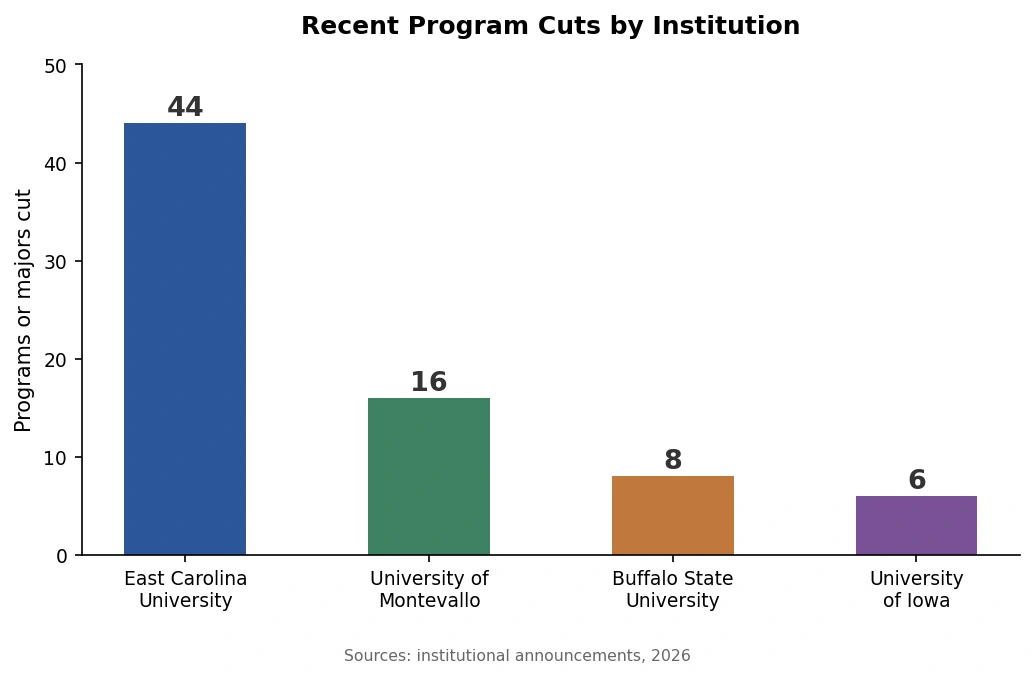
Keep Your Eyes Open
College budgets are tight right now, and that's not changing anytime soon. Spotting the warning signs early gives you options. Ignoring them just means finding out the hard way, mid semester, with fewer choices left on the table.
 How Universities Use Zero-Waste Swap Programs to Cut Student Costs
 How Industry Partnerships Shape Modern Curricula
 How Post-COVID Aid Programs Help Universities Rebuild Admissions
 Beyond the Acceptance Rate and How Colleges Decide Who Gets In
 How Leveraging Job Placement Strategies Can Reenroll Returning Students