Disclaimer: This article is for general informational purposes only and does not constitute legal, financial, medical, or professional advice. Policies, requirements, and costs may change. Always verify current information with the relevant institutions or official sources before making decisions.

A student graduates from a university in Brazil with a business degree and lands a job offer from a Chicago firm. She thinks the hard part is over. Then HR asks for her U.S. work authorization documents.
She has none. No F-1 visa, no OPT eligibility, no EAD. Getting a work permit with a foreign degree looks completely different from the path international students take after studying in the U.S. This guide breaks down both routes.
Two Paths, One Goal
Your starting point determines everything.
Path A: You earned your degree abroad. OPT is not an option. Your route runs through credential evaluation, employer sponsorship (H-1B or EB-3), or alternatives like TN or L-1.
Path B: You studied at a U.S. school on an F-1 visa. If you completed a U.S. degree, you're eligible for OPT. Your foreign undergraduate credential can also support a later sponsorship petition.
Visa / Pathway | Who It's For | Duration | Sponsor? | Path |
|---|---|---|---|---|
OPT | F-1 graduates of U.S. schools only | 12–36 months | No | B only |
H-1B | Specialty occupation workers | Up to 6 years | Yes | A and B |
TN Visa | Canadian and Mexican nationals | 3 years, renewable | Yes | A and B |
L-1 Visa | Intracompany transferees | Up to 7 years | Yes | A |
EB-3 | Skilled and professional workers | Permanent | Yes | A and B |
EB-2 NIW | Advanced degree / exceptional ability | Permanent | No | A and B |
Step 1: Get a Credential Evaluation
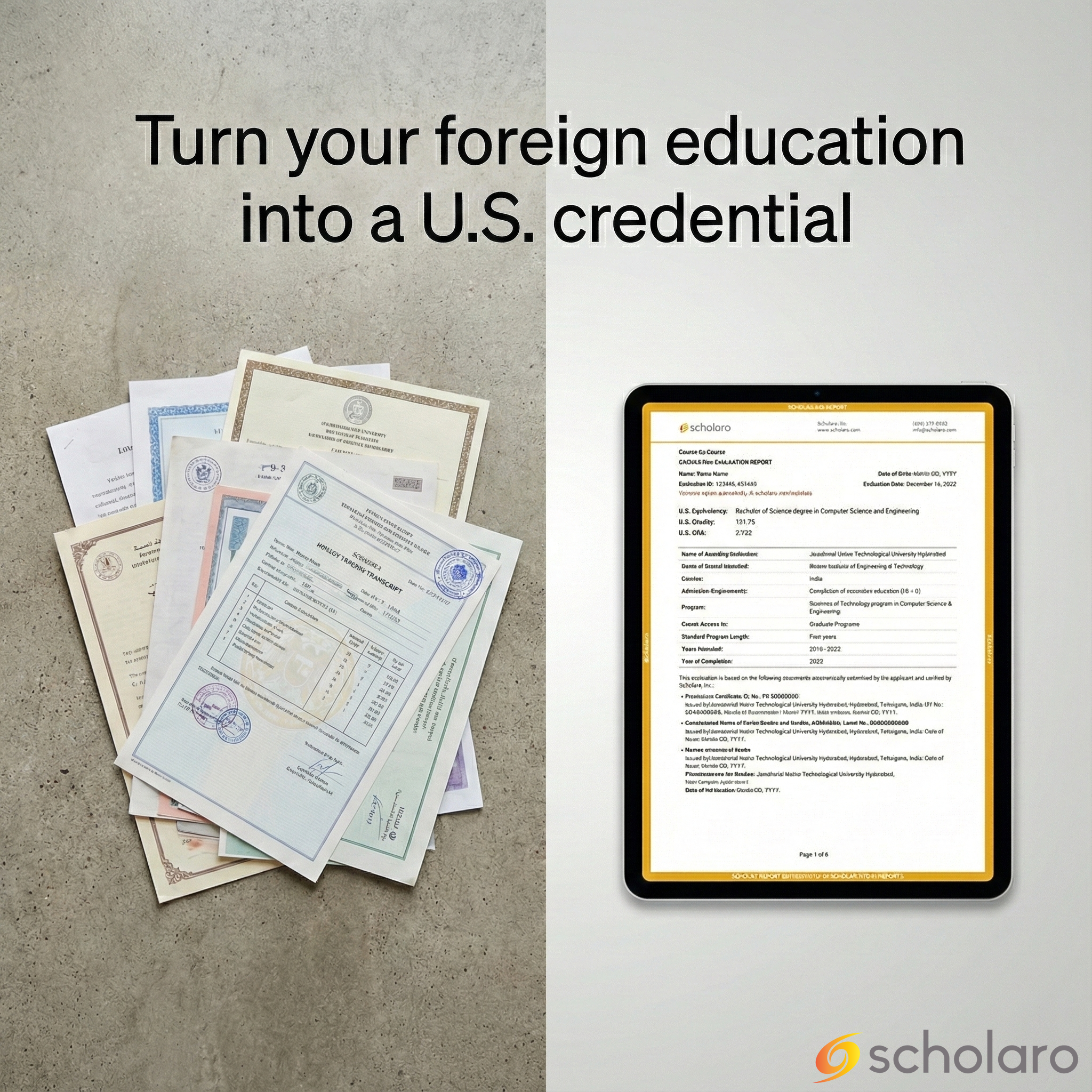
This comes first, before job hunting. U.S. employers and USCIS won't accept your foreign degree at face value. A credential evaluation agency reviews your transcripts and issues an equivalency report confirming your degree meets U.S. standards.
Two types exist:
Document-by-document: Confirms degree level. Costs $100 to $150. Often not enough for visa petitions.
Course-by-course: Reviews every course and credit. What USCIS actually requires. Costs $150 to $300 or more and takes 1 to 3 weeks.
Go course-by-course from the start. If your degree falls short of a U.S. bachelor's equivalent, USCIS applies a three-for-one rule: three years of relevant work experience substitutes for one year of study.
Say you graduated with an engineering degree in South Korea and applied for a software role in the U.S. Your employer orders a course-by-course evaluation upfront. It confirms equivalency to a U.S. computer science bachelor's. The H-1B petition goes through without a hitch.
Step 2: The OPT Route (Path B Only)
OPT is only available if you completed at least one academic year at a U.S. school on an F-1 visa. If your degree is from abroad, skip this step.
If you qualify, Optional Practical Training gives you 12 months of work authorization in a role related to your U.S. degree, or up to 36 months for STEM fields. Apply up to 90 days before graduation. Your physical EAD card must arrive before you start work. Processing currently takes 2 to 9 months, so apply early.
As of October 30, 2025, automatic EAD extensions no longer apply to renewal applications filed on or after that date. File for renewal at least 180 days before your card expires.
Take someone who earned an undergraduate degree in India and then completed a U.S. master's in data science on an F-1 visa. She qualifies for STEM OPT, giving her 36 months of work authorization. During that window her employer files an H-1B petition, using her Indian credential evaluation as supporting documentation.
Step 3: Employer Sponsorship (H-1B)
For Path A graduates, this is the main route. Your employer files a Form I-129 petition with USCIS. Your credential evaluation goes in as supporting evidence. If you're abroad, you complete a consular interview at a U.S. embassy after selection.
The H-1B covers specialty occupation roles: engineering, technology, finance, healthcare, and similar fields. Valid for three years, extendable to six, and can lead to a green card.
H-1B visas are capped at 65,000 per year (plus 20,000 for U.S. master's holders). Selection goes through a lottery. Starting with the March 2026 registration cycle, USCIS moved to a wage-weighted lottery: higher-wage offers get more lottery entries. Entry-level candidates face lower odds than before.
Imagine someone who earned a civil engineering degree in Egypt and received a U.S. job offer. Her employer files an H-1B petition backed by her course-by-course evaluation. She's selected in the lottery, attends a consular interview, and starts work the following October. From job offer to U.S. start date: about nine months.
Step 4: Alternative Visa Routes
TN Visa: For Canadian and Mexican nationals in USMCA-qualifying professions. No annual cap. Valid three years, renewable. Fast and accessible, but not designed as a green card path.
L-1 Visa: If you work for a multinational with a U.S. office, your employer can transfer you directly. No lottery, no annual cap. You need at least one continuous year with that company in the past three years. L-1A covers managers and executives; L-1B covers specialized knowledge workers.
EB-2 NIW: A self-petition permanent visa. No employer required. You must demonstrate an advanced degree or exceptional ability and show national benefit to the U.S. Processing takes 1 to 2 years or more.
A student works as a software engineer at a global tech firm in Germany for two years. When the company opens a U.S. office, she transfers on an L-1B. No lottery, no long wait. She starts in the U.S. six months after the transfer is approved.
Step 5: Green Card Through EB-3
The EB-3 is the most common long-term route for employer-sponsored permanent residency. Qualifying roles include skilled positions (two or more years of training), professional roles (bachelor's or equivalent), and other workers.
The Department of Labor is currently running 15 to 16 months behind on PERM applications. Total EB-3 processing runs three to four years for most applicants outside India and China, where backlogs are much longer. Once you file Form I-485, you can file Form I-765 at the same time and receive a work permit while the green card processes.
4 Mistakes to Avoid
1. Skipping the credential evaluation. Get your course-by-course evaluation before job hunting. A missing or weak evaluation is the most common reason USCIS issues a Request for Evidence, costing you weeks.
2. Assuming OPT applies to you. If your degree is from outside the U.S., it doesn't. OPT requires F-1 status earned at a U.S. institution.
3. Asking about sponsorship too late. Many employers don't sponsor visas. Raise it in the first or second interview, not after you've accepted an offer.
4. Missing EAD renewal deadlines. Automatic extensions no longer apply to renewals filed on or after October 30, 2025. File at least 180 days before your EAD expires or risk a gap in work authorization.
Wrapping Up
As for the student from Brazil? She couldn't use OPT, but she wasn't out of options. Her employer ordered a course-by-course evaluation, confirmed her business degree was equivalent to a U.S. bachelor's, and filed an H-1B petition. She completed consular processing in São Paulo and started work the following October.
Know which path applies to you, get your credential evaluation done early, and find employers who've sponsored visas before.
 How Universities Use Zero-Waste Swap Programs to Cut Student Costs
 How Industry Partnerships Shape Modern Curricula
 How Post-COVID Aid Programs Help Universities Rebuild Admissions
 Beyond the Acceptance Rate and How Colleges Decide Who Gets In
 How Leveraging Job Placement Strategies Can Reenroll Returning Students