

An honors college sits inside a larger university but operates as its own academic unit, with its own curriculum, faculty, advising, and often its own buildings and housing. For some students, it's the best use of their undergraduate years. For others, the extra requirements and GPA pressure outweigh the benefits. This guide helps you figure out which side you're on before you apply.
Factor | Honors College | Standard Program |
|---|---|---|
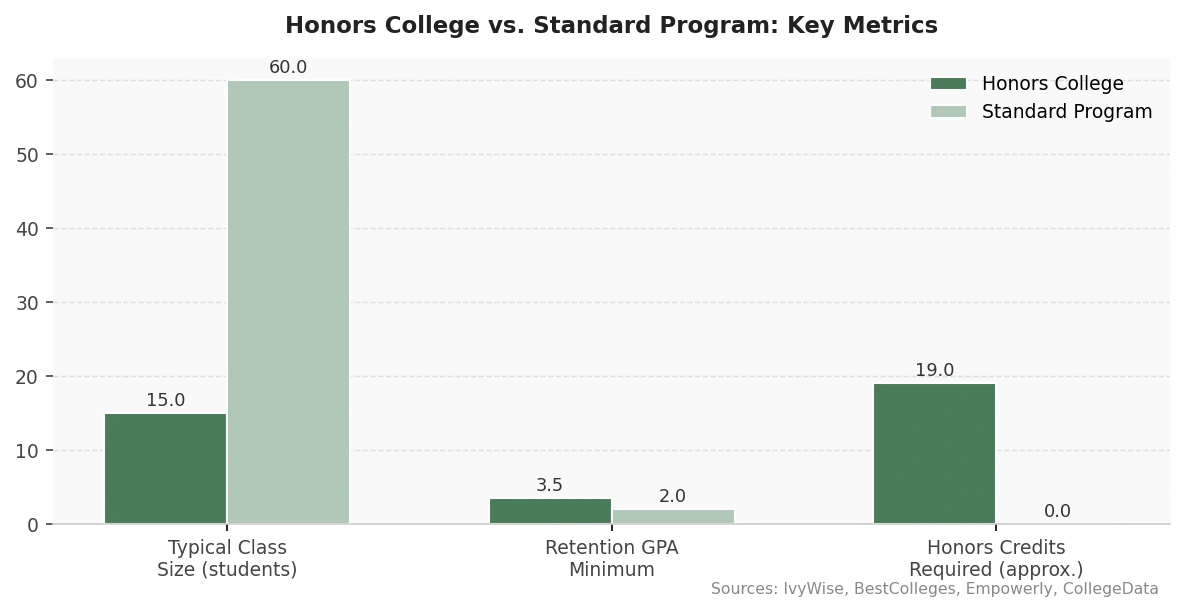
Typical class size | ~15 students (seminar-style) | 50–200+ students (lecture) |
Retention GPA (to stay enrolled) | 3.4–3.7 (varies by program) | Typically 2.0 |
Honors credits required | 15–24 honors-specific credits (typically replacing standard requirements) | None |
Thesis requirement | Required at most programs (30–40 pages) | Not required |
Housing | Dedicated honors residence halls | General campus housing |
Priority registration | Yes, at many institutions | No |
Scholarships | Available at many programs | Not program-specific |
Transcript distinction | Honors notation on diploma and transcript | GPA-based Latin honors only |
What Is an Honors College?
An honors college is a college within a university. It has its own dean, advisors, facilities, and curriculum. Students still earn a degree in their chosen major through the relevant department, but they do it while completing additional requirements through the honors college. Honors colleges are most common at large public universities, where they were created to offer top students the kind of intensive, small-group academic experience typically associated with selective private institutions.
Admission usually requires a separate application on top of the general university application, along with higher GPA and test score thresholds than the general admission pool.
Honors College vs. Honors Program
This is the question that trips up most applicants, and the difference matters practically, not just semantically. According to CollegeData's honors guide, an honors college is a standalone institution within the university, with its own buildings, administration, and faculty. An honors program is a series of courses or seminars layered on top of your regular degree requirements, not a separate college unto itself.
The distinction affects your diploma, your housing options, and how much your academic schedule is shaped by the program. At a school with an honors program, the honors designation appears as a transcript notation. At a school with a true honors college, that unit may appear on your diploma alongside your major. Confirm which structure you're dealing with before applying, since it changes the workload calculation significantly.
The Benefits: What You Gain
Smaller Classes and Better Faculty Access
This is the most consistent benefit across programs. Honors students get smaller, discussion-based classes from the start of their degree, while students in standard programs typically don't access that kind of environment until upper-level courses in their major. That early access to faculty relationships matters if you plan to pursue research, graduate school, or need strong letters of recommendation. A common misconception is that honors programs are only for students with a perfect GPA and a packed extracurricular list. Many programs are designed for engaged learners willing to put in the work, not just those with flawless records.
Priority Registration
Many honors colleges give students early access to course registration. This helps you balance required honors courses with your regular schedule without getting locked out of the classes you need.
Dedicated Housing
Most honors colleges offer or require students to live in honors-designated residence halls, at least in the first year. These living-learning communities put you alongside peers with similar academic goals, which can make the transition to college easier and build connections that carry forward well beyond graduation.
Scholarships and Financial Perks
Some honors colleges attach meaningful scholarships directly to admission, sometimes worth several thousand dollars a year, plus additional funding for research and study abroad. A small number of programs charge an extra honors fee, typically $200 to $500 per semester, but scholarship awards at well-funded programs generally offset this.
The following chart shows annual scholarship amounts at a selection of public university honors colleges.
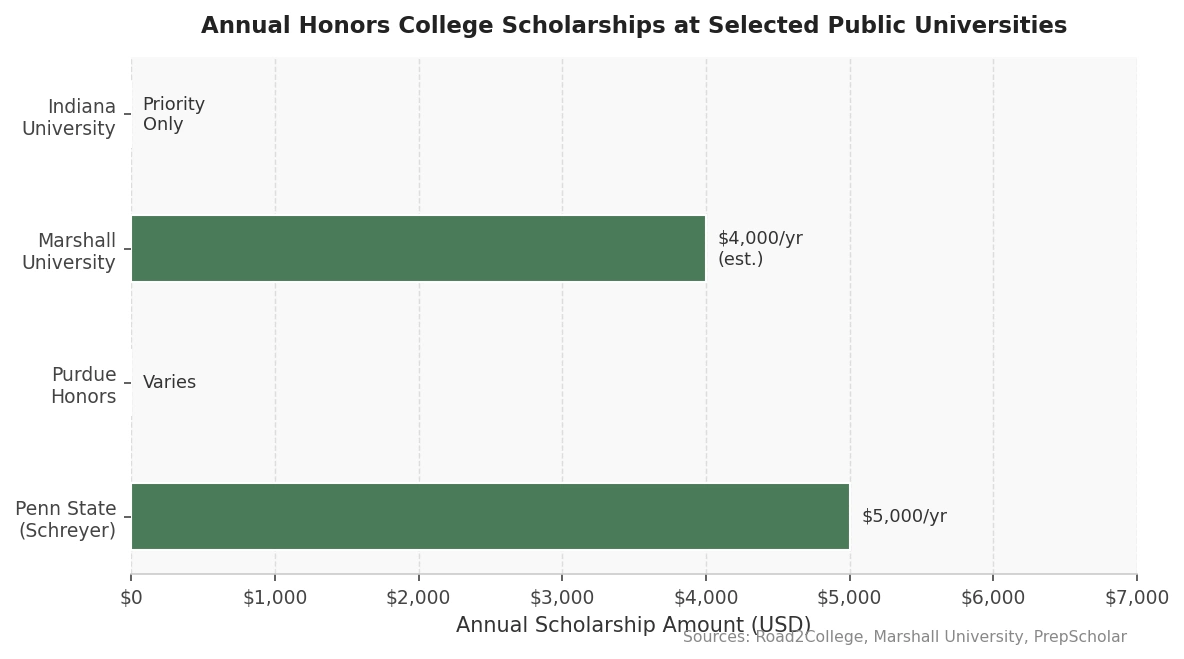
Not all programs offer flat scholarships. At some schools, the financial benefit comes primarily from priority access to competitive merit awards and research funding rather than a set annual amount. Check each program's financial aid page directly.
Advising, Research, and Alumni Networks
Honors students typically have access to dedicated academic advisors, thesis mentorship, and research placements not available to the general student body. Honors alumni networks are also a meaningful resource, particularly for students entering competitive industries or graduate programs.
Graduating With Honors
Students who complete all program requirements graduate with an honors distinction on their diploma and transcript, plus special regalia at commencement. This is a meaningful credential for graduate school applications and early-career roles where academic distinction carries weight. Earning it requires maintaining your program's retention GPA floor, which commonly sits between 3.4 and 3.7, through to graduation.
The Tradeoffs: What You Sacrifice
The following chart compares honors college and standard programs across three key metrics: class size, retention GPA minimum, and honors credits required.
Higher Academic Pressure
Staying enrolled requires maintaining a GPA above what standard students need. This is a real concern for students in demanding majors or those targeting medical school, law school, or other graduate programs where GPA is a decisive factor. Harder classes in a higher-stakes environment can push your GPA down at exactly the moment it matters most.
The Thesis Requirement
Most honors colleges require students to produce an honors thesis to graduate, typically running 30 to 40 pages and representing a synthesis of four years of study. Managing a project that size alongside a regular senior-year course load is genuinely demanding, particularly in the final year when academic and personal pressures tend to peak. If long-form academic writing is something you dread, factor that honestly into your decision.
Less Schedule Flexibility
Most honors students complete between 15 and 24 honors-designated credits over four years. While these typically replace standard general education requirements rather than adding entirely new credits on top, they still narrow how much room you have for electives. Plans to double major or study abroad can be harder to execute within the required structure.
Leaving the Program
Most colleges allow you to exit an honors college without it affecting your enrollment in the broader university. Depending on the institution, leaving the honors college prematurely may result in a program status notation on your internal academic record, though it rarely penalizes your primary major degree. You will lose your honors designation, priority housing access, and any program-tied scholarships.
Completion Rates Are Lower Than You'd Expect
Most programs offer a probationary period if your GPA drops below the threshold, but not all students make it through. According to CollegeData's program guide, some programs report completion rates as low as 25%, while others run closer to 90%. Ask each program directly for its completion rate before you apply.
Entry and Continuation Requirements
Admission GPA requirements typically sit at 3.75 or above, alongside above-average standardized test scores and a separate application with supplemental essays. That bar varies considerably by school, and many programs don't require a perfect record. They're open to students who demonstrate genuine academic engagement. Check each school's specific thresholds rather than assuming the bar is standardized.
Once enrolled, the requirements shift from admission GPA to retention GPA. Common continuation benchmarks include:
Maintaining a minimum retention GPA each semester, commonly between 3.4 and 3.7
Completing a set number of honors-designated courses each semester
Producing and defending an honors thesis in your final year
Meeting any additional extracurricular or community service requirements specific to the program
Most programs offer a probationary period if your GPA dips below the minimum. Check the specific terms at each institution when you receive your admission offer.
If you are applying as an international student, mapping your foreign credentials to these competitive GPA thresholds can be complex. Using a credential evaluation service helps ensure your international transcripts are accurately interpreted by U.S. honors selection committees, and avoids delays that can push you past application deadlines.
Is an Honors College Right for You?
Honors colleges tend to be a strong fit for students where the following traits sound like you:
Intellectually curious. You actively enjoy academic challenge beyond what's assigned. Seminar-style classes that require preparation and participation suit you better than large lectures.
Self-disciplined. You can manage a heavier workload without significant damage to your retention GPA, mental health, or other commitments.
Pre-professional. You're headed toward graduate school, research, or competitive fields where an honors transcript notation and a completed thesis give you a real edge.
Comfortable with long-form writing. The thesis requirement is not a formality. Completion rates drop significantly among students who underestimate this part of the commitment.
Skip it if your schedule is already at capacity due to a demanding double major or work commitments, if your target career path doesn't weight academic distinction, or if the programs you're considering have thin scholarship support, weak completion rates, or limited research access. Evaluate each program's concrete components, including curriculum quality, advising resources, outcomes data, and tangible perks, before deciding.
Before you apply, talk to current honors students and, where possible, sit in on a class. That gives you a direct read on the culture and workload rather than a marketing-page version of it. Ask each program directly about its completion rate, exit policy, how honors credits interact with your intended major, and what thesis support looks like in the final year. Well-run honors colleges are transparent about these details because they want students who will finish, not just students who will enroll.
 How Universities Are Adapting Health Programs to a Moderating Job Market
 How Flexible Are PhDs in a Changing Job Market
 Understanding the Decline of International Enrollment in American Universities
 Why AI Writing Polish Can Flatten Student Expression
 Connecting International Talent to Inclusive Careers