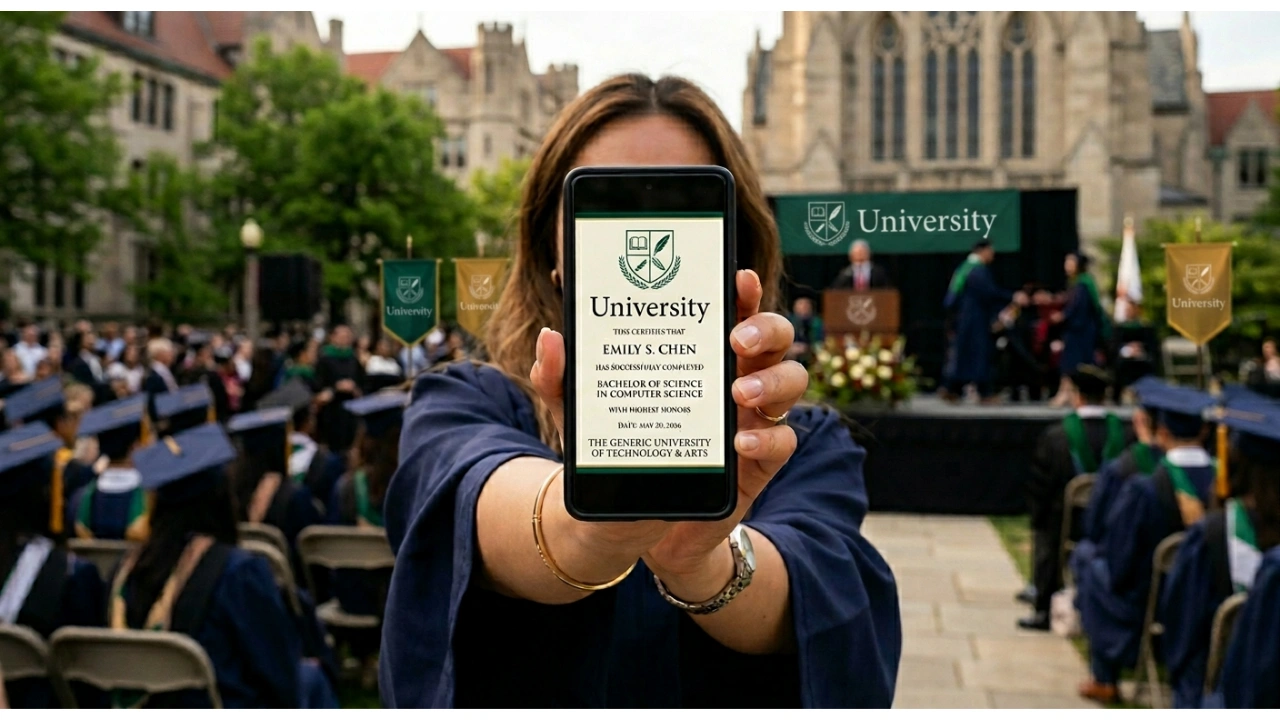
Picture this: you graduate, walk across the stage, and within minutes your degree is verified, shareable, and sitting in your LinkedIn profile. No waiting weeks for a paper diploma to arrive by mail. No photocopying it for every job application. No worrying it'll get lost in a move.
That's not a future scenario. Digital diplomas are here now, and higher education is catching up fast.
So, what exactly is a digital diploma?
A digital diploma is a secure, electronic version of your degree certificate. It looks like your paper diploma, but it lives online and can be shared with anyone, instantly.
There are two main types:
PDF diplomas (digitally signed, encrypted documents). UCLA calls theirs a CeDiploma, an exact digital copy of the paper version, verifiable by any employer
Blockchain-based credentials, stored on a decentralized network, making them nearly impossible to fake
MIT has issued blockchain diplomas since 2017. Harvard uses blockchain for executive education certificates. These aren't experiments anymore. They're standard practice at leading institutions.
The fraud problem is real
Here's an uncomfortable truth: credential fraud is widespread.
Around 60% of job applicants misrepresent their qualifications in some way. That puts admissions offices and employers in a tough spot, especially when verifying a paper document means calling a registrar and waiting days for a response.
Take this scenario: a hiring manager receives 200 applications. Manually verifying even 20% of those credentials by phone or email is a significant drain on resources, and easy to skip under time pressure.
That's the gap digital diplomas close.
How instant verification actually works
When a graduate sends a digital diploma, the recipient clicks a link or scans a QR code. The system confirms the credential is authentic in seconds. No calls, no emails, no waiting.
Institutions using digital credentialing report verification time dropping from around five days to near-instant, with a 60% speed improvement on average.
For domestic admissions teams processing transfer applications, that speed matters. You move faster, reduce bottlenecks, and spend less time chasing down third-party verification.
Tamper-proof by design
Paper documents get forged. Digital diplomas backed by blockchain don't.
Once a credential is recorded on a blockchain, it's immutable. Nobody can alter it without detection. Universities adopting blockchain credentialing report 30% fewer fraud cases, according to industry data.
Here's how the security layer works:
Each diploma gets a unique cryptographic signature
Any change to the document, even a single character, invalidates the signature
The record is stored across a decentralized network, so there's no single point of failure
For admissions staff, this means fewer fake documents in your applicant pool. For students, it means their credential carries weight wherever they take it.
How paper and digital stack up
A comparison table outlining the key differences between a traditional paper diploma and a modern digital diploma across six features.
Sharing to LinkedIn in one click
This is where digital diplomas start doing something paper never could: marketing your institution for you.
Every time a graduate shares their digital diploma on LinkedIn or adds it to a job application, your institution's name goes with it. It's visible to recruiters, hiring managers, and potential students, without you spending a dollar.
Parchment, one of the leading credentialing platforms, makes the process simple: graduates open their credential and click the LinkedIn icon. It posts directly to their profile and feed, with the university name and degree details intact.
"I shared my degree on LinkedIn the same day I graduated. Three recruiters reached out within a week. I didn't even apply to them." — Sarah, 2024 marketing graduate
That kind of reach from a paper diploma? Not possible.
Your credential, your portfolio
Digital diplomas don't sit in a drawer. Graduates carry them everywhere.
The move toward Self-Sovereign Identity (SSI) means students will own their credentials in personal digital wallets, linked to their identity, not a university server. The W3C Verifiable Credentials standard is already making this possible across platforms and borders.
For your students applying domestically, this means:
Attach a verified diploma link to any job or graduate school application
No need to request a new copy from the registrar each time
The credential is always current and always verifiable
It removes friction from the whole process, for students and for the institutions receiving those applications.
The honest catch

Digital diplomas aren't universally adopted yet.
A survey by the American Association of Collegiate Registrars and Admissions Officers found that only 7% of institutions currently provide digital diplomas. The technology is proven, but rollout is slow.
Smaller institutions often cite cost and implementation complexity. There's also a real interoperability gap. Not every employer or institution recognizes every credential format yet.
And here's something worth acknowledging: if your institution issues digital diplomas but the receiving institution has no system to verify them, the benefit disappears. Adoption has to move on both ends.
What to do next
If you're in a leadership role, the decision isn't really "should we do this." It's "how soon."
Start here:
Audit your current credentialing process and identify where verification bottlenecks happen
Evaluate platforms like Parchment, BCdiploma, or Blockcerts
Run a pilot with one graduating cohort before full rollout
Communicate the change clearly to students and employers ahead of time
The institutions that move first set the standard. Those that wait end up explaining to applicants why their credentials are still arriving by mail.
Paper is so last century
Digital diplomas are faster, more secure, and more portable than paper. They cut fraud, save admin time, and give your graduates a tool that actually works in a digital hiring market.
The technology is ready. The question is whether your institution is.
 5 ways colleges can make career prep 'unavoidable' for students
 The Real Economics Behind Entry-Level Gigs
 Can 3-Year Degrees Solve the Teacher Shortage?
 Does College Public Speaking Really Matter in Today’s Job Market?
 Strategies for Communicating Tuition and Outcomes to Prospective Students