Every fall, your advising team burns through hours triaging transcripts, deciding who gets fast-tracked into honors, who lands a standard schedule, and who gets flagged for extra support. That triage usually runs on three data points: AP credits, test scores, and résumé length. None of those three actually measure what you need to know, which is how fast a given student will move once they're here.

Colleges routinely mistake a strong start for a strong finish. It's an easy mistake to make, since the signals look identical on paper. But a head start and real velocity are two different things, and mixing them up costs your institution more than you'd think, in advising hours, misplaced honors seats, and retention numbers that don't add up later.
Let's break down where this goes wrong, one credential at a time, starting with the one your registrar's office deals with most.
Where Colleges Get the Story Wrong
Here's the short version before we go deep. Three types of early academic advantage get read as more than they actually mean:
What Colleges See | What Colleges Assume | What's Actually True |
|---|---|---|
A stack of AP or IB credits | Ready to skip ahead, no gaps | Outcomes depend heavily on the specific course and institution, not the credit count |
A near-perfect SAT or ACT score | Top performer across the board | Strong signal for first-year GPA, weaker signal for retention and graduation |
A résumé full of leadership titles and awards | Natural leader, self-starter | Often reflects which families had the money and time to build that résumé |
The Credit Doesn't Always Match the Skill
Let's talk AP and IB credit first, because this is where a lot of institutional guesswork happens.
A study out of a large public research university, published in the NACADA Journal, tracked over 20,000 students across 42 courses. The finding: even after controlling for high school GPA and test scores, students who came in with AP credit still outpaced their non-AP peers, by roughly a third to half a grade point. That part's real.
Here's the part that surprised the researchers. It barely mattered whether students used their AP credit to skip ahead or chose to repeat the prerequisite course anyway. Both groups did about the same. The difference between repeating and not repeating was tiny, less than a tenth of a grade point.
So if a student earns AP credit but their advisor pushes them to repeat the intro course "just to be safe," for example, that advice probably isn't backed by much. The credit itself isn't the problem. The blanket policy treating every AP student the same way, regardless of the course or the department, is where things fall apart.
Different departments at the same school often have wildly different rules for the same exam score. That's not a diagnostic system. That's inconsistency wearing a rulebook.
Credit policy is one blind spot. The other big one sits right next to it on the application, and it's arguably trusted even more.
A High Score Doesn't Predict What You Think It Does
Standardized test scores get treated like a crystal ball. They're not, but they're also not nothing, so let's be precise here.
Research from Harvard's Opportunity Insights team looked at Ivy-Plus admissions data and found that students with the highest possible scores posted first-year GPAs about 0.43 points higher than students scoring roughly 400 points lower. Score in that lower band, and a student is five times as likely to slip into C-plus territory or worse in at least one class. That's a real gap, and it holds up even after accounting for race, income, and family background.
But here's the catch your admissions office probably doesn't advertise. The same research found that high school GPA barely moved the needle on first-year performance. A separate look, from the University of California's own 2020 testing task force, complicates things further. Its faculty panel found test scores were the stronger predictor of first-year grades, but high school GPA edged them out, slightly, for retention and four-year graduation.
Translation: a great test score tells you a lot about a student's freshman year. It tells you a lot less about whether they'll still be enrolled in year four. If your honors program or scholarship criteria lean almost entirely on test scores, you're optimizing for a number that fades in relevance the longer a student stays.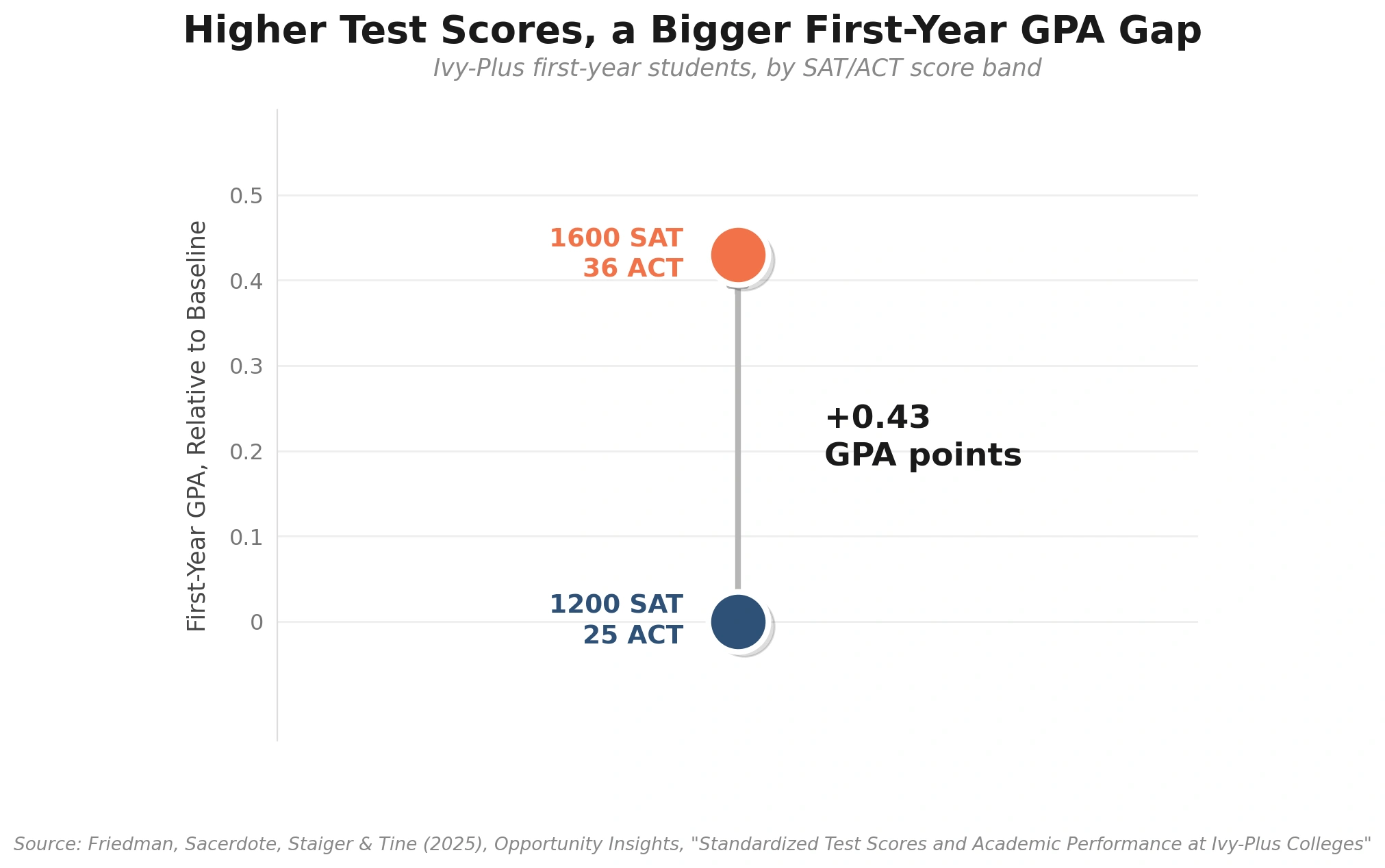
Test scores at least try to measure ability. The third credential on every application is supposed to measure something harder to fake: character. That's exactly where it falls apart.
A Loaded Résumé Isn't Proof of Leadership
This one stings a little, because it's the credential most likely to get read as character.
A review covered by Inside Higher Ed found something worth sitting with: wealthier, white, Asian American, and private-school students showed up with longer activity lists, sure, but they also held more of the top leadership titles and collected more honors tied to those activities. The researchers flagged this as the same bias problem test scores have, just wearing a different outfit.
Think about what it actually takes to become "club president" or "founder of a nonprofit" by age seventeen. It usually takes a car, free time after school, and parents who know how the game works. If a student spends those same hours working a retail job to help pay rent, for example, that experience won't show up as a title on a résumé. It'll show up as a gap.
Reading a polished résumé as proof of drive, while reading an empty one as a lack of drive, gets the story backward more often than admissions committees like to admit.
None of these three credentials are the real problem on their own. The trouble starts once your institution starts spending real resources based on them.
Where the Advising Time and Money Actually Go
Here's the part that should worry a leadership team more than any single admissions decision.
When your institution treats these credentials as settled facts instead of partial clues, resources follow the wrong signal. Honors cohorts fill up with students who tested well, not necessarily students who'll thrive in a rigorous program. Advising hours go to students whose transcripts look complicated (loads of AP credit to sort through) while a first-generation student with a thinner transcript, but real potential, gets a rubber-stamp advising session and moves on.
Scholarship dollars often follow the same pattern. Money chases the résumé, not the trajectory.
None of this is malicious. It's just what happens when a system optimizes for legible signals over accurate ones.
What This Costs You Down the Road
The cost shows up late, which is exactly why it's easy to miss at the time.
A student who got waved through on paper credentials but never got real advising support might stumble in year two or three, right when it's harder to catch. Meanwhile, a student who looked "average" on entry but had genuine drive might never get pointed toward the honors track or research opportunities they'd have thrived in.
Multiply that across a few thousand students a year, and you're not looking at a handful of misjudged cases. You're looking at a structural pattern that shows up in your retention data a few years out, quietly, without an obvious cause.
Two Better Signals to Track Instead
Early academic advantage tells you where a student started. It doesn't tell you where they're headed. Swapping out entry credentials for trajectory data gets you closer to the truth. Two places to start: watch grade trajectory across the first four semesters, since a student trending upward tells you more about drive than a flat transcript full of AP fives ever will. And weigh depth over breadth in activities, since two years of sustained involvement in one thing beats a résumé with ten scattered clubs, regardless of which one had a fancier title attached.
Neither metric is perfect. Both get you closer to measuring velocity instead of a head start.
 How Politics Is Shaping College Enrollment
 How Top Performers Land US Job Offers
 The College Majors Foreign Students Regret Choosing
 The Tightest Job Market in Years for College Grads
 How Universities Are Adapting Health Programs to a Moderating Job Market