
If you want to find legitimate college scholarships, you don't need a paid service or a secret list. You need free, trusted databases, your local network, and a sharp eye for scams.

The money is real. Sallie Mae's How America Pays study found families spent an average of $34,019 on college in 2025-26, up 10% from the year before. Grants and scholarships covered 27% of that bill.
Here's how families split the cost.
Funding source | Share of costs | Average amount |
|---|---|---|
Parent income and savings | 39% | $13,087 |
Scholarships | 15% | $5,077 |
Grants | 12% | $4,186 |
Student borrowing | 11% | $3,793 |
Parent borrowing | 11% | $3,734 |
Student income and savings | 10% | $3,536 |
Gifts from friends or family | 2% | $604 |
Scholarships alone covered about $5,000 per family. That's money you never pay back. Here's how to find legitimate college scholarships and go get your share.
At a Glance
Start local: community awards draw fewer applicants, so your odds go up.
College money is king: colleges hand out far more grant aid than private and employer scholarships combined.
Zero fees: never pay to search or apply. Real scholarships are free.
Start With Scholarships in Your Own Backyard
Big national awards grab the headlines. Local awards are where your odds get a lot better.
Why? Fewer people apply. A scholarship from your town's Rotary club won't show up in front of every high school senior in the country.
Here's where to look first:
Your high school counselor's office
Community foundations in your county or city
Your parents' employers and unions
Local credit unions and banks
Civic clubs and religious groups
Local businesses, from car dealers to law firms
If a student in a small town applies for a $1,000 award from her local credit union, for example, she might be up against a few dozen classmates. Compare that with a national essay contest drawing thousands of entries. Same effort, much better shot.
You also don't need to be a star athlete or a straight-A student. Plenty of awards target where you live, what you plan to study, or what you've lived through.
And don't sneer at small checks. Three $500 awards add up to $1,500, which covers a lot of textbooks.
Search Free Scholarship Databases the Smart Way
People ask me all the time which website is best for finding real scholarships. Honest answer: there isn't one perfect site. But there's a smart place to start.
The U.S. Department of Labor sponsors the CareerOneStop Scholarship Finder tool. It lists more than 9,500 scholarships, fellowships, grants, and other awards. It costs nothing, and a federal agency backs it.
Other free search sites exist too. Stick with ones that never charge you to search or apply.
A few habits make your search way more productive:
Filter hard. Narrow by state, level of study, and major so you only see awards you qualify for.
Use a separate email. Scholarship sites send a lot of messages. Keep them out of your main inbox.
Guard your personal data. No legit search tool needs your Social Security number or bank details.
Check back monthly. New awards get added all year.
Find Unlisted Awards With Smart Google Searches
Lots of local scholarships never make it into a database. You can dig them up with a few targeted searches. Copy these into Google and swap in your own details:
scholarship "community foundation" "[your county]"
scholarship ("high school senior" OR undergraduate) "[your major]" site:.org
scholarship "[your city]" "apply by"
A few rules that make these work. Quotation marks force an exact phrase. OR needs to be in capital letters. And site:.org limits results to nonprofit sites, where lots of local foundations live. You don't need to type AND, since Google already looks for every word you enter.
If a student planning to study nursing searches "nursing" and filters by her state, for example, a list of thousands shrinks to a few dozen. Those are the ones worth her weekend.
Going back to school after time away? Databases aren't only for teens. Many awards target returning adult learners too.
Ask Your Target Colleges What They Offer
Here's something a lot of students miss. The biggest pile of grant money usually sits with colleges themselves.
The College Board's Trends in Student Aid report shows how grant aid broke down in 2024-25:
Colleges' own grants: $85.1 billion
Federal grants: $53.7 billion
Other grants, including private and employer awards: $18.2 billion
State grants: $16.6 billion
Add it up and colleges gave out more than four times as much grant money as private and employer sources combined. That makes your target colleges the first place to look, not the last.
Here's how to get at it:
Read each financial aid page. Look for merit awards, need-based grants, and department scholarships.
Note separate applications. Some awards are automatic. Others need their own form and an early deadline.
File the FAFSA early. Colleges and states use it to hand out their own aid. The 2027-28 form is already open, so you can file the FAFSA now.
Check for the CSS Profile. Some private colleges ask for this extra aid form too.
Look up your state grant agency. Many state programs have priority dates months before the federal deadline.
If a student applies to three public universities in his state, for example, one might give automatic merit money based on his GPA. Another might need a separate scholarship application due in December. Skip that second form and he leaves real money on the table.
Scholarships are only one piece of your aid package. If you'll borrow too, get up to speed on recent federal loan changes before you sign anything.
Watch Out for Scholarship Displacement
Here's a catch most students never hear about. Winning an outside scholarship can lead some colleges to cut the grant money they already offered you. Financial aid offices call this scholarship displacement.
Colleges generally can't let your total aid go past your cost of attendance. Many also stop need-based aid once it covers your calculated financial need. So when an outside award pushes you past either line, something gets trimmed. The question is what.
If a student wins a $2,000 award from a local foundation, for example, her college might lower her student loans by $2,000. That's great. Or it might cut her college grant by $2,000, and she ends up paying the same amount as before.
So ask each financial aid office about its displacement policy before you commit. You want outside awards to reduce your loans or work-study first, not replace the college's grants.
Some states limit the practice. The Connecticut General Assembly's Office of Legislative Research lists at least six states with state displacement laws: California, Maryland, Minnesota, New Jersey, Pennsylvania, and Washington. The rules vary a lot. Some laws only cover public colleges, and California's only protects low-income students, so check the details for your state.
Spot Scholarship Scams Before They Spot You
So how do you know which scholarships are legit? Start with one rule: legitimate college scholarships don't charge you money.
According to the Federal Trade Commission's FTC scam guidance, these scams often start with a social media post, email, or letter dressed up as a personal invitation. Some push you to call a number or attend a "free" workshop at a local hotel, which turns into a high-pressure sales pitch.
Use this quick gut check:
Legit scholarship | Red flag |
|---|---|
Free to apply | Application, processing, or "redemption" fee |
No promise you'll win | "Guaranteed or your money back" |
You applied first | You "won" something you never entered |
Asks for essays and transcripts | Asks for bank or credit card numbers |
Clear deadline, no pressure | "Pay today or lose your spot" |
If a student gets an email saying she's a finalist for a $10,000 award she never applied for, for example, and it asks for a $25 processing fee, that's a scam. Real sponsors don't make you pay to receive their money.
FAFSA warning: The FAFSA is always free to submit at StudentAid.gov. Never pay a third party to fill it out, and never give anyone your FSA ID.
The FTC also warns that false information on the form can lead to fines up to $20,000, jail time, or both.
Before you apply to anything unfamiliar, run these checks:
Search the sponsor's name plus the word "scam"
Look for a real address, phone number, and history of past winners
Ask your school counselor or a college financial aid office
Think you've been targeted? You can report the scam to the FTC and let your state attorney general know too.
Get Organized So No Deadline Slips By
Finding scholarships is half the work. Keeping track of them is the other half.
Set up a simple spreadsheet with these columns:
Scholarship name and sponsor
Award amount
Deadline
Requirements, like essays or letters
Status: not started, in progress, submitted
Login details, stored safely
Always confirm dates on the sponsor's own site. CareerOneStop notes that sponsors can change deadlines and rules without telling the database.
Keep applying after you start college, too. Plenty of awards target current students, and some scholarships renew each year if you keep your grades up.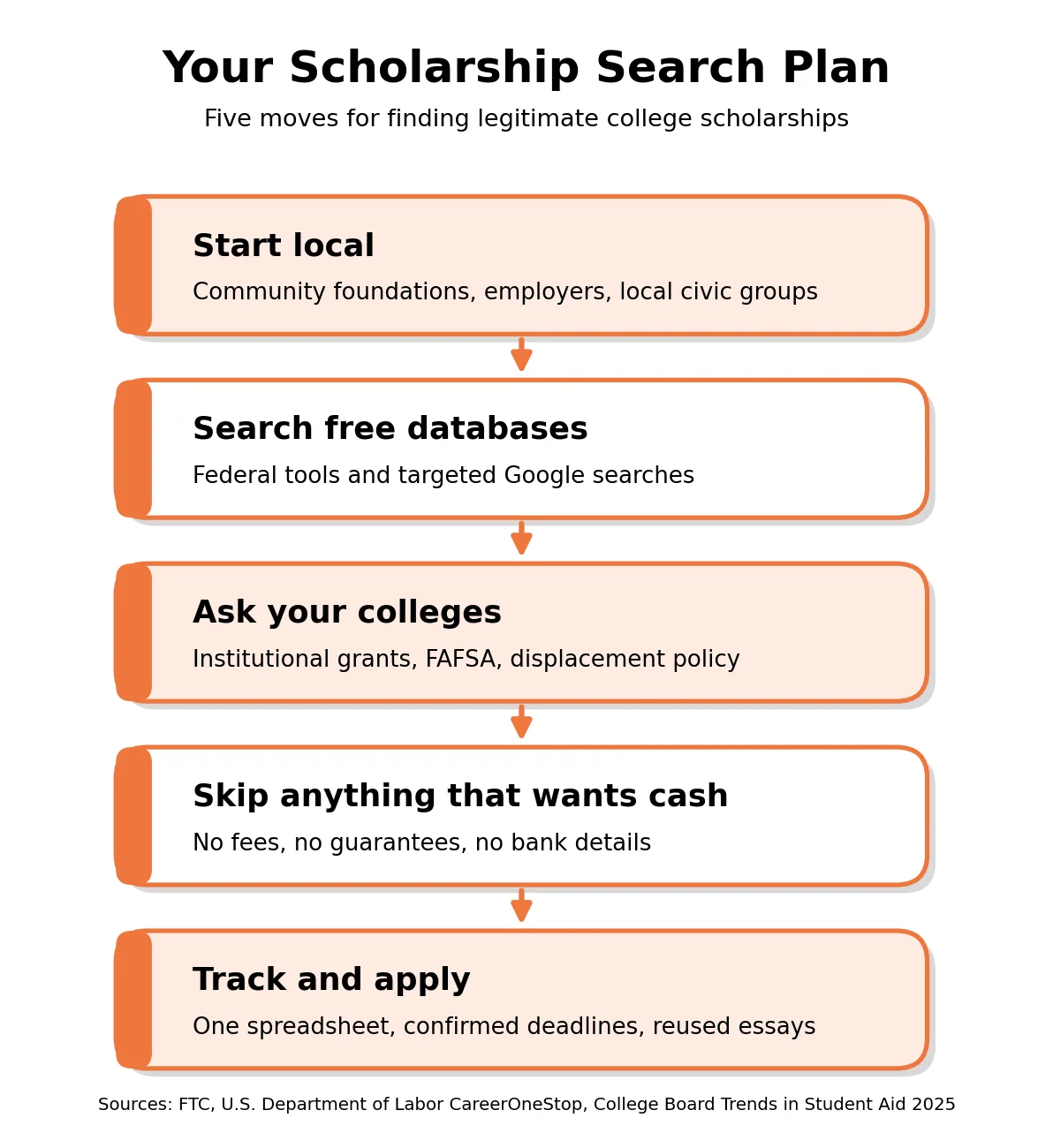
If a student keeps every application in one tracker, for example, she might notice two awards due the same week ask nearly the same essay question. One strong draft, two submissions.
Write Applications That Actually Win
Finding scholarships you can win comes down to fit and effort. Here's what gives you the edge:
Follow directions to the letter. Committees toss incomplete or off-topic entries first.
Answer the sponsor's question. A local nursing association wants to hear about your nursing goals, not your summer trip.
Build an essay bank. Save every essay, then tweak it for each new prompt.
Ask for letters early, with a brag sheet. Give teachers and bosses at least three weeks, plus a one-page sheet listing your GPA, activities, volunteer work, and career goals. They'll write a stronger letter faster when they don't have to work from memory.
Proofread out loud. You'll catch mistakes your eyes skip over.
Play the numbers. Apply to lots of smaller awards instead of one or two big ones.
Go Grab That Free Money
Legitimate college scholarships are out there. Start local, search free databases, and ask your colleges what they offer. Skip anything that wants your cash. Open a tracker this week and send your first application.
Don't stress if your first few applications don't pay off. Rejections come with the territory, and every essay you write makes the next one easier. Keep your tracker updated, keep checking your college's aid pages, and keep your guard up for anything that asks for money. A few hours a month spent applying can add up to real money you never have to pay back.
 The Real Economics Behind Entry-Level Gigs
 Can 3-Year Degrees Solve the Teacher Shortage?
 Does College Public Speaking Really Matter in Today’s Job Market?
 Strategies for Communicating Tuition and Outcomes to Prospective Students
 How Politics Is Shaping College Enrollment