
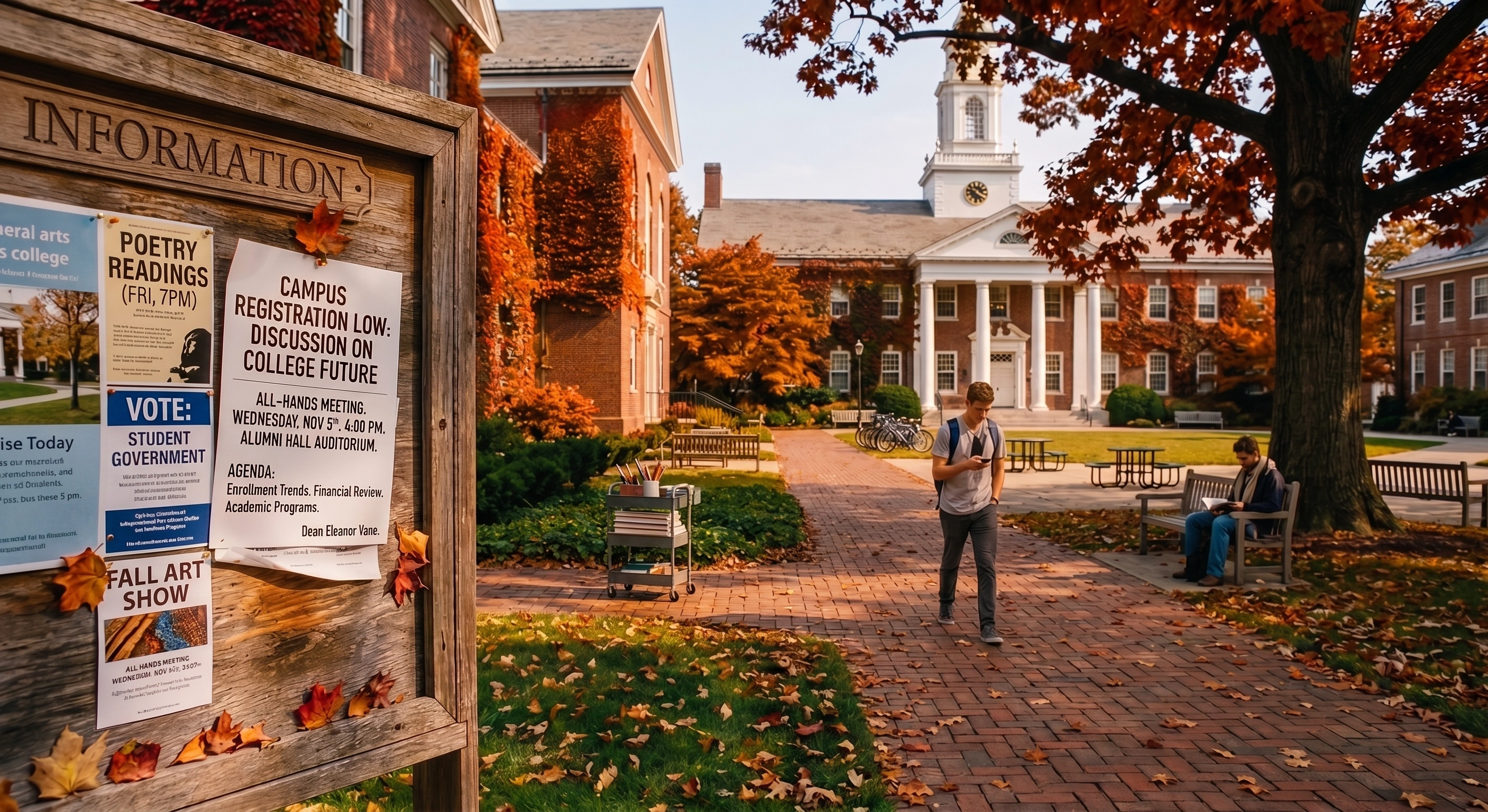
Small colleges are not falling apart from one bad decision. They are buckling under a handful of pressures that all landed at the same time, and the people in charge of these schools are watching decades of financial patchwork finally run out of tape.
The Math That Stopped Adding Up
Fewer 18 year olds are showing up. That is not a guess. It is a birth rate problem from 2008, and it is arriving right on schedule.
The number of U.S. high school graduates peaked at roughly 3.9 million in 2025 and is expected to drop to around 3.4 million by 2041, according to projected graduate enrollment decline tracking from the Western Interstate Commission for Higher Education. That is a 13 percent drop in the pool every college pulls from.
It hits some regions harder than others. The Northeast and Midwest are seeing the steepest declines. The South and West are seeing smaller ones, but nobody gets to skip this entirely.
Metric | A Decade Ago | Now |
|---|---|---|
Average tuition discount rate | 48% (2015 to 16) | 57.1% (2025 to 26, projected) |
Certificate vs bachelor's enrollment growth | Certificate and associate programs saw years of decline while bachelor's held steadier | Certificates growing more than double the rate of bachelor's (1.9% vs 0.9%, fall 2025) |
Nonprofit college closures since 2020 | N/A | Roughly 48 closures or announced closures |
Discounting Your Way Into a Hole
For years, small colleges have handled falling enrollment the same way: cut the sticker price. Offer bigger scholarships. Get students in the door any way possible.
It worked for a while. It does not work anymore. Colleges reached a record tuition discount rate of 57.1 percent for first time undergraduates in 2025 to 26, according to the National Association of College and University Business Officers. That means for every dollar of tuition a college could charge, it is giving back 57 cents in aid.
Here is the part that should worry you. Net tuition revenue still fell, even with all that discounting. You are giving away more and collecting less. That is not a strategy. That is a slow leak.
What This Looks Like on the Ground
If a student, for example, gets accepted with a scholarship that covers 60 percent of tuition, the college still needs that student's remaining 40 percent to cover a fixed cost. Multiply that gap across a shrinking freshman class, and you get a budget hole that grows every single year, not just once.
When the Rainy Day Fund Runs Dry
Big name universities with billion dollar endowments are not sweating this. Small colleges rarely have that kind of buffer.
Some schools lean on their endowment to cover operating costs when enrollment or grant funding falls short. That works once. Maybe twice. But every dollar pulled out to patch a budget gap is a dollar that is not there for the next gap, and the gaps keep coming.
One small college that closed in 2026 pointed to the loss of roughly $600,000 in annual grant funding as a tipping point. Its endowment sat at just over $25,000. That is not a cushion. That is barely a pillow.
Students Want Something Different Now
This is the part leadership tends to underestimate. Students are not just picking different colleges. Some are skipping the four year track altogether.
Undergraduate certificate programs grew 1.9 percent in fall 2025, while bachelor's degree enrollment grew just 0.9 percent, according to certificate program enrollment growth data from the National Student Clearinghouse Research Center. Spring 2026 numbers pushed that certificate growth even higher, to over 10 percent.
You cannot out market that shift. Students are watching the price of a degree climb while wage payoff stays flat, and a shorter, cheaper credential looks like a smarter bet to a lot of families right now.
Chasing Vocational Programs Is Not a Quick Fix
Plenty of small colleges have responded by bolting a certificate track onto their existing setup. That is not the same as building a program that actually competes on cost and speed. If the staffing, the facilities, and the overhead all stay the same, adding one new credential does not solve a structural cost problem. It just adds a new line item.
Closing the Doors Isn't the End of the Story
When a college shuts down, the story does not end there for students. It gets messier.
Colleges are usually required to set up a teach-out agreement, letting students finish their degree at a partner school. Sounds tidy on paper. In practice, credits do not always transfer clean, especially in specialized programs like nursing or education.
And the damage runs deeper than a scheduling headache. Just 47 percent of students who experienced a closure between 2004 and 2020 ever re-enrolled anywhere else, according to a joint study from the State Higher Education Executive Officers Association and the National Student Clearinghouse Research Center. That means more than half of those students never came back to higher education at all. That is not a footnote. That is half a graduating class walking away completely.
What Survival Actually Looks Like
Cutting a discount rate or bolting on one certificate program will not fix a structural problem. Some schools are trying moves that go deeper, and a few of them are actually working.
Share the back office. A handful of regional colleges are teaming up on IT, HR, and compliance systems instead of each running its own version of the same department. Nobody merges brands or gives up its identity. They just stop paying four times for the same payroll software.
Pick a lane and go narrow. Offering thirty majors when you can only properly staff ten is not a strength, it is overhead. Some colleges are cutting redundant broad degree programs and putting real money behind two or three programs tied directly to regional job demand.
Turn empty buildings into income. A half empty dorm or an unused academic building is not sitting quietly for free. Some colleges are leasing space to local businesses, community groups, or workforce training partners, turning dead square footage into a recurring revenue line instead of a maintenance cost.
None of these fix a college on their own. But they buy time, and time is the one thing most of these schools do not have enough of right now.
Two Different Risk Checklists
Everything above matters whether you run a college or you are choosing one to attend. From here, what you should actually watch depends on which side of that decision you are on.
If You Are Leading an Institution
Watch your discount rate trend, not just this year's number. Watch how fast your reserves are being drawn down to cover operating gaps. Watch program level demand closely, since a couple of oversubscribed majors can hide serious decline happening everywhere else.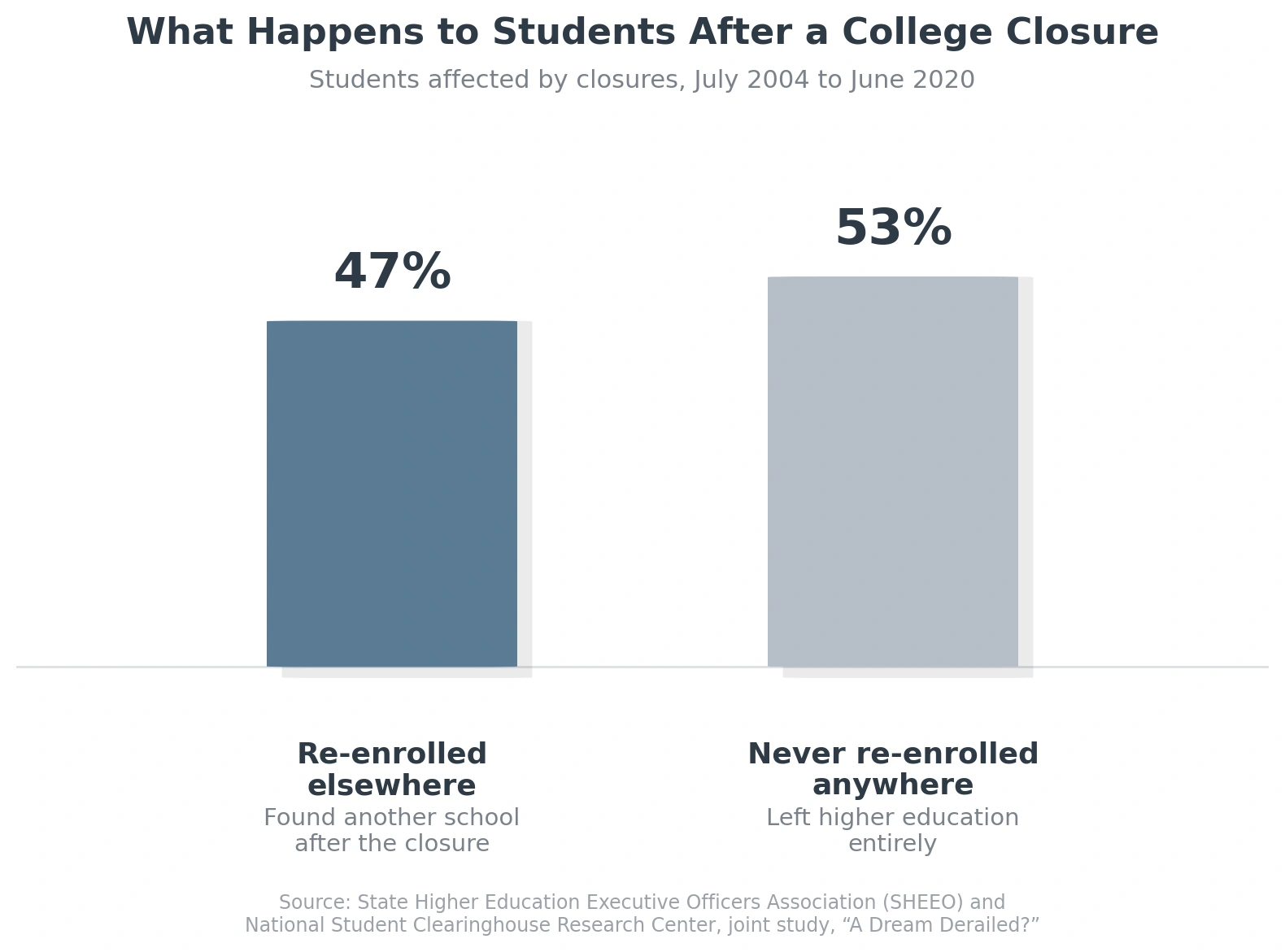
Also watch the policy environment. Legislation introduced in early 2026 aims to give closing colleges clearer obligations toward students, including rules around debt collection and records access, based on state closure protection laws tracked by higher ed policy researchers. More states are heading in this direction, and it will change what an orderly closure or merger requires going forward.
If You Are Choosing a School
If a student, for example, is deciding between two schools and one of them has cut faculty or slashed majors recently, that is worth asking about directly before enrolling. Ask whether the school has a teach-out agreement in place. Ask how its enrollment and discount rate have trended over the last few years, if that information is public.
And do not panic transfer the moment a closure gets announced. Students who transfer outside an official teach-out agreement are not guaranteed any credit recognition at all, which can mean losing a year of progress over one rushed decision.
 The Real Risks Behind Social Media Screening
 Why Expanding Higher Ed Access in SIDS and LDCs Matters for Global Progress
 What the Education Department’s New Rules Mean for Your Career
 How AI Chatbots Shape Student Retention and Academic Navigation
 How AI Is Affecting the Job Market for New International Graduates