

If you're applying to college, already enrolled, or paying off loans, the rules just changed under you. The Education Department finalized new Pell Grant limits, rolled out new student loan repayment options, and proposed a rule that could reshape which schools even count for federal aid. None of this is background noise. It touches your tuition bill, your monthly loan payment, and how much your degree actually pays off down the line.
Here's what's different, what it means for your wallet, and what to check before you make your next enrollment or loan decision.
Pell Grant Rule | Before | Starting July 1, 2026 |
|---|---|---|
Full scholarship coverage | You could still get a Pell Grant on top of full scholarships | You lose Pell eligibility if aid already covers your full cost of attendance |
Income and asset cutoff | No fixed cutoff based on Student Aid Index | You're ineligible if your Student Aid Index hits $14,790 or more |
Short-term workforce programs | Not eligible for Pell funding | Eligible if the program meets state approval and completion benchmarks |
Your Pell Grant Might Look Different Now
Let's start with the headline. Pell Grants are not disappearing. But two changes could shrink or eliminate yours starting with the 2026-27 school year.
If your scholarships and waivers already cover your entire cost of attendance, you no longer get a Pell Grant stacked on top.
If your Student Aid Index comes in at $14,790 or higher, twice the current Pell max, you're not eligible at all.
The Department expects this to affect a small share of the roughly 6 million students who get a Pell Grant each year. Still, if a student is close to that SAI line, for example, this is worth double-checking on your FAFSA before you build your budget around an award you might not get.
Your SAI math is shifting too. Foreign earned income now gets added back into the calculation, while family farms and small business assets get excluded again. If your family runs a small business, that exclusion could help you.
More Programs Now Qualify for Pell Money
Here's the flip side. Pell eligibility just expanded to short-term workforce training programs, including for students who already hold a bachelor's degree. That's new. Before this, a four-year grad usually couldn't touch Pell funds for a certificate program.
To qualify, a program needs:
State approval as aligned with in-demand local jobs
At least one year of track record at that school
A completion rate of 70% or higher
A job placement rate of 70% or higher
If a student already has a degree and wants to pivot into a trade or technical field, for example, this opens a funding door that didn't exist before. Just know the award amount for these shorter programs will be smaller than a traditional Pell Grant, since it's prorated to the length of the program.
Your Loan Repayment Options Just Got Simpler
If you're borrowing federal student loans for the first time after July 1, 2026, or consolidating existing loans, you now pick between two repayment plans:
The Tiered Standard Plan, a fixed monthly payment over 10 to 25 years
RAP (Repayment Assistance Plan), a new income-based option with a $10 minimum monthly payment
Already borrowed before that date? You keep most of your current plan options for now, and you can add RAP if it works better for you. SAVE is gone, and PAYE and ICR are being phased out by 2028. If a student's income drops after graduation, for example, RAP's income-based structure means the payment adjusts instead of staying fixed no matter what you earn.
The bigger shakeup is on the borrowing side. Grad PLUS loans, which used to let you borrow up to your full cost of attendance, are gone for new borrowers. Here's what replaces them:
Loan Type | New Annual Cap |
|---|---|
Standard grad loans | $20,500 |
Professional grad loans (med, law, etc.) | $50,000 |
Parent PLUS loans | $20,000 |
Med and law students used to borrow well past $200,000 for school. Under the new professional cap, that's still possible up to the lifetime limit, but anyone borrowing beyond it will need to look at private loans, which don't come with income-based payments or federal forgiveness protections. If you're eyeing grad school, run the numbers on your program's real cost against these caps before you commit. Scholaro's guide to the loan changes breaks down the repayment side in more detail if you want the full picture.
Financial Aid Overall Is Getting a Facelift
Beyond Pell and loans, a few smaller tweaks are rolling into your FAFSA experience for 2026-27:
Foreign income exclusions now count toward your Pell eligibility calculation
Family farm and small business ownership gets excluded from your asset calculation again
The so-called "loophole" that let families with low income but high assets qualify for Pell is now closed
None of this needs close study on your end. Just know your FAFSA numbers this year might come out differently than last year's, even if your family's actual situation hasn't changed much.
Schools Now Have to Prove Your Degree Pays Off
This is the one that could matter most for your career, even though it's aimed at schools, not you directly. Starting with data reported in 2026 and consequences kicking in from 2027, individual college programs have to clear an earnings bar or risk losing federal loan access, according to the Department's rule announcement.
The rule works like this:
Undergrad programs must show graduates out-earn people with just a high school diploma
Grad programs must show graduates out-earn people with just a bachelor's degree
Fail that test two years out of three and the program loses access to federal Direct Loans
Translation for you: before you commit to a specific major or program, check if it's the kind of program that could get flagged. A program that can't clear this bar is telling you something about its return on investment, loan eligibility rules aside.
New Terms You'll Start Seeing Everywhere
All these rules come out of one law, and the acronyms pile up fast. Quick glossary:
SAI: Student Aid Index, the number that replaced the old EFC and decides your aid eligibility
RAP: Repayment Assistance Plan, the new income-based loan repayment option
STATS: the new reporting system schools use to disclose program cost and outcomes
Cost of Attendance (COA): your school's full estimated cost, used to test Pell eligibility
You don't need to memorize these, but you'll see them on your financial aid portal and loan servicer emails, so it helps to know what they mean when they show up.
Your Diploma Could Get Easier to Transfer
One more rule is still just a proposal, not law yet. The Department wants to overhaul how accreditors get approved, and a few pieces would directly affect you:
More accreditor choice: schools could hold more than one accreditation, and new accreditors could enter faster
Outcomes over paperwork: accreditors would judge schools by real outcomes like job placement instead of process compliance alone
Transfer credit protection: a school couldn't deny your transfer credit just because of who accredited your old school, and would owe you a written reason plus a way to appeal
Academic freedom standards: accreditors would need to protect intellectual diversity on campus
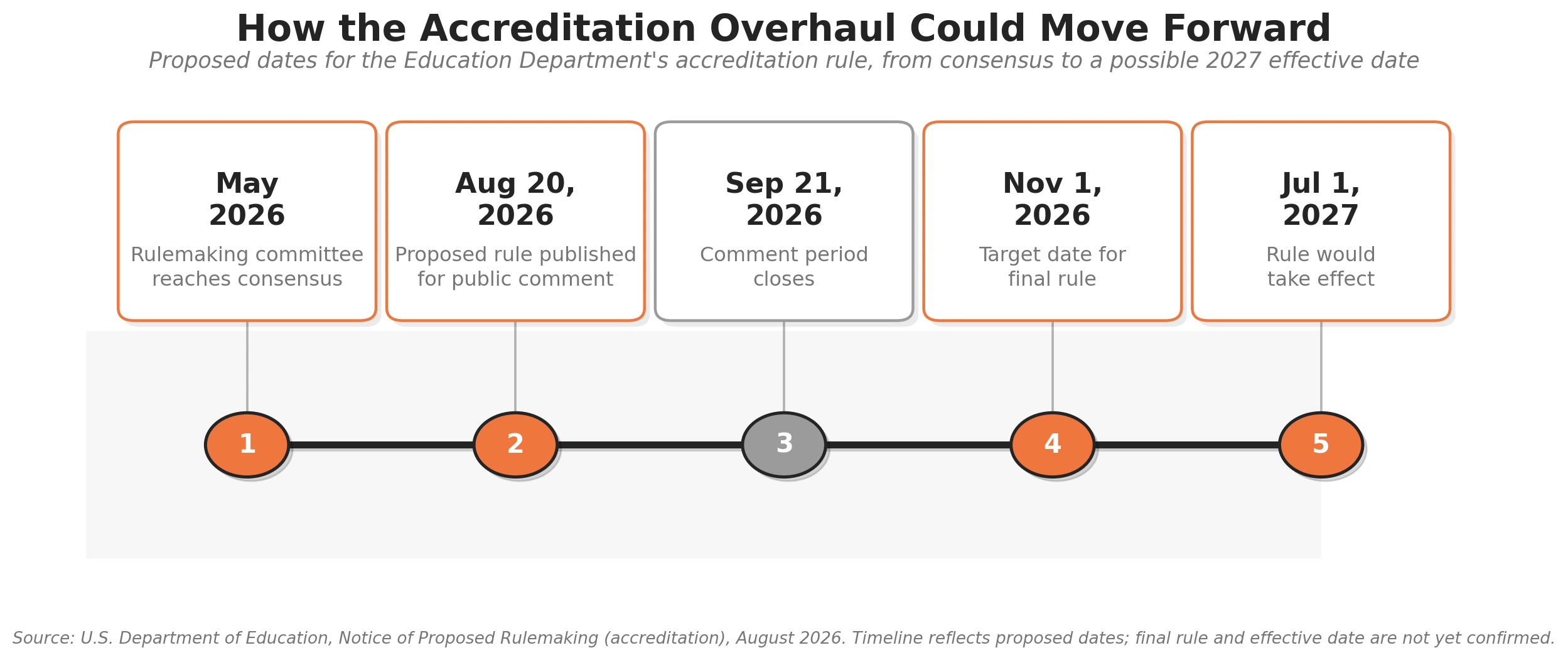
If a student transferred schools before, for example, they know how often credits just vanish for no clear reason. This proposal is aimed straight at that problem. It's not final yet. Comments closed in September 2026, and if it does get finalized, most of it wouldn't kick in until mid-2027. Worth watching if you're thinking about transferring.
What to Do With All This
Check your SAI on your next FAFSA. Price out loan caps before picking a grad program. And if a program's earnings data looks shaky, ask why before you enroll. Small checks now save you a messy surprise later.
 How Universities Use Zero-Waste Swap Programs to Cut Student Costs
 How Industry Partnerships Shape Modern Curricula
 How Post-COVID Aid Programs Help Universities Rebuild Admissions
 Beyond the Acceptance Rate and How Colleges Decide Who Gets In
 How Leveraging Job Placement Strategies Can Reenroll Returning Students