If you work in student success or academic leadership, you've probably noticed chatbots showing up everywhere on campus. They started as glorified FAQ machines. Now they're doing a lot more, and some of it is actually moving the needle on retention.
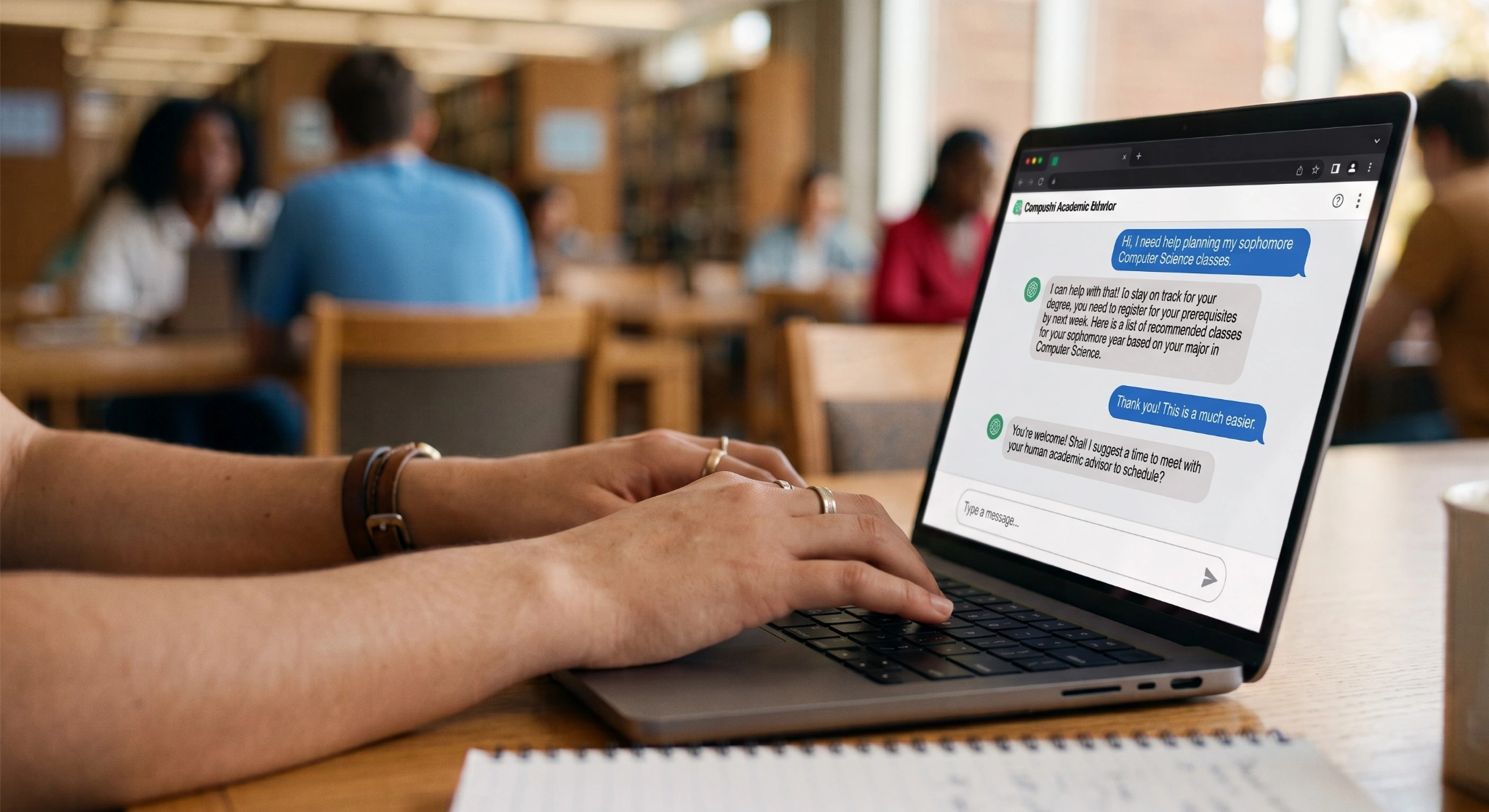
This isn't a pitch for AI. It's a straight look at what these tools are actually doing for academic navigation and retention, where they fall short, and what you should watch out for before you lean on them too hard.
The Four Flavors of Campus Chatbots
Before you can weigh the pros and cons, it helps to know what you're actually comparing. Not all chatbots do the same job.
Type | What it does | Retention role |
|---|---|---|
FAQ bot | Answers common questions on deadlines, registration, forms | Low, mostly frees up staff time |
Early alert bot | Flags students showing signs of disengagement | High, catches problems before they snowball |
Course bot | Answers assignment and content questions inside a class | Medium, supports the student while they're already enrolled |
AI agent | Monitors signals and acts without being asked | High, can reach students who never reach out |
Why Students Actually Talk to a Bot
Here's the thing nobody expects: students often prefer talking to a bot over calling an office. Not because they hate people. Because typing a question at midnight feels a lot less awkward than calling an advisor during business hours.
No waiting on hold. A student asks about a deadline and gets an answer instantly instead of sitting in a queue.
Less pressure to explain yourself. Research on campus chatbot use found that chat feels more approachable than a form or a phone call, which makes students more willing to bring up sensitive topics.
Works in more than one language. Coverage varies a lot by platform, but this matters most for international student offices juggling dozens of languages.
Actually finishes the task. The better bots don't just answer questions, they push the request through to whatever system needs to see it.
If a student is embarrassed about failing a class, for example, they might never walk into an advisor's office to ask about withdrawal deadlines. Typing the same question into a chat window feels like a much smaller step.
Where Chatbots Actually Move the Retention Needle
This is the part that should matter most to you as a decision-maker. Chatbots that just answer questions are nice. Chatbots that catch a student before they quietly disappear are worth real budget.
Catching Trouble Before It Becomes a Dropout
A 2026 PeerJ study tested this directly. Researchers paired a prediction model with a chatbot that texted students on WhatsApp. Out of 108 students, the system flagged 39 as at risk and logged 742 back and forth interactions with them. Nearly 90 percent of flagged students actually responded, in about 7 seconds on average. That's a much higher engagement rate than most schools get from a generic check in email.
The Nudge That Happens Without Anyone Asking
A basic bot waits for a student to type something. A more advanced setup watches for warning signs on its own, missed classes, a login streak that suddenly stops, a grade that's sliding, and reaches out first.
Say a student misses three classes in a row. A system built for this can text them a check in, flag it for their advisor, and prompt a faculty member to reach out, all without a human noticing the pattern first.
If a student is quietly struggling with a family emergency, for example, they might not think to email their advisor. But if the system pings them first with a simple "everything okay," that one message can be the difference between dropping out silently and getting connected to the right support.
Where This Can Backfire
Here's the part that doesn't get talked about enough. These same systems can get it wrong, and getting it wrong isn't neutral.
When a risk-flagging system carries bias, it can trap students in a loop where being labeled high risk actually leads to fewer opportunities and more scrutiny, which then reinforces the very outcome it predicted. A Clark School of Engineering study at the University of Maryland found that language models respond differently depending on identity cues a student reveals, even unintentionally.
None of this means skip the tool. It means audit it like you'd audit any other system making decisions about real people.
There's also a compliance angle leadership can't skip. Any chatbot touching student records falls under FERPA, and vendor contracts need to spell out whether student conversations get used to train third party foundation models. If a vendor can't answer that clearly, that's a red flag before you sign anything.
The Classroom Is the Bot's New Home Turf
Everything above happens outside the classroom. But chatbots have also started showing up inside courses, not just around them.
Five Ways Bots Already Live Inside Courses
Answering assignment and deadline questions built into the course platform
Giving instant feedback on practice problems
Running low stakes conversation practice in language courses
Walking students through simulated scenarios in clinical or lab based programs
If a nursing student needs to practice a tough patient conversation, for example, a scenario bot lets them try it, mess it up, and try again, without a real patient in the room.
What Bots Are Good At, and Where They Fall Flat
Bots are consistent. They don't get tired, they don't have an off day, and they answer the same question the same way every time. That's genuinely useful for the repetitive stuff.
Where they fall short is judgment. One tutoring quality study comparing AI tutors to real instructors found the bots did fine on back and forth conversation but scored noticeably lower on actual teaching quality, especially when a student needed real guidance, not just an answer.
Add to that the privacy question. Any course bot that sees grades, attendance, or written work is handling FERPA protected data, which means the same protection bar as your student information system, not a lighter one just because it's a chat window. Overreliance on a bot can also quietly chip away at a student's own critical thinking if nobody's watching for it.
Bot vs. Teaching Assistant: Who Wins?
Factor | Chatbot | Human TA |
|---|---|---|
Availability | 24/7 | Office hours only |
Consistency | Same answer every time | Varies by mood, workload, day |
Judgment calls | Weak | Strong |
Mentorship | Basically none | Real relationship |
The smartest setups don't pick one. They let the bot soak up the repetitive volume so the human TA actually has time to mentor instead of answering "when is this due" for the tenth time that day.
A 4-Step Campus Governance Checklist
Most of what separates a smart chatbot rollout from a messy one comes down to four things. Get these right and the rest tends to fall into place.
Transparency. Always disclose when a student is talking to a bot instead of a person, every single time.
Warm handoffs. Guarantee a fast, obvious path to a human advisor whenever a student needs one.
Auditing. Run regular audits for both algorithmic bias and identity bias, not just accuracy checks.
Human in the loop. Require a real person to sign off before any high risk flag gets attached to a student's file.
Start narrow too. Institutions that get this right usually launch in one area first, often admissions or IT support, prove it works, then expand. And none of this replaces faculty. Educators still need to verify what the bot tells students, catch anything biased or just wrong, and decide what it's allowed to answer inside their course. A bot nobody's watching is a bot that can quietly go off the rails.
Efficacy, Perception, and Scope
Does It Actually Help Students Learn?
The honest answer is we're still figuring it out. A five year course study published in Frontiers in Education tracked a first year course and found real gains in performance and engagement when a chatbot supplemented regular teaching. But the sample sizes in this research area are still small, and results vary a lot from study to study.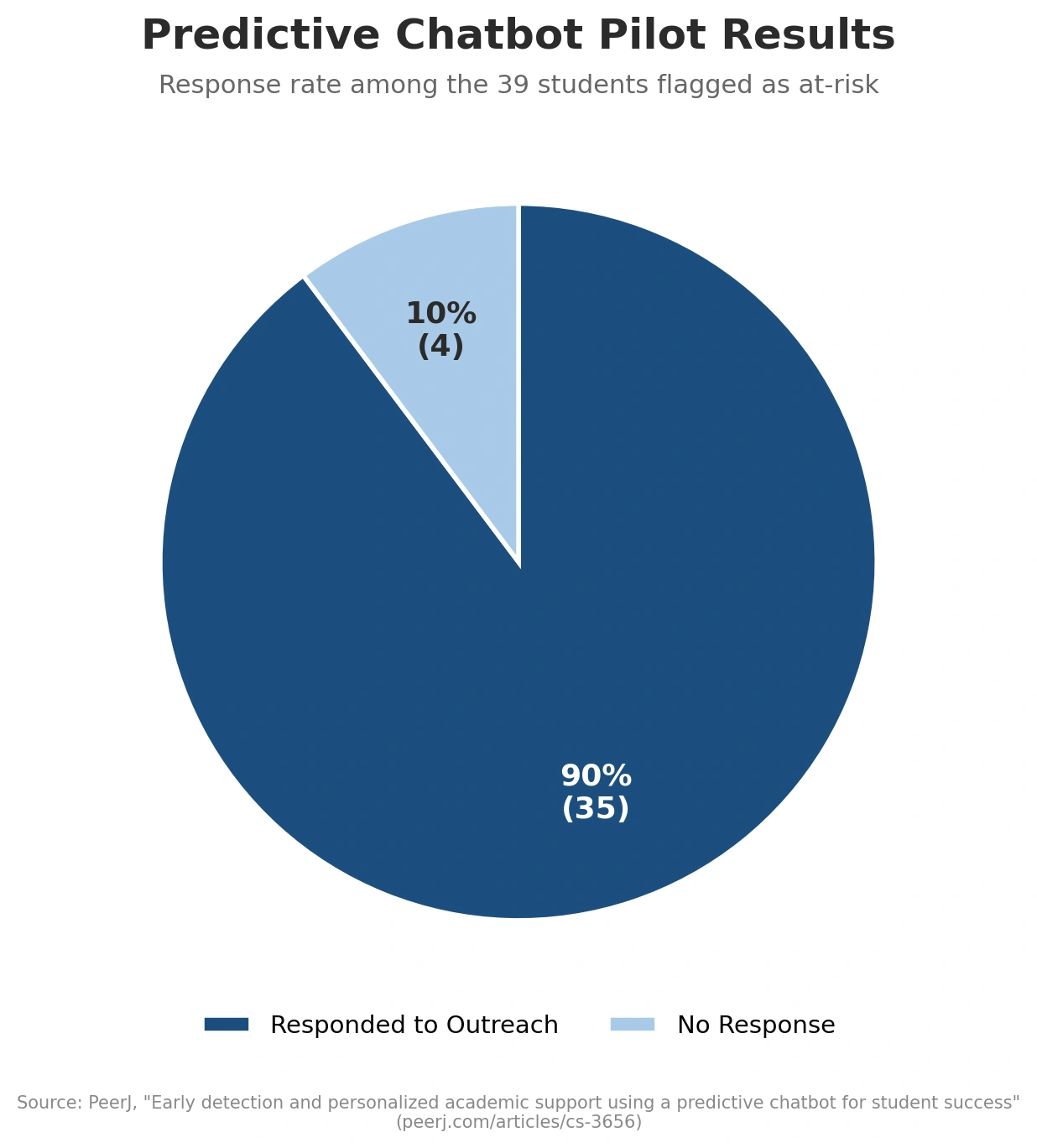
Treat any big claim about learning outcomes with a little skepticism until more research catches up.
Do Students Actually Trust These Bots?
Perception is improving, but it's not universal love. One study comparing student feedback on working with a teacher versus an AI assistant found satisfaction with the AI option climbed meaningfully year over year as the tools got better.
Students like the speed. They're still a bit wary about accuracy and fairness, which tracks with everything above about bias risk.
Course Bot or General Tool?
A bot trained only on your course material sticks closer to the truth because it's not guessing from the entire internet. A general purpose tool is more flexible but more likely to wander off topic or make something up.
Simple rule of thumb: the higher the stakes, the narrower the bot should be. Advising and anything touching grades needs a tightly scoped, auditable tool. General study help can afford to use something broader.
What This Means for Your Campus
Chatbots genuinely help with academic navigation and retention, but only with real oversight behind them. Skip the audits and human checks, and you're just automating the same blind spots at a bigger scale.
 How Universities Use Zero-Waste Swap Programs to Cut Student Costs
 How Industry Partnerships Shape Modern Curricula
 How Post-COVID Aid Programs Help Universities Rebuild Admissions
 Beyond the Acceptance Rate and How Colleges Decide Who Gets In
 How Leveraging Job Placement Strategies Can Reenroll Returning Students